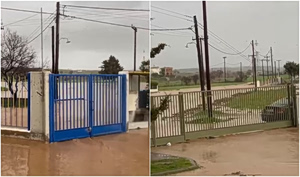
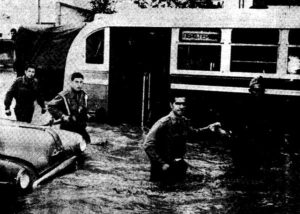
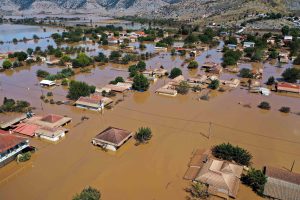
An emergency alert has been issued in northeastern Greece’s Evros region after rapidly rising river levels inundated large stretches of farmland and nearby settlements.
Early estimates suggest that roughly 12,300 acres of agricultural land — about 50,000 stremmata, a Greek unit equal to 1,000 square meters — are now underwater. The flooding has triggered deep concern in one of Greece’s most important farming areas, where local livelihoods depend heavily on seasonal crop production.
The situation has been particularly severe near the town of Didymoteicho, where the Erythropotamos, Ardas and Evros rivers swelled and overflowed following days of extreme weather. Strong winds and heavy rainfall have battered the region since Thursday, with snowfall reported in northern areas.

Additional pressure is coming from across the border, as significant volumes of water continue flowing into Greece via the Ardas River from Bulgaria, further straining an already overloaded river system.
Water Levels Breach Safety Limits
River measurements confirm the mounting risk. In parts of the region, the Evros River has exceeded official safety thresholds, heightening fears of further flooding.
On the morning of Feb. 20, 2026, water levels at Pythio measured 6.75 meters — 20 centimeters above the alarm limit — while at Petalo the river stood just 15 centimeters below the critical mark. Authorities remain on heightened alert as upstream inflows continue.
Crops Destroyed, Soil at Risk
Flood defenses have ruptured in several areas, allowing water to spill across fields and into neighboring communities.
Cereal crops have been submerged, and rushing waters have deposited sand and debris across farmland, threatening not only this year’s harvest but also future growing seasons.
“The impacts are not temporary,” the Panhellenic Center for Ecological Research (PAKOE) said in a statement, warning that soil degradation could reduce fertility in the years ahead.
A Cycle of Drought and Destruction
PAKOE also renewed its call for improved natural resource management in the Evros basin. According to the organization, approximately 703 million cubic meters of water in the Evros River go unutilized.
The group described what it called a recurring and destructive cycle: severe summer drought that leaves farmers struggling with dry fields, followed by winter floods that overwhelm crops, homes and infrastructure.
“This shocking pendulum repeats every year,” PAKOE said, attributing the situation not only to adverse weather but also to what it characterized as insufficient planning and state mismanagement.