Hundreds of executives and entrepreneurs from the global shipping world gathered in Dubai over the past few days, where on Saturday, November 8, Bahri Week officially began—an event lasting five to six days that has evolved into one of the most important annual events in the tanker sector.
Approximately 5,000 visitors are estimated to have traveled to Dubai for the event, which many call the “Posidonia of tankers,” comparing it to the major Greek shipping exhibition held every two years in Athens.
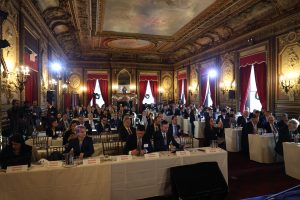
Of particular interest during this year’s Bahri Week was the Capital Link Forum, held on Tuesday, with the participation of leading figures in international shipping: Evangelos Marinakis, founder and chairman of Capital Maritime & Trading; Ahmed Ali Alsubaey, CEO of Bahri Group; Lois Zabrocky, CEO of International Seaways; and George Prokopiou, founder of Dynacom Tankers Management.
Evangelos Marinakis’s proposal caused a sensation among the discussion participants—and was applauded by the audience—calling for a temporary lifting of sanctions for a period, aimed at enabling the disposal of many old vessels belonging to the so-called “shadow tanker fleet,” which poses a serious threat to the environment.
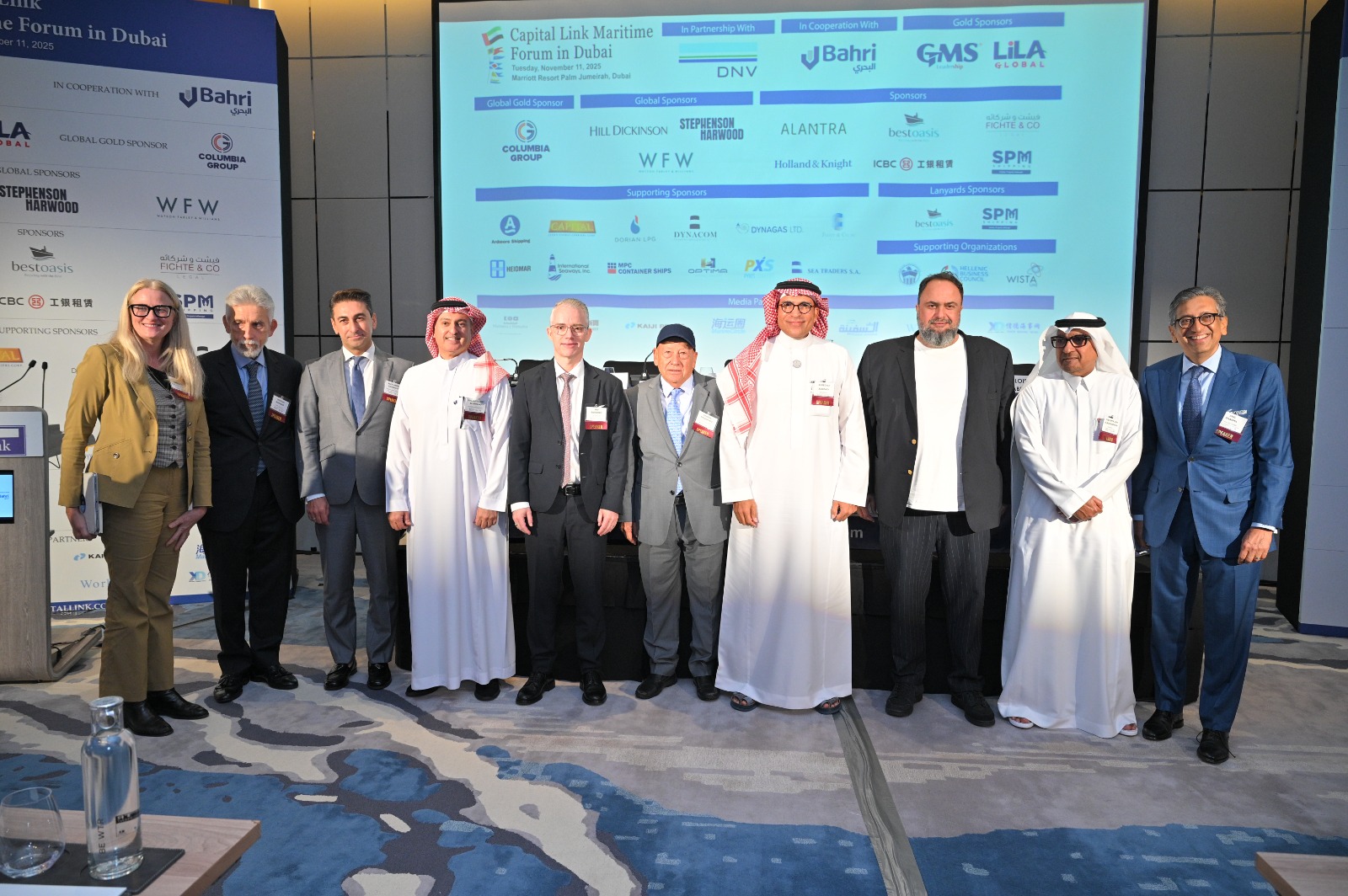
Capital Link Dubai Maritime Forum: Lois Zabrocky CEO International Seaways; Nicolas Bornozis, President Capital Link; Alexandros Damianidis, Partner, Watson Farley Williams; Khalid Yousef Alhammad, President Bahri Shipmanagement; Ian Edwards, Regional Manager Middle East and Africa, DNV Maritime; George Prokopiou, Founder Dynacom, Dynagas; Eng. Ahmed Ali Alsubaey CEO & Board Member Bahri Group; Evangelos Marinakis, Founder & Chairman, Capital Maritime & Trading; Hisham Nasir Alnughaimish, President Bahri Oil; Dr. Anil Sharma, Founder & CEO GMS Group.
The IMO Regulation Postponement
The first topic of discussion was the one-year postponement of the International Maritime Organization (IMO) vote regarding the new framework for zero emissions balance.
The moderator asked whether this represents “a steady stance” or “a restart from zero” aimed at formulating a new proposal.
Evangelos Marinakis focused on the failure of international organizations to arrive at implementable solutions:
“We have our views. They may be different. It is not a matter of disagreement. It is a matter of how each of us perceives our responsibilities and what we need to do as leaders in our industry. Because of the number of ships we operate and the volume of cargo we transport. Over the past ten years, there have been a lot of discussions within the IMO, the committees of the Greek Shipowners Association, Norwegian Shipowners Association, European Associations, and with our classification societies regarding efforts to reduce emissions. But the problem begins when disagreements lead us to find compromises. So at the end of the day, the compromise reached allows us to continue using our vessels but we will be penalized with taxes that the European countries will be receiving. So, in this way, we do not solve our environmental problem. It is like paying someone to die happier. It does not make sense. Mr. Prokopiou has consistently advocated for slow steaming, which produces a result: reduced emissions. The only increase is in transportation time, but we see a benefit to the environment. This is a matter of fact. Being penalized with high taxation for vessel use does not solve the problem.”
Mr. Marinakis added:
“They resorted to this measure because they could not agree on the basics in the first place. This is the reality. Another reality is Mr. Trump’s election. From the beginning, he has been radical regarding green discussions and transitions. By campaigning for countries not to vote for this taxation, we saw some European countries—Greece and Cyprus—change their position at the last minute, resulting in postponement. What I think we should do is compromise but agree on measures that will have an immediate effect on our environment. We have at least a year ahead to engage in constructive discussions and find a solution. That is how I see it from my point of view. Having seen these regulations and deadlines, we invested a lot—not in $10,000 ‘LNG ready’ certificates, but in proper LNG dual-fuel vessels, over 30 ships. We have paid a significant premium. And this is now delayed. But when the LNG market stabilizes and new production comes online, LNG prices will be lower. It will make sense to consume LNG irrespective of the emission reductions. This is my view on your question.”

Industry Realism & Green Transition
George Prokopiou was clear about his position: “I was convinced this would not pass because it is absurd to penalize someone for not using fuels that don’t exist. How can you penalize somebody for something that does not exist?”
He went on to explain the financial implications: “A Suezmax costs $75-80 million, yet during its lifespan, the vessel would incur $240 million in penalties—three times the ship’s value on top of the initial cost. Nobody can bear such costs except the consumer, which will increase inflation and poverty while reducing living standards.”
He emphasized the industry’s limited role in global pollution: “Shipping is responsible for only 2.5% of world pollution. Why don’t we focus on what causes the other 97.5% first?”
Prokopiou stressed that shipowners are being unfairly targeted: “We are not engine builders or shipyards. We are the taxi drivers—the users, not the fuel makers. The refineries and energy companies produce the fuel. The surest way to discredit an organization is to issue rules that cannot be implemented.”
He expressed confusion about certain countries’ positions: “I cannot understand why the Norwegians and other northern countries favor this net zero framework so strongly. I have yet to receive a satisfactory explanation.”
Emphasizing the practical approach of family companies, he concluded: “We are a family company. We strive for excellence and care about leaving a better environment for our children and grandchildren, but we must pursue what is possible, not just what is desirable.”
Lois Zabrocky emphasized that the industry has already demonstrated its commitment: “Looking at the order book, we’re talking about over $70 billion in real investment. The industry is not reluctant—we’re stepping up and doing our duty. However, we need the technology to be ready for us. Once fees are collected, there must be effective utilization of these funds, which currently lacks a clear framework.”
She expressed confidence in the industry’s ability to adapt, though with realistic expectations: “We’re accustomed to overcoming obstacles—delivering oil and containers despite every challenge thrown at us. I believe we will decarbonize, but it will take longer than idealists anticipate.”
Ahmed Ali Alsubaey emphasized the industry’s proactive approach: “Regardless of regulations, we will invest in the safest possible vessels using the best available technology. Nobody wants to invest in what was available five years ago—we want what’s available today, and we do this without mandates because we genuinely care about this blue planet. My hope is that future negotiations will not produce rules that appear environmentally friendly but are actually environmentally damaging. Shipping has always been at the forefront of pushing toward cleaner and safer operations. When we meet with regulators, we need something practical and achievable that allows us to demonstrate our genuine commitment to environmental protection.”
Call to Scrap the Dark Fleet
Marinakis specifically addressed the creation of the so-called “shadow fleet,” a result of geopolitical tensions:
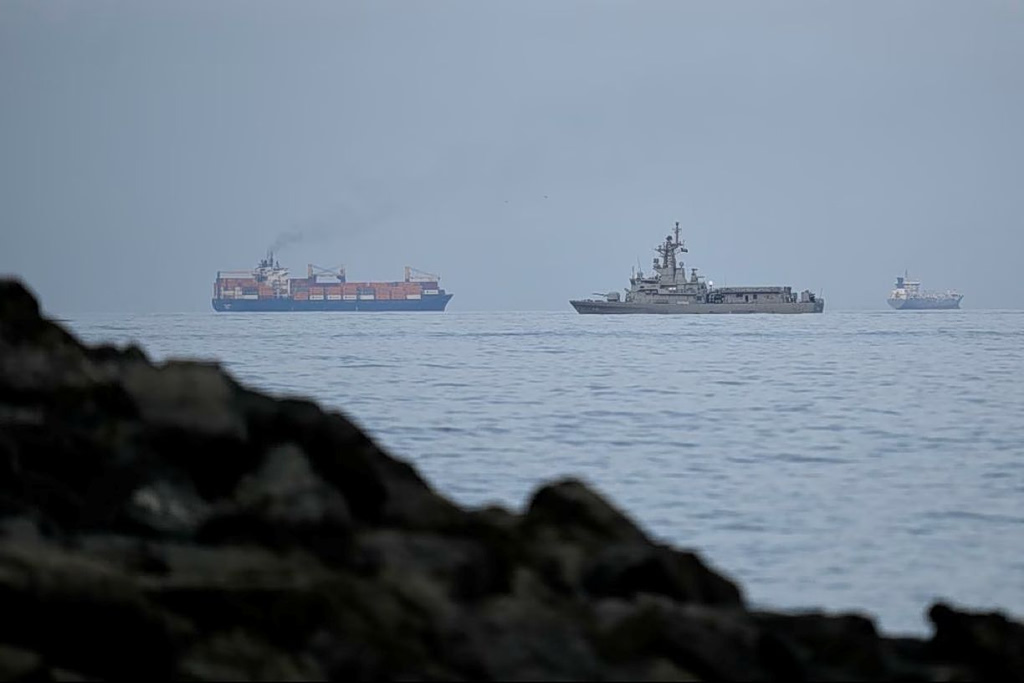
“I would like to make another point. This starts from geopolitics, because of the wars between Ukraine and Russia, conflicts in the Middle East in the past involving Iran, and the situation in Venezuela with its sanctions. Previously, we talked about net zero. All the discussion is about keeping our seas clean. There have been a lot of discussions, legislation, and expenses from all of us in order to maintain our seas clean. At the same time we have politicians discuss sanctions and also talking about peace. When I entered the conference room, there was a discussion with Anil Sharma regarding the dark fleet and sanctioned fleet. We have allowed all this time over 1,500 ships to operate—876 are already sanctioned. They don’t have insurance, proper crews, and adequate maintenance. We have seen also many incidents and accidents in the past 12 months involving these vessels in the Suez Canal, the Baltic, and collisions in Singapore. As an industry, we need to urge the US administration and Europe to immediately grant permission for these sanctioned vessels to be scrapped without further delay. India can receive vessels for scrap because they have not sanctioned these vessels.”
Mr. Marinakis continued:
“Owners cannot be paid to scrap their vessels, because they are sanctioned and alternative payment methods must be found. If we immediately obtain a waiver for the next 2-3 months at least to reduce this sanctioned dark fleet, it will help a lot the industry while significantly reducing unlawful trade. We spend time, effort, and money on issues with minimal impact on pollution. At the same time we allow fundamental problems to persist. It doesn’t make sense. We must make a concerted effort to send a strong message to provide this waiver immediately, so that we can eliminate this fleet. I don’t need to add anything more. Of course we like peace. We want peace. And at the end of the day, we look forward to peace.”
Dark Fleet Scrapping Projections
When asked about potential scrapping if sanctions were lifted, Marinakis estimated:
“At least 25% will proceed with scrapping, as many ships can barely operate. These vessels are used for trade with significant risk. Anil is the appropriate person to address this question, but from our observations, at least 25%—which represents many ships—will be scrapped. This will create a significant market impact.”
Dr. Anil Sharma commented: “It will be a way out for them. I think definitely if the licenses are given, there will be a flood of ships that are coming in because some of them are indeed unsafe and face insurance issues”.
When asked about the time frame, Marinakis added: “The time limit will help this. They will know they have three months and they will go for it.”
Prokopiou also stressed that it is important to “put a time limit within the next three months” as an incentive.
The Call for Peace
George Prokopiou emphasized the fundamental connection between peace and prosperity: “The best way to improve living standards is peace. When peace prevails, trade flourishes, and 90% of globalization occurs through shipping. Geopolitics remains one of the most unpredictable factors—nobody knows what will happen tomorrow. But if we must bet on something, we should bet on peace, not war.”
Prokopiou also challenged the terminology used for sanctioned vessels: “The term ‘dark fleet’ is misleading. It’s not dark—it’s a parallel fleet operating at different cost levels. Instead of penalizing Russia, we’re effectively providing them with cheaper transportation.”
Lois Zabrocky stressed the importance of free trade: “We thrive in an environment of open and free trade. Protectionism and tariff walls are not optimal scenarios for our industry. The Trump administration appears to believe that applying significant pressure can create peace.”
Ahmed Ali Alsubaey underscored the essential nature of shipping: “Without open and free trade, there is no long-term sustainability for any business. I always emphasize, particularly to the ladies in the audience, that without shipping there’s no shopping. We need to convince even protectionists that free trade must prosper again as it did in the past. I believe we’re approaching that point.”
Middle East Investment Opportunities
The discussion extended to the future of the United Arab Emirates and the broader Middle East region.
Marinakis expressed optimism about regional stability:
“Over the past 40 years, the region has experienced numerous wars—Iraq, Iran, the Kuwait invasion, and ongoing troubles in Syria and Lebanon. With such instability, it has been difficult to invest more or do things that we have seen recently. But the situation is now stabilizing. The threat from Iraq has diminished, Iran also has not been as aggressive as in the past. Solutions have been found in Syria and the surrounding region. Now is the time to expand and make real investments that were maybe postponed in previous years. This region has all the fundamentals necessary for much more investment and infrastructure progress. We are happy to be here, to do repeat business with friends and partners and to increase our activities in the region.”
Ahmed Ali Alsubaey highlighted the region’s strategic importance: “The Arabian Gulf has always been central to shipping, from the Silk Road to the Spice Route. Today it continues to serve as a crucial crossroads. If geopolitical conditions improve, we will witness a renaissance for the region. As the second fastest-growing economy after India and China, the Middle East sits at the intersection of global economies. That’s why I’m confident shipping will return strongly to this region.”
George Prokopiou noted the ongoing transformation: “Something very special is happening in this region in terms of investments.”
He also advocated for pragmatic energy solutions: “We shouldn’t fear oil—it will remain relevant. Carbon capture technology offers the solution. Capturing 50% of emissions would be sufficient. We have the infrastructure, refining capacity, and distribution networks. We should utilize them while making energy affordable globally.”
Lois Zabrocky observed market dynamics: “OPEC is beginning to reclaim market share, and regional countries are working intensively to achieve peace—a critical and valuable role.”
Newbuilding Market Outlook
The panel concluded with discussions about vessel orders and market conditions.
Marinakis acknowledged his position:
“Regarding newbuilding risks, we may be the wrong people to ask, as we have 100 vessels on order. We are obliged to be optimistic. And we are optimistic by nature, and we believe in the market. There are a lot of needs, more stability, and growth opportunities. As far as the newbuildings are concerned, the industry needs these vessels. If we have also significant progress with the dark fleet issue and scrapping of vessels delayed by market conditions and illegal trade, there is room to accommodate newbuildings. We are quite optimistic. We live in an inflationary environment where prices do not seem to go down. All costs have increased, and I do not see any immediate price reductions. We are optimistic that ships are needed for growth. Additionally, our new vessel orders are significantly more economical. This benefits both the environment and emissions reduction. Answering your question, yes, we are optimistic. We expect prices to remain high for a significant amount of time.”
Ahmed Ali Alsubaey offered a succinct philosophy: “Donald Trump says ‘drill, baby, drill.’ I say ‘build, baby, build.’ When regulations change, you need ships on order.”
Lois Zabrocky described International Seaways’ strategy: “We’ve renewed our MR fleet while selling older vessels and taking delivery of new LR1s. We recently purchased a secondhand VLCC. While new vessels are preferable, we’re constantly working to upgrade our fleet through various means.”
George Prokopiou acknowledged the complexity of market predictions: “This is the most difficult question, and certainty is impossible. Shipyards are fully booked through 2029. Predicting conditions four years ahead requires exceptional foresight. A financial crisis could disrupt everything, particularly if tariffs backfire.”
He emphasized efficiency gains: “Every newer vessel is more efficient. Fuel represents our largest expense, so a 30-35% reduction is significantly advantageous. However, older vessels and the parallel fleet continue generating substantial profits, which explains why secondhand vessels command prices disproportionate to their age.”
Bahri Week: Shipping at Crossroads
This year’s Bahri Week demonstrated that shipping stands at a crucial crossroads. Industry leaders are calling for pragmatic approaches to the green transition, peace to enable trade prosperity, and strategic investments to secure the maritime economy’s future.
As one participant noted about Dubai and the region: “The region is experiencing a resurrection, becoming an increasingly important crossroads for global trade and shipping.”
This year’s Bahri Week proved that shipping is at a crucial crossroads. Industry leaders are calling for realism in the green transition, peace for trade to flourish, and investments to secure the future of the maritime economy.
As Ahmed Ali Alsubaey noted about Dubai and the region: “The region is going through a resurrection… becoming a really important crossroads in the world for trade and global shipping.”