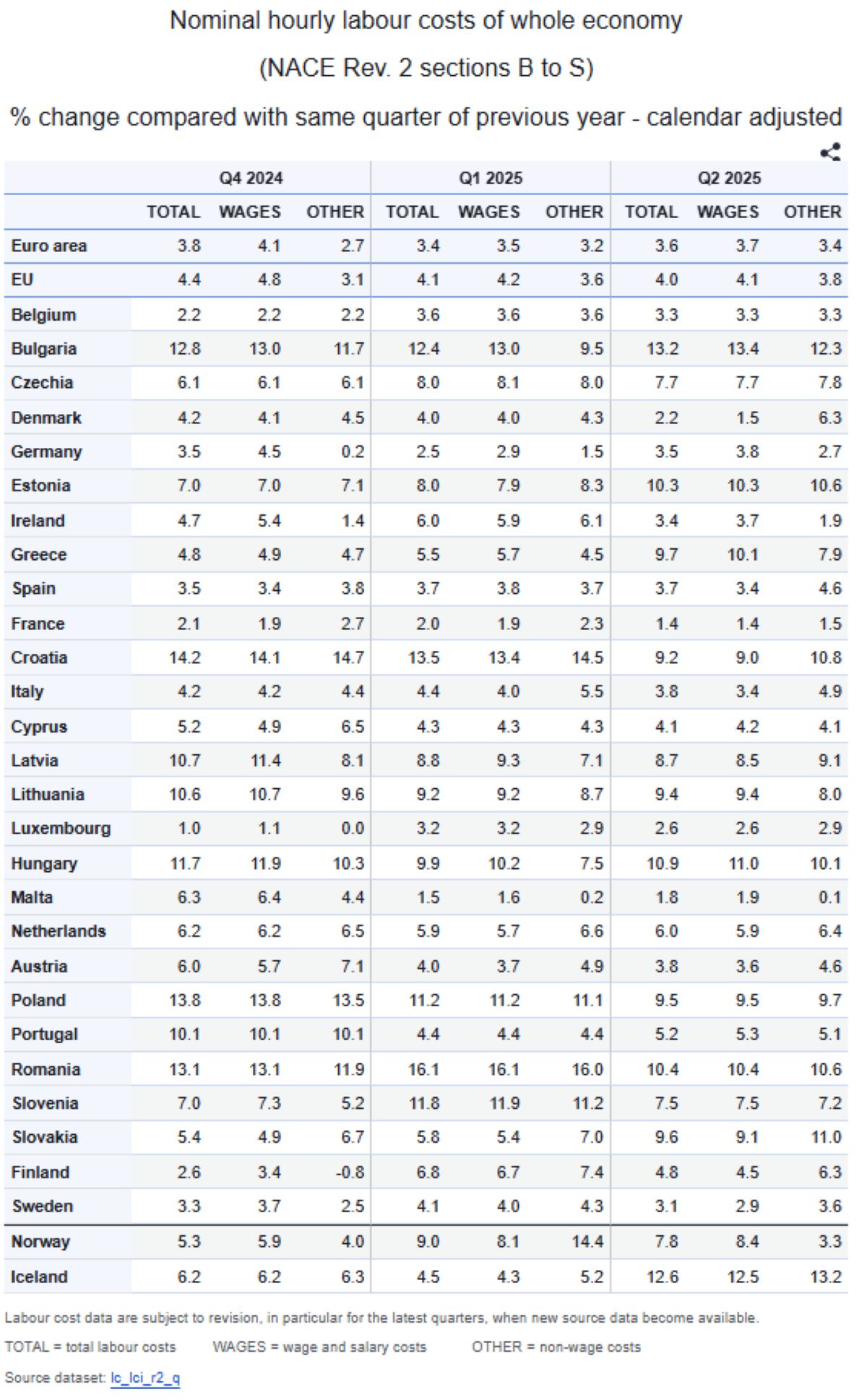
Labor costs in the euro area rose by 3.6% in the second quarter of 2025 compared with the same period last year, according to data released by Eurostat. Across the European Union as a whole, the increase was slightly higher, at 4.0%.
Among member states, Bulgaria (+13.4%) and Hungary (+11.0%) recorded the steepest annual rises in hourly labor costs. Romania (+10.4%), Estonia (+10.3%) and Greece (+10.1%) also posted double-digit growth. At the other end of the scale, the smallest increases were seen in France (+1.4%), Denmark (+1.5%) and Malta (+1.9%).
Wages vs. Non-Wage Costs
Labor costs are driven by two main components: wages and salaries, and non-wage expenses such as social contributions.
• In the eurozone, wages and salaries rose by 3.7%, while non-wage costs increased by 3.4%.
• In the EU overall, the respective figures were 4.1% and 3.8%.
Sectoral Breakdown
Looking at economic activity, hourly labor costs in the euro area climbed by 4.0% in business sectors and by 2.7% in predominantly non-business sectors. By industry, the increases were:
• +3.3% in manufacturing,
• +4.7% in construction,
• +4.3% in services.
In the EU, hourly labor costs rose by 4.4% in business sectors and 3.1% in non-business sectors, with growth of 3.9% in industry, 4.8% in construction and 4.6% in services.
Strongest and Weakest Growth by Activity
Across the EU, the sharpest annual increases in hourly labor costs were recorded in:
• Professional, scientific and technical activities (+8.9%)
• Mining and quarrying (+6.7%)
The lowest increase was observed in real estate activities (+1.6%).
For the non-wage component specifically, the strongest growth was again in:
• Professional, scientific and technical activities (+7.3%)
• Mining and quarrying (+6.6%)
The smallest rise was reported in administrative and support service activities (+1.8%).