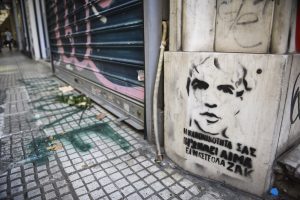
It is the 1970s. Suddenly, everyone is chasing you. You are expelled from the Greek Navy after being caught having sex with another boy. At just sixteen, you find yourself living alone in Omonia, in downtown Athens. You begin navigating the city’s nightlife, from Exarchia and Plaka to Siggrou Avenue. You learn what it means to live on society’s margins—and that the margins are your only refuge. Everyone has a name for you, a way to pity you, a way to exclude you: faggot, travestí, cross-dresser. Society has already written a fantasy about you and people like you, one in which you are beaten, humiliated, raped, or dead.
And then, faced with this tidal wave of hatred, you do something extraordinary. You look back. You begin speaking a language you were never allowed to speak. You begin answering back. At the precise moment when everything around you insists that you will never be allowed to tell your own story—that you will never become the narrator of your own life, you decide to speak, and never stop. You are powerless, marginalized, pushed outside society, yet you rise and declare, “But I…”
That is the moment when you refuse, as the saying goes, to accept defeat. And Paola, you became the ultimate embodiment of those words. Someone else may have written the phrase, but you rewrote its meaning. Not simply, “I did not accept defeat.” You overturned it.
There are two ways to speak about Paola Revenioti, one of the most significant figures of modern Greece, who passed away last week at the age of 68.
The first is to focus on the past—to revisit the defining moments of this charismatic transgender activist, sex worker, and artist whose interventions have illuminated the past five decades. There was “Paola the travestí-for-sale” as she described herself, appropriating the term used in Greece in the 1970s for trans women sex workers. This is how she signed her own zine, Kraximo (“Bashing”), in 1981, which she subtitled a “newspaper-magazine of self-expression and social criticism.”
Rather than offering the confessional narrative many expected from someone in her position, she transformed her life into a fearless exercise in speaking truth without restraint. Paola became the symbol of an entire counterculture—a role beautifully captured in portraits taken of her by artist Dimitris Papaioannou. As she once wrote, “A travestí—especially a politically conscious one—is a bomb that demolishes and ridicules the role of the male chauvinist on which patriarchal, oppressive society is built.”
In 1990, Paola ran for Parliament with the Ecologist Alternatives party, becoming the first transgender parliamentary candidate in Greek history. Had Greece’s electoral system distributed one seat differently, she would have been elected. More than three decades later, in 2019 and in 2023, she again ran for office, this time on the national party list of MeRA25.
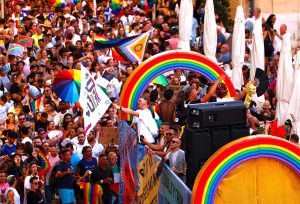
She was also among the founders of Greece’s ACT UP movement in the 1990s and organized Athens’ first improvised Pride event in 1992. During the 1990s she became a recognizable television figure, including through what has since become a landmark interview with journalist Malvina Karali.
A photographer, self-taught documentary filmmaker, poet, and singular chronicler of urban life, Paola found a new audience in the 21st century, largely through social media. When she eventually launched her own podcast, she proved herself capable of conducting refreshingly uninhibited and deeply engaging interviews.
Throughout all of this, her compass remained the same: an honest willingness to admit what she did not know, a determination to understand the political stakes of every moment—even if she was not always right—confidence in her own voice, a clear class consciousness, unwavering support for minorities and migrants, and a fierce anti-fascism.
“Politics is the way you choose to live,” she repeatedly wrote in Kraximo. For nearly half a century, that is precisely what she tried to show us.
The second way to speak about Paola is to look at the passion and respect with which a younger generation embraced her over recent decades, engaging her as an equal in a fruitful dialogue.
To them, Paola was a trans woman who, as Panos Michail aptly wrote, “turned her body into an archive.” They saw an activist who had carved out public space by speaking openly about rights, desire, and pleasure all at once. New generations drew inspiration from her example for their own social movements—a development that occasionally left her somewhat uneasy.
Yet through that dialogue, she also came to understand how her presence and oral testimony had become catalysts for new narratives and for the collective preservation of memory. Outstanding examples of this work are the videos she created and shared online alongside a dynamic group of younger collaborators through the Paola Project.
Together with her feature-length documentaries Kaliarda (2015)—named after the secret slang once used by Greece’s LGBTQ+ community—and Oleanders (Pikrodafnes, 2021), she became, fortunately, an internationally recognized figure in queer history. Galleries, festivals, and museums dedicated exhibitions to her. Universities and activist spaces around the world hosted discussions about her work. It was recognition she genuinely enjoyed, even if it still made her a little uncomfortable.
There is, however, a tragic irony here. As much as Paola came to symbolize Greece’s recent effort to recover and preserve minority history, she also represented an era in which queer and minority archives were destined to be lost, fragmented, or erased. Until the end of her life, it was clear that although she had transformed her entire existence into a living archive of memory and emotion, she never had the privilege of building a complete, organized archive documenting her own journey.
I wanted to conclude this piece by repeating how profoundly Paola’s example shaped my own life—as a model of resistance, perseverance, queer survival, and remarkable civic courage.
Yet I would also like to end with a reflection made from the slightly different perspective of a much younger colleague, political scientist Ervin Kondakciu.
Ervin writes:
“The first time I saw and heard Paola Revenioti, I was seven or eight years old. […] I remember feeling an unusual sense of familiarity toward her. […] Looking back on that memory today, I think I understand a little better why. Perhaps because Paola defended otherness in a completely uncompromising way. She stood up for people pushed to the margins, for society’s outcasts. And she did so without the slightest trace of apology. Her solidarity seemed to be a way of existing. […] We all owe her a great deal for the way she lived in this world. Farewell, Paola.”
Dimitris Papanikolaou is Professor of Modern Greek and Cultural Studies at the University of Oxford.