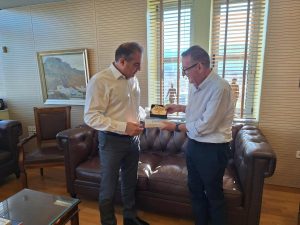
In late July, in a symbolic and strategic meeting at the Athens City Hall, Adelaide based Federal Member of the Australian Parliament Steve Georganas and the Mayor of Athens, Haris Doukas, discussed the prospects of a sister city relationship of the Greek capital with Adelaide, known for decades as the “Athens of the South”. Conveying the warm greetings of the Mayor of Adelaide, Dr. Jane Lomax Smith, Mr Georganas expressed his enthusiasm for a future collaboration, as the framework within which a joint Memorandum of Understanding (MOU) will form the basis for future collaboration. This initiative aimed at deepening relations between the two cities, through cultural, educational and entrepreneurial exchanges, against the background of Adelaide’s bid to host COP31, the next UN Climate Change in 2026.
In parallel with the meeting at City Hall, the Foreign Ministers of Greece and Australia had held previously constructive discussions on the issue. Their discussions underlined the importance of the Greek-Australian relationship in an ever-changing geopolitical environment and highlighted a clear orientation: that of strengthening bilateral relations through a multidimensional dialogue, focusing on economic investment, green growth, innovation and tourism. The discussion went beyond conventional approaches and opened avenues for sustainable cooperation in areas of strategic importance, with the Greek diaspora in Australia as a pillar.
At the same time, an important institutional initiative has been underway – the dialogue for the establishment of a Strategic Plan for Greeks Abroad. This is a necessary step, which aspires to transform the relationship of the Greek state with the diaspora into a coherent policy, overcoming the past of fragmented actions. This new framework will aim not only at the coordination of actions but also at the active integration of the knowledge, experience and innovative potential of the diaspora.
The social psychology of the diaspora: Collective identity and reconnection
From the perspective of social psychology, ethnocultural identity is a fundamental factor in the construction of the “we” concept of the diaspora. Theories of social identity and cultural continuity show that expatriates, especially those of the second and third generations, do not connect to the homeland only in terms of cultural nostalgia but seek recognition, an active role and two-way exchanges.
In the case of Australia, the Greek diaspora is divided into three main groups: the first generation (~100,000 people), the next generations (~300,000 people) and the new migration stream of recent years (~20,000 people). Diaspora policy, to be effective, must recognize these differences, enhancing participation with appropriate support and inclusion structures.
The absence of these elements in the past largely explains the low engagement of younger generations. As the theory of perceived social acceptance points out, the sense of disconnection from the homeland acts as an inhibitor to the mobilization for creation. A new institutional environment that embodies the values of transparency, recognition and collective action could reactivate these groups.
The Case of The Athens of the South: A Model of Modern Development
In this context, the case of SmartSat CRC and the Renew Adelaide initiatives are of strategic importance for Athens and Athens of the South.
SmartSat CRC is focused on developing space technologies for various applications, including earth observation for agriculture and environmental monitoring. SmartSat and the Hellenic Space Centre (HSC) have signed a landmark Memorandum of Understanding (MoU) at the International Astronautical Congress (IAC) which marks a pivotal step in enhancing international cooperation in space science, technology, and innovation between Australia and Greece. It is a model of diaspora action, where Greek scientists lead technological and social innovations, in Adelaide.
Lot 14, a former brownfield site, which has been transformed into a hub for technology, defence and space research. Its development strategy was based on three principles: a) university-business collaboration, b) the creation of high-tech infrastructure and c) reducing the brain drain through quality jobs. Deloitte estimated that for every $1 invested in Renew Adelaide, $4 is returned to the local economy, mainly through the temporary provision of rent-free properties to young entrepreneurs to pilot ideas. This “controlled failure” allows innovation without the fear of consequences, enhancing psychological safety and creating an ecosystem of learning and adaptation.
From innovation to reconnection: The role of diaspora as a bridge of trust
Greece-Australian cooperation in such formats strengthens the concept of “distant trust”, that is, the institutional and interpersonal relationship that does not require physical proximity but is built through shared goals and transparent processes. Both scientific collaborations and shared cultural references contribute in this direction.
Social psychology argues that reconnection with the homeland is achieved not only through emotional connection but also through collective action and a sense of efficacy. Participation in meaningful initiatives, such as that of SmartSatCRC and Renew Adelaide, strengthen the “collective ego” of the diaspora and restructure its relationship with Greece, not simply as a root but as a renewed, equal partner.
From political intent to institutional change
The example of South Australia and the participation of the Greek diaspora in high-tech and social innovation projects offer Greece a model of development strategy that combines institutional foresight, social cohesion and intercultural connection. The challenge now is not only to maintain ties but to build new relationships based on mutual trust, knowledge and co-creation.
The Greek diaspora is not only the past of migration, but the future of modern, polycentric Greece. And the twinning of Athens and Adelaide is not only a symbolic union of two cultures but also a modern bridge of cooperation: through shared values and strategic synergies, the two cities confirm in practice that the bonds of diaspora can evolve into models of international coexistence.
*Nikolaos Begakis AO is an Entrepreneur and President of Renew Adelaide. Steve Bakalis is a Visiting Professor of The Central University of Economics and Finance Beijing-China. Despoina Limniotaki is a Social Psychologist, Appointed Councilor for Public Health and Municipal Clinics at the Municipality of Athens.