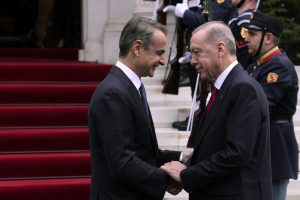
The derailment of the Erdogan-Mitsotakis meeting in New York caused more fuss than its going ahead would have done.
Which is reasonable. Meetings between two leaders are not canceled every day, even when they aren’t the best of friends.
We know that the Turks asked for a postponement, which ended up being a cancellation, but from that point on, every interpretation—from the probable to the highly improbable—has been discussed.
The would-be explanations are perhaps less important than the cancellation itself, which may set other events in motion. Though, we’ll have to wait and see what they might be.
Still, the cancellation itself has something to teach us: we pay far too much attention to Turkey. Interestingly, the Milliyet from the day after (24/9) reached the same conclusion.
Only they didn’t present it as a good thing, or as an excuse. Because, while Greek policy remains trapped in a “Turkish prism,” Turkey no longer views developments though a distorting Greek-centric filter.
Sure, Turkey is the nearest thing Greece has to a “primordial foe”, especially now that there are no others left.
But the obligation to restrict ourselves to reacting to Ankara’s initiatives and policies, rather than acting independently, belongs firmly in the past. Only a few superannuated Turkey-obsessed hawks still think that’s the way to go.
Greece is a European democracy, economically ascendant and militarily strong, with allies and partners in Europe, the Mediterranean and around the world.
Its fixation on Turkish claims and braggadocio is just plain silly. Greek must formulate its own policy, and too bad if someone doesn’t like it.
“C’est la vie”, as the French say.
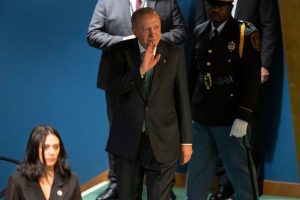
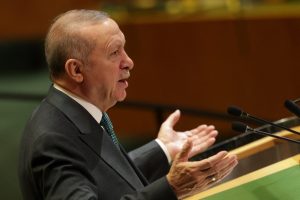
Moreover, Erdogan’s speech at the UN was met more with deep indifference to his bluster than fear of the threats that lurk behind the rhetoric.
What does it even mean to say Turkey has to be involved in every project in the Eastern Mediterranean? What is Ankara going to do if the other countries don’t ask it to play? Sue us?
But I fear we can’t help ourselves when it comes to sabotaging the national self-confidence we want to project.
When Mitsotakis’ meeting with Erdogan was canceled, the Turks didn’t even issue a statement, just as they hadn’t announced the meeting in the first place. But every Greek party, including the Union of Itinerant Travelers, had something to say.
It will, of course, be hard to free ourselves of knee-jerk reactions of this sort, especially in today’s troubled world. But let’s hope we can at least stick calmly and soberly to our policy.
And if anyone doesn’t like it… well, c’est la vie!