In the years following the pandemic, the Greek economy and politics appear frozen in time, according to some analysts and economists. Since 2021, growth, fiscal policy, and political dynamics have all moved within a narrow range—no surges, no collapses, just a steady rhythm of modest results and limited change.
Public finances seem remarkably stable, bolstered by hefty primary budget surpluses -government revenues minus expenditures before interest payments-that consistently outpace even government projections. The government’s caution led to surpluses of over €11 billion in 2024, more than double the €5 billion target. Similar strong results are expected again this year, though they clearly divert vital resources away from growth. Growth rates, directly affected by the persistent pressure of high surpluses, may exceed the EU average, but still fall short of what the Greek economy requires.
The much-anticipated post-pandemic leap forward never came. After an exceptional rebound of 8.4% in 2021, annual GDP growth has hovered around 2.5%, with forecasts now slipping toward 2% or lower, according to the Bank of Greece. The expected spring-back after the long financial crisis never materialized.
There was some increase in investment and exports over the past four years, but not enough to create an environment of strong growth and significant income gains. On the contrary, as inflationary pressures mounted after the pandemic, corporate profits and government tax receipts soared, yet wages lagged, widening inequalities. The idea that new wealth would be created and fairly redistributed through the market did not take hold in Greece, for many reasons. Profits grew and businesses were strengthened, but social redistribution was limited, and investments were not proportional.
Private investments -foreign and domestic- remain narrowly focused. Nearly 40% goes into tourism, hotels, real estate, and short-term rentals, while sectors like industry, energy, agriculture, and technology attract far less. Even with recent increases, investment volumes in 2024 amounted to just 65% of their pre-crisis peak in 2007. Tourism, by contrast, has become the dominant force in the economy, reshaping its very structure.
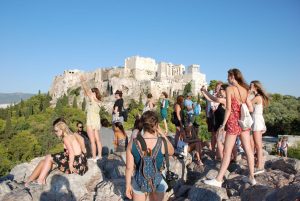
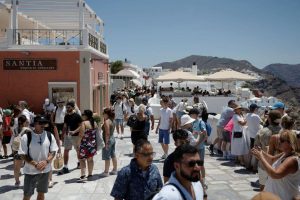
In recent years, the country and its economy have steadily transformed into an endless stage set for the flow of tourists. This shift has moved far beyond lofty aspirations and the occasional political call for a change in the production model. The truth is undeniable: tourism stands alone as the only sector in Greece racing ahead at full speed.
The country now hosts around 40 million visitors annually, quadrupling its population during the May -October season. This surge drives consumption, now representing about 70% of GDP, and ties growth directly to visitor flows rather than domestic demand. Economists note that summer spending has replaced Christmas as the defining peak in household consumption.
This deepening reliance makes Greece highly exposed to external shocks. A slowdown or crisis in Europe, the country’s main tourist source, could instantly undermine growth, consumption, and employment. Analysts warn that the Greek economy has effectively “touristified”, sustained but vulnerable, stable yet lacking strong drivers beyond the travel sector.
Politics mirror this same frozen picture. Lofty aspirations subsided during the post-pandemic years. And since the European elections, the government has entered a period of protracted erosion, yet a fragmented opposition remains unable to present a credible alternative to Kyriakos Mitsotakis’ New Democracy party. If this permafrost persists and the balance of power remains unchanged, the political problems will come to the fore, adding weight to an already sluggish economy.
The Prime Minister’s announcements at the Thessaloniki International Fair, sought to change the narrative. In attempt to revive middle-class optimism, Kyriakos Mitsotakis announced a raft of measures including relief for families with children and incentives for under-30s. But early polls show little enthusiasm. For now, the political landscape remains as stagnant as the economy it reflects: steady, predictable, but fragile.
Greece’s post-pandemic story, is one of stability that borders on paralysis. An economy bound to tourism and surpluses, and a political system stuck in neutral. Whether this “frozen image” endures may determine not only growth but the country’s long-term resilience.