With centrist prime minister François Bayrou’s time likely to run out tomorrow, France is set to become a political laboratory for Europe for the umpteenth time in its history.
At least for the Europe that watches on as social inequalities widen at a dizzying pace, and its political forces fragment and divide at the speed of an amoeba. Needless to say, there are many—most of them adherents of Anglo-Saxon political models—who refuse to take on board any lessons from the experiences of the nation that produced the French Revolution. They insist that its descendants have always grumbled and are dissatisfied by conviction.
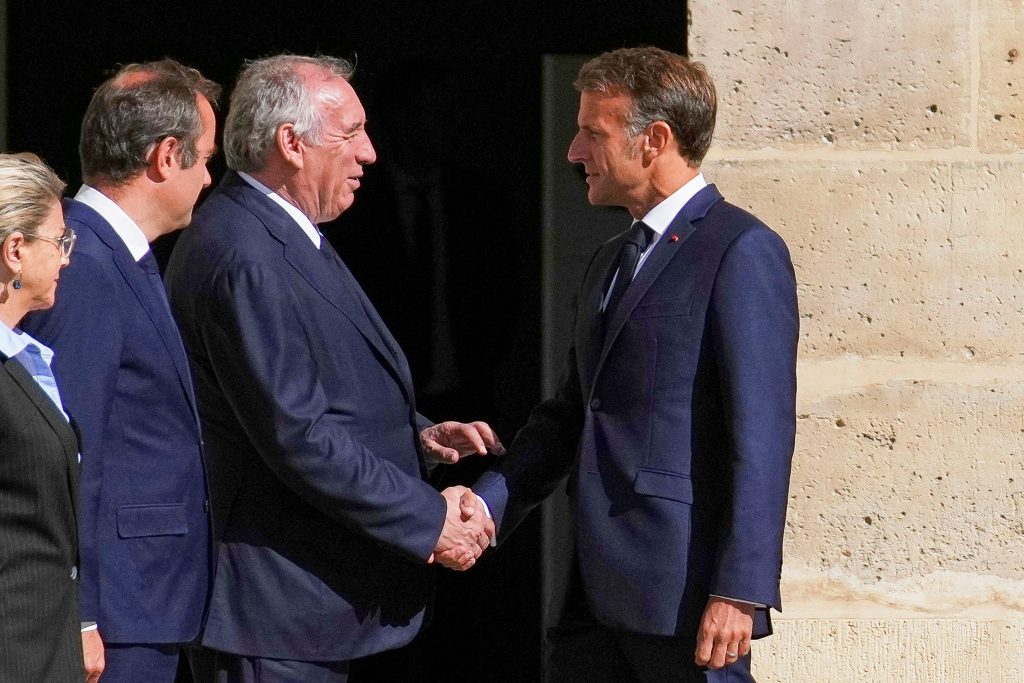
French President Emmanuel Macron and French Prime Minister Francois Bayrou shake hands as they attend a farewell ceremony to former Chief of the Defence Staff of the French Armed Forces Thierry Burkhard, in the courtyard of Les Invalides, in Paris, France September 5, 2025. Christophe Ena/Pool via REUTERS
In fact, the slyest and presumably most historically illiterate have taken to invoking the incipient French political crisis as a cautionary tale, hoping it will serve as a wake-up call to those who are flirting with the idea of casting a protest vote, and thereby running the risk of creating a deadlock that will leave France ungoverned.
On the basis of my hands-on experience of French daily life, I don’t think society shares those fears. I can, however, imagine what the superficial similarities might be that conceal the otherwise enormous differences between the structures, class stratifications, developmental potential, institutional functions, and intellectual givens of Greek and French society respectively. With any overlaps representing comparable—but in no way identical—functions and perceptions.
It is of course true that, apart from the well-known historical ties and emotional bonds, there are also wide-ranging ideological affinities between the two nations and peoples, which come accompanied by similar political attitudes that lend themselves to the drawing of parallels that are not always baseless. It is true, for example, of the statism and egalitarianism which, if no longer dominant, still characterize the political and social traditions in both countries—and not only on the Left.
The same applies, due allowances made, to the passions—personal and not only political—which are still part and parcel of political life in both Greece and France. Less so in the latter, since politicization is stronger there and personification less commonplace. Still, antagonisms continue to create situations in both in which it is difficult to distinguish personal from party-political clashes, or to differentiate strategic from purely political criteria.
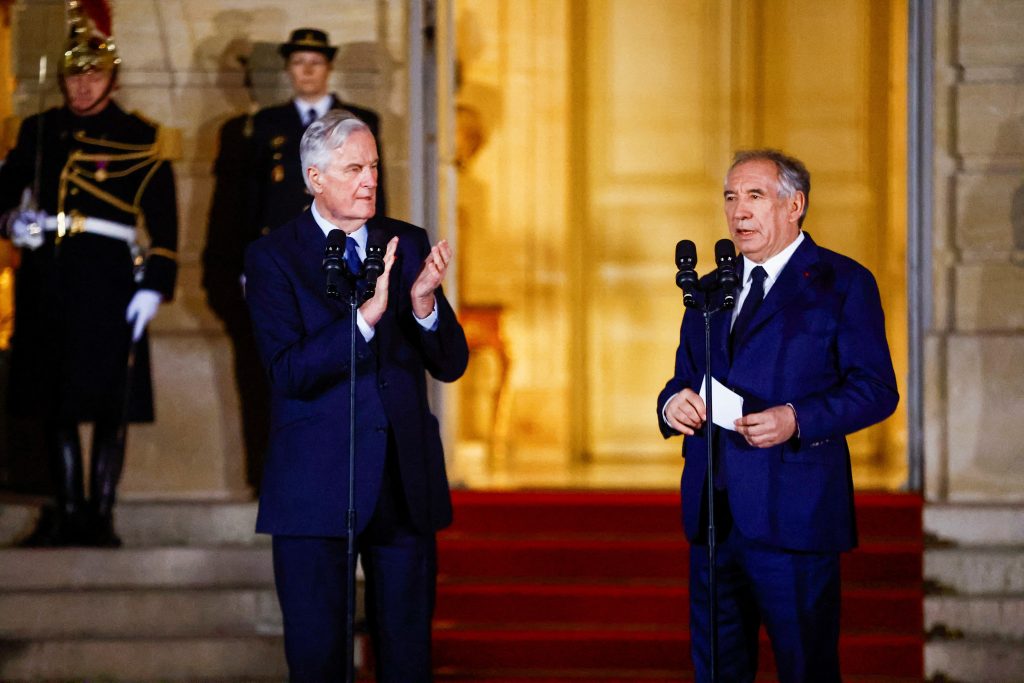
epa11775178 France’s outgoing Prime Minister Michel Barnier (L) applauds as the newly appointed Prime Minister Francois Bayrou speaks during the handover ceremony at the Hotel Matignon in Paris, France, 13 December 2024. French President Macron named Francois Bayrou as the country’s new prime minister on 13 December 2024. The appointment follows premier Michel Barnier’s resignation after a no-confidence vote in the National Assembly on 04 December 2024. EPA/ABDUL SABOOR / POOL MAXPPP OUT
In this respect, the experience of the political crisis in France is revealing of the role played in political developments by imponderables, such as the personality of a political leader. And, in the case of Prime Minister Bayrou, serves to confirm the traditional warning not to “cut off one’s nose to spite one’s face”. He began by taking advantage of the fall of his predecessor Barnier to demand that President Macron appoint him prime minister.
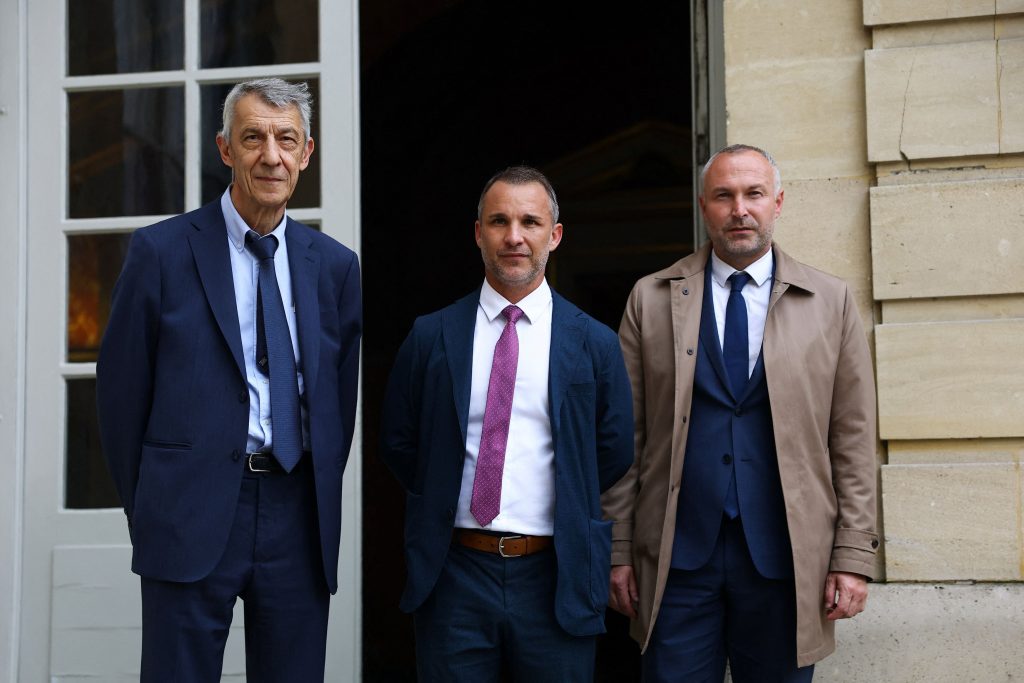
Laurent Panifous, member of parliament and president of centrist group Liot (Libertes, Independants, Outre-mer et Territoires) parliamentary group, and members of parliament Michel Castellani and Christophe Naegelen arrive for a meeting with French Prime Minister Francois Bayrou, as part of a series of consultations with political parties, a week before a confidence vote he is seeking from the National Assembly on the budget issue, at the Hotel Matignon in Paris, France, September 3, 2025. REUTERS/Sarah Meyssonnier
His demand came with a threat: his party’s parliamentary group would withhold their vote of confidence from any other parliamentarian the president chose to head his government. But even as Bayrou dreamed of being hailed as the Pierre Mendès France of the 21st century, he moved to improve his already excellent relations with Marine Le Pen and the patriotic Far Right, rather than making himself amenable to a partnership with the French Socialist Party, on whose support the parliamentary majority necessary for his survival depended. Indeed, his intransigence vis-a-vis a party he has always viewed as a rival was such that he did not even include the Socialists in the summer consultations, while continuing to claim that he alone had a miraculous formula up his sleeve for securing the political consensus required to prevent the French economy sliding into bankruptcy.
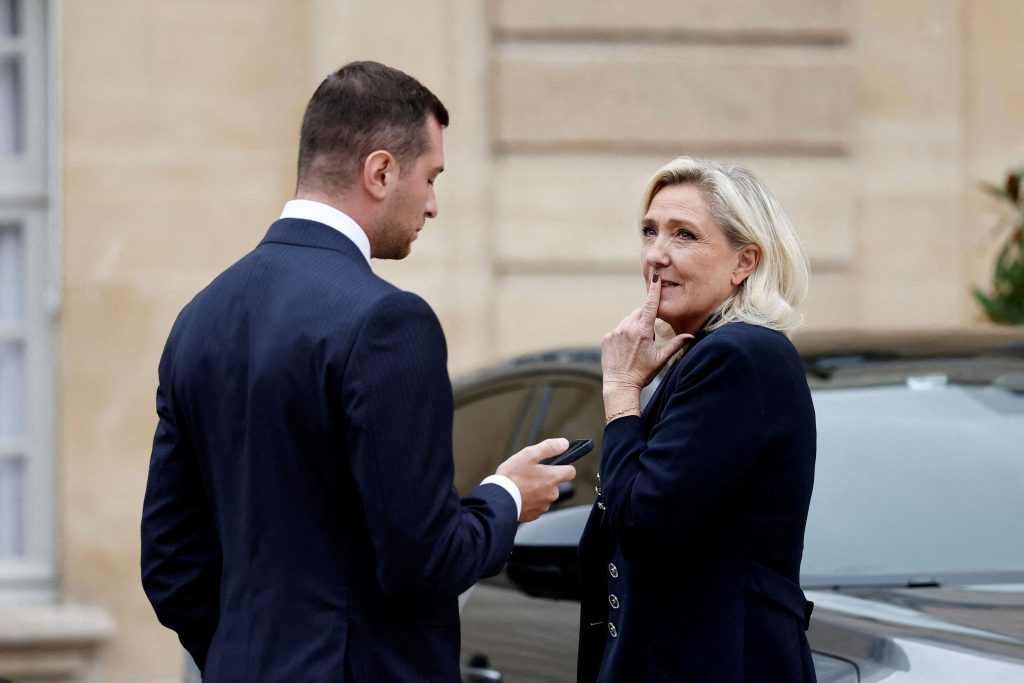
FILE PHOTO: Jordan Bardella, president of the French far-right National Rally (Rassemblement National – RN) political party, and French far-right leader and member of parliament Marine Le Pen leave after a meeting with the French Prime Minister as part of a series of consultations with political parties, a week before a confidence vote he is seeking from the National Assembly on the budget issue, at the Hotel Matignon in Paris, France, September 2, 2025. REUTERS/Benoit Tessier/File Photo
Finally, his decision to request a vote of confidence from the National Assembly when the polls clearly showed the public had long considered him the least popular prime minister since the inauguration of the Fifth Republic in 1958, would seem to have been motivated by sheer obstinacy. That same refusal to face facts may well mean he remains optimistic that he will ultimately be able to reverse both the public’s aversion and decisions already taken by the parties outside the Macron bloc, and miraculously secure the vote of confidence he so wants at the twelfth hour.
Is that a possibility?
In theory, nothing is impossible, especially given that, apart from the far-right National Rally and far-left France Unbowed, no other formation has any reason to wish for early Easter elections. And given that the President of the Republic has even less desire to resign in order to call early presidential elections and add another layer to the chaos towards which France will be heading should a gilets jaunes-style movement re-emerge on the way to the presidential elections scheduled for 2027.
Which is not to say that obstinacy will drive other figures in French public life to follow the example of Nicolas Sarkozy who, never having forgiven Bayrou for having supported his rival Ségolène Royal in the 2012 presidential elections, has proposed the immediate dissolution of the National Assembly and the calling of early parliamentary elections. François Hollande, too, proved equally stubborn yesterday, when he publicly asked how President Macron could have allowed Bayrou to request a vote of confidence in the National Assembly.

Nevertheless, it may yet turn out that the most self-destructive obstinacy of all remains, paradoxically, that of a traditional centrist prime minister, who, failing to grasp what his compatriots want and how far they’ve been pushed, has chosen to challenge their emotional intelligence and force them to make the unreasonable choice between “me or chaos”. And to do so in a country that no longer seems willing or able to tolerate the injustice of the minority of billionaires who became richer under Macron refusing to accept their share of the burdens and sacrifices that are now needed to ward off a debt crisis which would have an incalculable impact on the European Union as a whole.
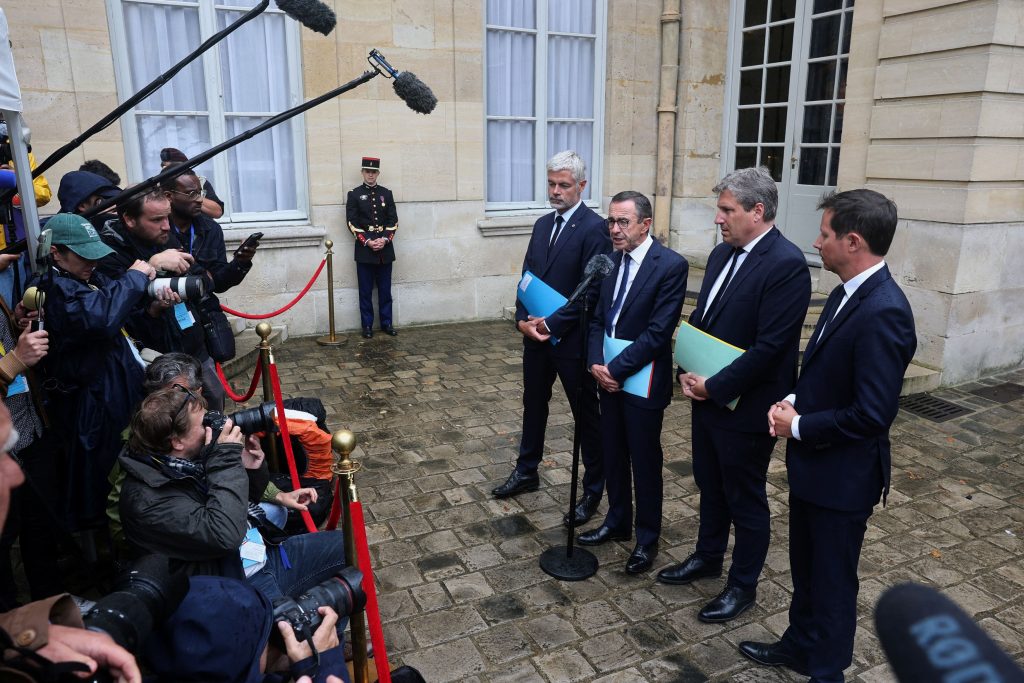
Bruno Retailleau, French Interior Minister and leader of the Les Republicains (LR) political party, Laurent Wauquiez, member of parliament and president of the Droite Republicaine (DR) parliamentary group,Mathieu Darnaud, president of the Droite Republicaine (DR) parliamentary group at the French Senate, and Francois-Xavier Bellamy, Deputy vice-president of the Les Republicains (LR) political party, talk to journalists as they leave after a meeting with the French Prime Minister as part of a series of consultations with political parties, a week before a confidence vote he is seeking from the National Assembly on the budget issue, at the Hotel Matignon in Paris, France, September 2, 2025. REUTERS/Gonzalo Fuentes
This is also the reason, this time round, why the political deadlock is expected to continue indefinitely, and why the democratic front against the Far Right is not expected to re-form ahead of the next presidential elections to block the march to power of the once isolated forces of reaction. All the more so since, across the Alps, the Meloni project continues to garner both political and economic praise, further reducing the perceived peril posed by a Far Right rise to power. In a country that remains nostalgic in any case for the glories of its past and has not reconciled itself to current geostrategic realities, the idea of being knocked out of the big league is not something it is willing to countenance. Just as the idea of sacrificing itself for an economic model that has proven unworkable is not something the majority of society are willing to entertain. Hence the seething anger revealed by every opinion poll, which renders futile every attempt to produce even the slightest political consensus.
M. Georges Sefertzis is a political scientist and communications expert.