One can win without an opponent. But can one also lose without an opponent? A solitary victory is a triumph; a solitary defeat amounts to devastation. If, however, one’s triumph is interpreted as an “opposition problem,” then one’s collapse undoubtedly constitutes a governance problem. In this second case, it is not merely a political system that tilts asymmetrically—it is an entire country.
This country is now confronted with a chain of burdens. From the Predator wiretappings to agricultural subsidies, the governing party bears the weight of a multiple stigma. It is not only that “scandals have erupted,” but also how they were managed. It is that the state, while declaring itself uninvolved in the contamination caused by illegal software, never moved against the “private actors” who attempted to entrap its political and military leadership. In the case of OPEKEPE, it expelled—through salary deprivation and disciplinary proceedings—the employee who reported illegalities within the organization. In the wiretapping case it remained silent; in the subsidies case it retaliated. What kind of state is this? Detached or complicit? What “normality” and what “stability” can its government guarantee under such conditions?
On the other side, within the fragmented political system, opposition parties have so far failed to carry the weight of an alternative governing proposal. For seven years now, each for different reasons, they have been electorally crushed and compressed in the polls—not because of the opposition they exercise, but because of the governability they fail to project.
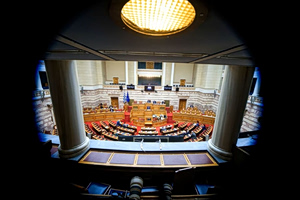
With so many burdens on both government and opposition, the issue is also framed as an electoral question. Who is the cuckoo that would bring spring? The same one now sinking into a deep winter? Someone else? And from where? In the good days of the two-party system, the ballot box would provide the answer. But this is not that era. In the summer of 2019, the so-called “1.5-party system” was formed. The system reaffirmed itself in the double elections of 2023, with Parliament retaining the character of a park hosting many and diverse species of political fauna—not only cuckoos, nightingales, and hoopoes, but also wildlife.
In the next Parliament, some species will disappear and new ones will likely emerge. Yet, even if the structure of the system does not change, the nature of the problem already has. The single pole of power of this seven-year period—the “cuckoo” of the story—now bears the stamp of corruption. Within it, mechanisms with the prefix “para-” have developed: para-state and extra-institutional in the wiretapping case, para-economic in that of agricultural subsidies and direct assignments, about which perhaps less is said today than will be heard one day.
Thus returns the political vocabulary of another era: “our own people,” clientelism, old-style party politics, “our boys,” “crooks,” and every expression of a parallel power structure with its connections, protections, and impunity. Only, on the electoral horizon, the political system of that era does not seem to be returning as well. The ballot box will not “punish” the previous ones only to place its hopes in the next—until it “punishes” them too.
What is happening instead is that post-election cooperation becomes even more difficult—if not an impossible equation. Who would sit down to cooperate with such a party, with its burdens and its stains? How will the numbers that “do not add up” ever align?
These may well be the elections of 2026: a result without a cuckoo, a package with no known recipient. It is called ungovernability. And the burden—now on the shoulders of the country—will be enormous.