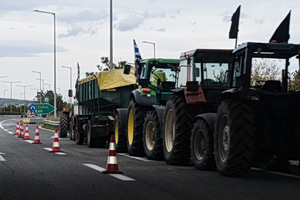
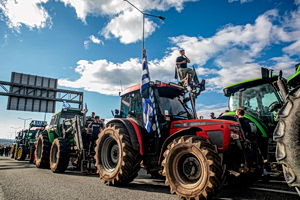
With Wednesday’s press conference and the measures the Greek government announced in favor of farmers, the government sought to show that it was meeting most of the farmers’ demands, with the ultimate aim of easing tensions, defusing the mobilizations, and taking the steam out of the road blockades. To be even more certain of the desired outcome, the prosecutorial authorities also stepped in, effectively warning protesting farmers that if they did not open the roads, they would face fines and criminal prosecution. This time, at least, we did not hear anything about the farmers being an… “organized criminal group.”
However, the measures spelled out by the four ministers provoked more anger and disappointment than satisfaction or optimism about the farmers’ future. This is reflected in the 48-hour “hard” blockade of major road arteries, bridges, tunnels, and service roads in many parts of the country. More radical voices are also calling for a joint strike by farmers and workers and for a rally on Sunday at Syntagma Square in support of farmers who refuse to give up.
So are the farmers being stubborn? Are they excessive, making “unrealistic” demands? Didn’t the government satisfy “16 of the 27 demands”?
The government knows how to play with words and stage communication games. “Sixteen of the 27 demands of the farmers’ unions have been resolved or are being addressed positively,” reads one of the slides the government posted online after the press conference. But does this claim hold water? Let’s look at a few examples, in the government’s own language.
“Return to real producers of the funds embezzled from OPEKEPE,” the farmers demand. The government responds: “Our commitment once the cases are finalized.”
“Payment of outstanding subsidies,” the farmers demand. “€3.82 billion paid versus €3.38 billion in 2024,” the government replies—without specifying which amounts are still outstanding.
“100% compensation from ELGA,” the farmers say. “Immediate promotion of a change to the regulation,” the government responds, without indicating a timeline.
And now to the most serious demands. “No reduction in the resources of the new CAP,” the farmers insist. The government answers: “Negotiations in Brussels are ongoing for the new MFF.” This is presented as an answer that falls under “resolved or addressed positively.” In reality, it constitutes no commitment at all; the government simply kicks the ball into the stands of the EU and the Commission.
Or take compensation for culling due to sheep pox: the government settles the matter with €250 per animal, while farmers estimate the real cost per animal at at least double that amount.
Finally, the government says that seven other core demands are “outside the European framework or cannot be implemented,” even though they are demands tied to the survival of farmers and livestock breeders—such as minimum guaranteed prices; the regime of mass and often uncontrolled imports; the abolition of the Energy Exchange, which has led to soaring electricity prices; or the immediate doubling of agricultural pensions, a measure the government deems fiscally “unfeasible.” As for compensating lost income when products are sold below cost, the government’s response is that implementing such a measure would undermine a core principle of the CAP.
No one can predict where this head-on collision between farmers and the government will end. The attempt to ignite “social automatism” over the holidays did not succeed. The government is now deploying not only the carrot of certain pro-farmer measures but also the… stick of the prosecutorial authorities—and who knows, perhaps the riot police as well, as we saw in the first days of the farmers’ mobilizations.
The real question is which side will endure longer, which will better organize its social alliances, and which will escalate more effectively. What matters, in any case, is that the people who toil in the countryside emerge standing—because as a society we need them if we are to have a future and prospects.