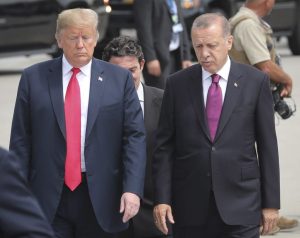
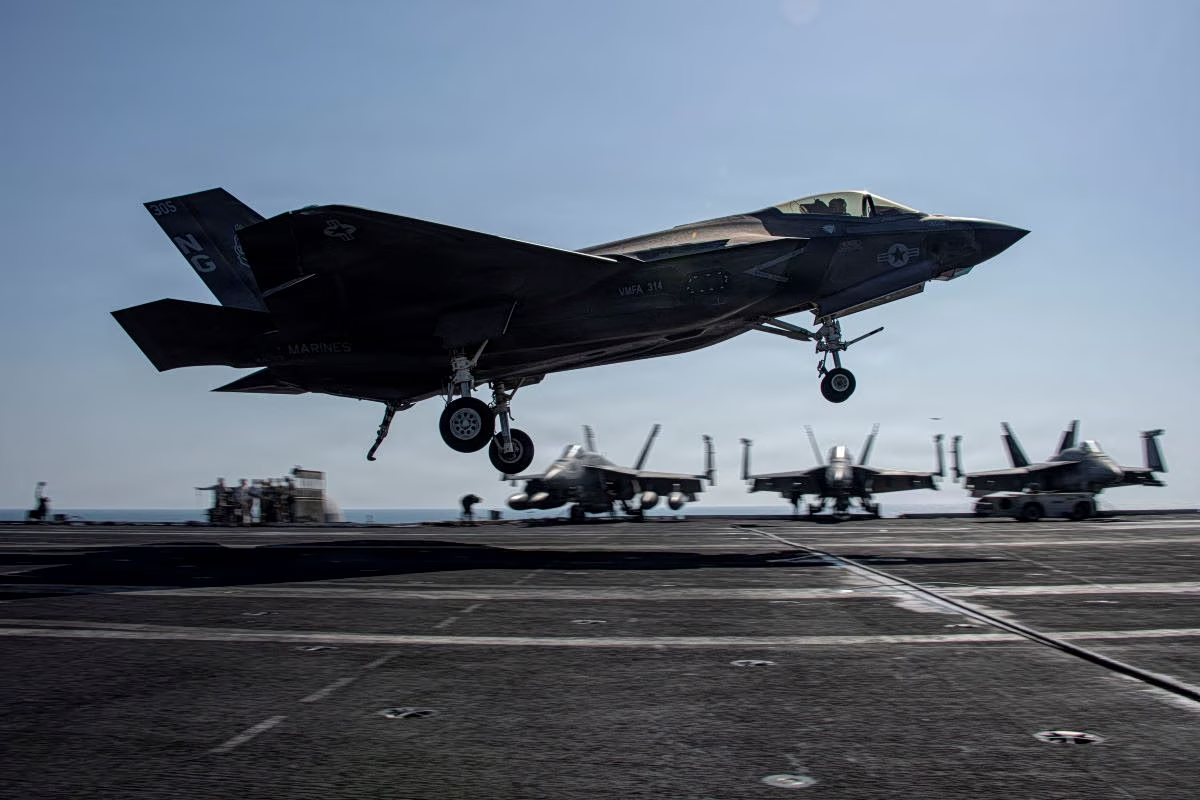
On September 25, Erdoğan will step into the Oval Office for the first time. The upcoming meeting was announced by the U.S. president on Truth Social, where Trump outlined the agenda, highlighting a “major deal” on F-16 fighter jets and the continuation of negotiations over the F-35 program.
F-16s and the F-35 Dispute
For the F-16s, roughly 80 jets are awaiting upgrades and Turkey also seeks to purchase an additional 40 aircraft. The F-35 issue is far more complicated: Washington has banned sales as long as Turkey retains the Russian S-400 missile defense system.
Trump nonetheless expressed optimism, saying he expected a “positive conclusion” to talks. Yet U.S. sanctions under CAATSA remain in force on Turkey’s defense industry for the S-400 acquisition.
As sources with knowledge of the matter point out, while the lifting of the CAATSA sanctions could be decided by executive order, Turkey’s return to the F-35 program requires the involvement of Congress to amend the relevant law, again under the condition of deactivating the S-400s.
In the discussions held so far with the Americans, Ankara does not appear willing to remove the Russian missiles from its territory, while at the same time there is clear suspicion in both the Senate and the House of Representatives regarding Turkey’s relations with Russia in general, and in particular over the deployment of Russian weapons systems in a NATO country, which moreover functions as an intermediary hub for circumventing Western sanctions against Moscow.
A Relationship of Contrasts
Since the re-election of the American president, the two leaders have spoken by phone at least three times, while Mr. Trump did not hesitate to express his appreciation for his Turkish counterpart, writing on Truth Social that they maintain a very good relationship.
Indeed, the two presidents may be linked by elective affinities regarding the way they conduct politics and address a range of issues inside and outside their countries, yet their relations have been far from cloudless, especially during Mr. Trump’s first term.
In fact, on the occasion of the imprisonment of Pastor Brunson in Turkey, the American president had sent Tayyip Erdoğan a letter—a monument of diplomatic impropriety—in which he directly threatened his counterpart with the destruction of the Turkish economy.
It is no coincidence, moreover, that the Turkish president had not until now received an invitation to the White House, with the two men meeting instead on the sidelines of NATO summits, while Ankara remained consistently excluded from the F-16 upgrade and the F-35 program—in contrast to Greece.
Timing of the Visit
The meeting between Mr. Trump and Mr. Erdoğan will take place two days after the tête-à-tête between Kyriakos Mitsotakis and the Turkish president, and only a few hours after the latter’s speech at the rostrum of the United Nations General Assembly, where Erdoğan is expected once again to appear vehement against Israel, at a time when the White House openly supports Netanyahu.
Ankara, moreover, continually targets Tel Aviv, with the two sides on the brink of a dangerous, direct confrontation on Syrian territory, which in any case is struck at regular intervals by the Israeli armed forces.
Turkey’s rhetoric against Tel Aviv has intensified, with the two sides edging toward direct confrontation in Syria, already subject to frequent Israeli strikes.
Many Thorny Issues Ahead
While Ankara and Turkish media express enthusiasm over the Oval Office invitation, the reality is less clear. Despite Trump’s grand statements, numerous contentious issues divide Washington and Ankara.
Observers are watching for possible awkward moments in the Oval Office, where other leaders in recent months have faced unexpected and uncomfortable encounters. Still, regardless of how events unfold in front of or behind the cameras, no rapid breakthroughs in U.S.-Turkey relations should be expected.