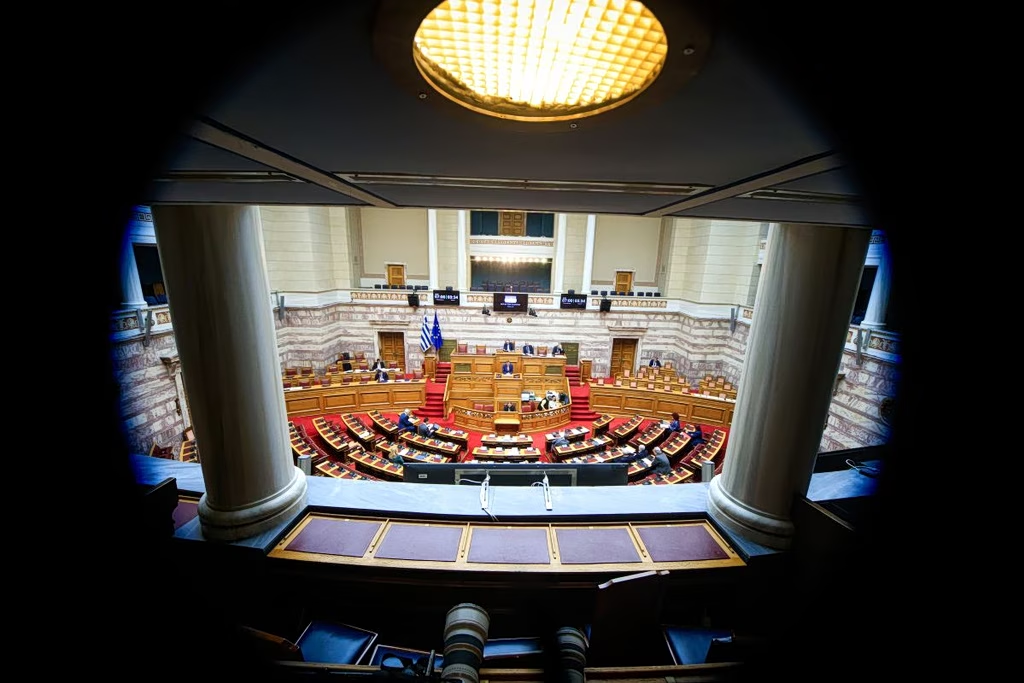
The case files at the center of one of the most consequential political crises Greece has seen in years arrived at the Greek Parliament earlier today, and in less than an hour the political fallout had forced its first resignations: three government ministers stepped down at Prime Minister Kyriakos Mitsotakis’ request, as their names surfaced in connection with the OPEKEPE agricultural subsidy scandal.
Yannis Kefalogiannis, Minister for Climate Crisis and Civil Protection, Kostas Tsiaras, Minister of Rural Development and Food, and Dimitris Vartzopoulos, Deputy Minister of Health, all submitted their resignations shortly after the case files reached parliament. Although a reshuffle had been expected to be announced on Monday, April 6 , Mitsotakis moved up the timeline.
The shake-up extended beyond the cabinet. Kostas Skrekas, secretary general of New Democracy, and Notis Mitarakis, the party’s parliamentary spokesman, also resigned their party posts. Both men are among the eight sitting lawmakers named in the EPPO case file.
The files, compiled by the European Public Prosecutor’s Office, name eight sitting New Democracy lawmakers and two former ministers of Rural Development and Food in connection with an alleged organized scheme to illegally distribute EU agricultural subsidies through OPEKEPE, Greece’s agency for administering EU farm payments.
The two former ministers named in the files are Spilios Livanos and Foteini Arampatzi, both of whom led the Rural Development and Food Ministry during the period under investigation. Their file will be formally announced in a plenary session, after which they will receive copies directly. Lawmakers wishing to review it may do so in a designated reading room inside the parliament building.
The eight sitting lawmakers named are Maximos Senetakis (Heraklion), Lakis Vasileiadis (Pella), Notis Mitarakis (Chios), Katerina Papakosta-Palioura (Trikala), Kostas Karamanlis (Serres), Christos Boukoros (Magnesia), Theophilos Leontaridis (Serres), and Kostas Skrekas (Trikala), who also serves as secretary general of New Democracy.
The three departing ministers will be replaced by Margaritis Schinas, a former European Commission vice president, who takes over as Minister of Rural Development and Food; Evangelos Tournas, a retired air force general and former deputy minister for Civil Protection, who steps in as Minister for Climate Crisis and Civil Protection; and Makarios Lazaridis, who is appointed Deputy Minister of Rural Development.
The new ministers will be sworn in Saturday, April 4, at 11 a.m. at the Presidential Palace, in the presence of President of the Republic Konstantinos Tasoulas.
According to government sources, the changes at the Rural Development Ministry go beyond a simple reshuffle. The government describes it as a deliberate overhaul, part of Mitsotakis’ stated ambition to transform a ministry that has functioned for decades as a subsidies-and-compensation mechanism into a modern structure capable of properly managing European funds. According to Ta Nea, the portfolio has been handed not to a regional lawmaker but to a figure of European stature, a choice the government says reflects the priority it places on restructuring Greece’s agricultural sector, which Mitsotakis has named as one of his top three goals for New Democracy’s third term.
Two Tracks, Two Very Different Processes
The files against the ministers and the lawmakers follow entirely separate legal paths — and understanding the distinction matters.
For the former ministers, the process is governed by Article 86 of the Greek Constitution. At least 30 lawmakers must sign a motion calling for a preliminary investigative committee to be established. That motion goes to a special plenary session, is debated, and put to a secret vote. If parliament approves, the committee is formed and determines whether the case proceeds to trial.
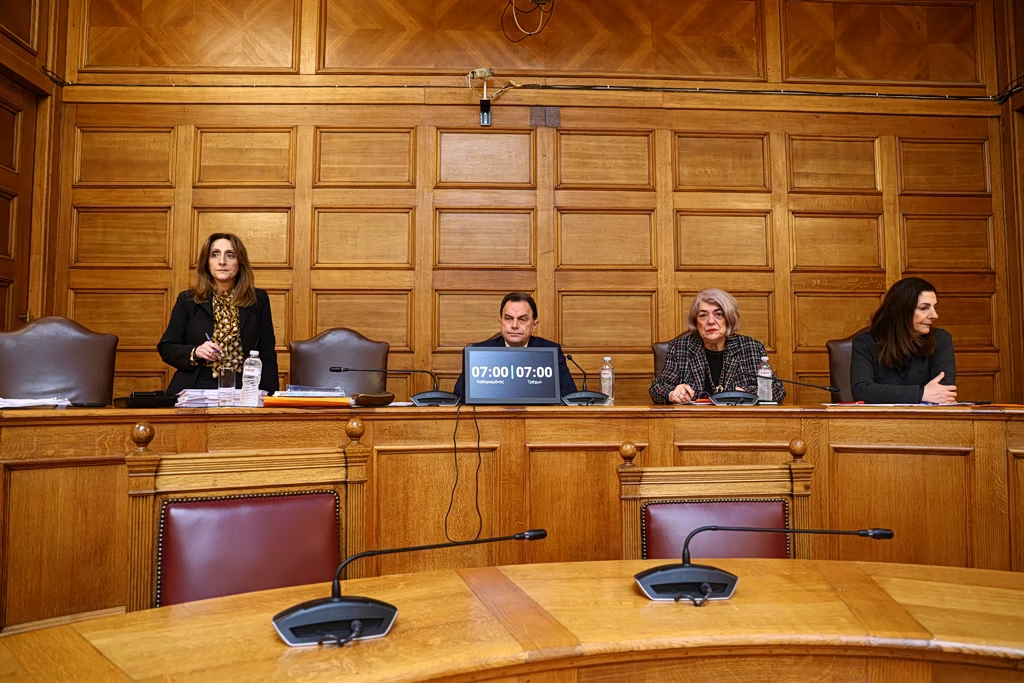
For the eight sitting lawmakers, the file goes straight to parliament’s Ethics Committee under Article 62 of the Constitution. Committee chairman Georgios Georgantas will send each of the accused a copy of the file and, once a session is scheduled, distribute it to all committee members. The committee then meets, hears from the eight lawmakers, and issues a recommendation on whether immunity should be lifted, with representatives of all parties weighing in. The final decision will be made by the full plenary in an open roll-call vote.
A Deadline Looming
Time is a factor. The misdemeanor charges carry a five-year statute of limitations that is at risk of expiring and according to reporting by TO BHMA, that deadline is likely to force the Ethics Committee to convene before the Easter recess, so that everything is in place for a full parliamentary vote before the clock runs out.
Mitsotakis Digs In
With the files now in parliament’s hands, the political pressure is on Prime Minister Kyriakos Mitsotakis. According to reporting by TO BHMA, Mitsotakis has resolved to make no concessions on either the legal or the ethical dimensions of the crisis. He is also preparing to go on the offensive against an opposition that has already turned up the heat and shows no sign of letting up.
All persons mentioned in connection with this investigation are presumed innocent until proven guilty.