If, at the beginning of the 21st century, at the height of Western prosperity, someone had predicted that in the near future a war would break out on European soil—the first since 1945—they would probably have been misunderstood. And if they had added that shortly afterward Israel and the United States would bomb Iran, the reaction would have been even worse. Yet this happened. Furthermore, the reelection of Donald Trump led to the realization that the world is changing at a violent pace. Geopolitics, defense, and security are once again at the forefront of national priorities, while international organizations such as the European Union and the United Nations are losing their prestige and influence. Governments are called to adapt to the demands of the times, and the transformation of the Armed Forces, based on emerging needs and under the conditions imposed by technology, is at the top of the agenda. Many believe that Greece is unable to follow this rapid change. Others see a significant opportunity that should not be left unexploited.
What Kind of Armed Forces Do We Need?
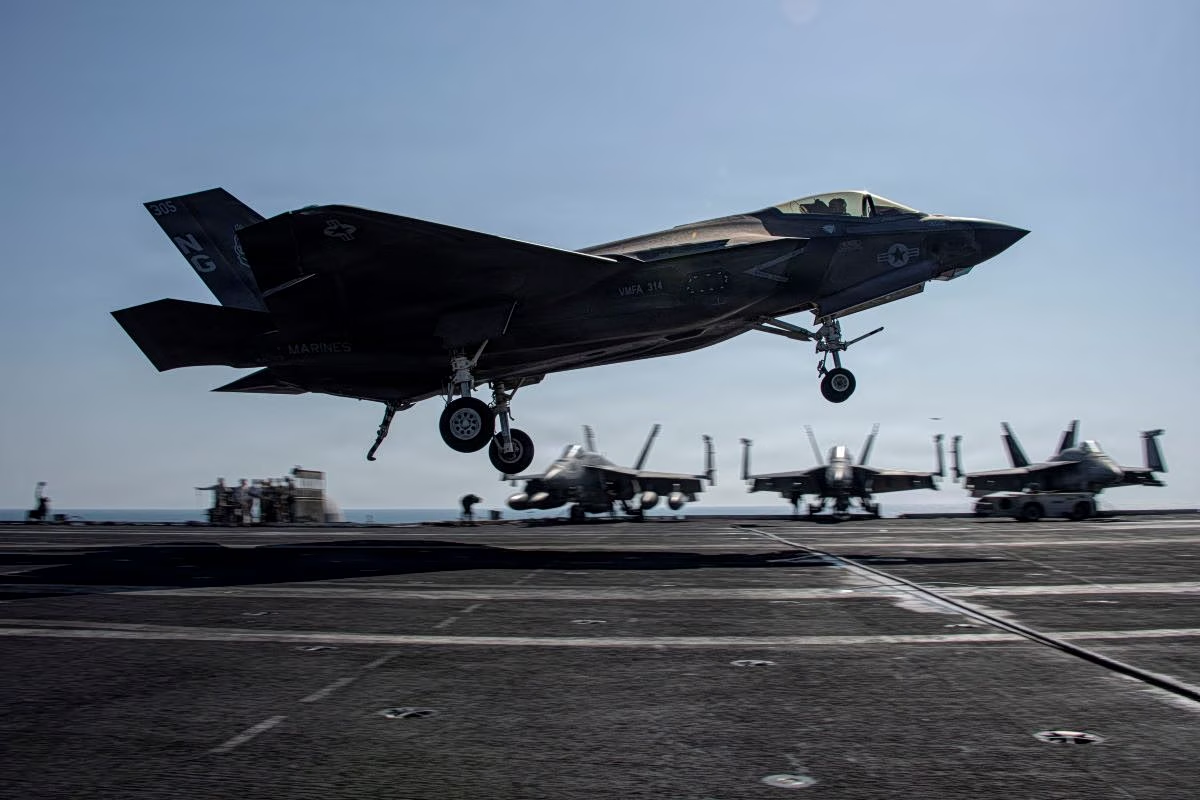
No one disputes the combat readiness of the Armed Forces, the excellent skills of Greek pilots, and the importance of integrating Rafale, Belharra, and later F-35 aircraft into the country’s firepower. However, as modern battlefields demonstrate—where unmanned aerial vehicles, hybrid warfare, and cybersecurity now heavily influence the outcome of conflicts—these are no longer enough. One only needs to recall how last June Ukraine destroyed at least ten Russian bombers using drones supported by a sophisticated intelligence network.
The question, then, is what kind of Armed Forces we need. “The new era is founded on the extensive use of highly advanced strategic technology,” says Athanasios I. Bozinis, Assistant Professor of Global Political Economy and New Technologies – Biosecurity at the University of Macedonia, adding that in the future the strategic advantage for the Greek military will be “the effective integration of all strategic technologies for proper access and real-time information on the battlefield, as well as efficient crisis management.”
According to Charalampos Papaspyros, retired Air Force brigadier general and former vice president of the Hellenic Aerospace Industry (EAB), “The country must invest in electronic warfare, drone and anti-drone technologies, as well as multi-layered air defense to address conventional and asymmetric threats. Upgrading weapons systems, strengthening cybersecurity, training in new technologies, and international cooperation are essential,” he notes.
Where We Stand Today
From 1975 to the present, Greece has spent more than €200 billion on weapons systems. Today, it should actively participate, at least in co-productions of equipment and weapons, relying on a domestic base. In reality, however, Greek defense industries are unable to become competitive and, despite efforts in recent years, are still, in many cases, loss-making. A comparison with Turkey—which is currently building warships and has one of the most advanced drone production companies—yields disappointing results. “Domestic defense industry contributes only 0.6% to GDP, while we spend over 3% on defense,” said Defense Minister Nikos Dendias in Parliament recently, noting that one of the main goals of the “Agenda 2030” is for Greece to stop purchasing “off-the-shelf” high-end weaponry. Another major deficit is the inability to meaningfully incorporate new technologies into defense production.
The Ministry of Defense’s declared goal is to strengthen domestic industry without burdening the budget, so that it can become internationally competitive in the future. The spearhead of this effort is the Hellenic Center for Defense Innovation S.A (ELKAK), which has operated since 2024 as an ecosystem for producing innovative products, while promoting research and technology beyond purely defense purposes.
At its promising start, ELKAK has delivered results in anti-drone defense, such as the “Centaur” unmanned aerial vehicle countermeasure system, successfully deployed on Greek frigates as part of Operation “ASPIDES” in the Red Sea. “We are proud of the outstanding work done on upgrading ‘Centaur’ in cooperation with EAB. Equally proud are we of the excellent work of KETAK (Hellenic Research Technological Development and Innovation Center), which developed the industrial prototype kamikaze drone for ELKAK,” says Pantelis Tzortzakis, CEO of ELKAK, adding that “when there is willpower and access to necessary tools (financial and otherwise), there is nothing we cannot achieve.”
Much more, however, is required. “A decade-long strategic plan, staffing with specialized personnel, and attractive employment contracts are needed,” proposes Papaspyros. “Production of new Armed Forces personnel and specialized training,” adds Bozinis, highlighting the importance of cooperation between the military, universities, and research centers, as well as collaboration with specialized companies. Tzortzakis emphasizes that Armed Forces personnel must adopt innovations; otherwise, “technology will remain fragile and ultimately alien to our operational environment. True technological dominance is not bought—it is built within institutions.”
Looking to the Future
Transitioning to the new era requires partnerships with the private sector—one of the priorities in “Agenda 2030.” “The role of Greek companies is crucial for integrating innovation into the Armed Forces. Innovation that is not dominant is borrowed. It may appear to strengthen the state, but in reality, it can expose it,” Tzortzakis emphasizes, adding that ELKAK has identified Greek companies with strong proposals in space systems, cybersecurity, and defense platforms.
Connecting companies with production and the Armed Forces, however, is not easy. “Financial resources exist. Talent exists. But ideas rarely reach the implementation stage,” says Artemios Achillopoulos, founder of a software company now part of a larger consortium. “Everything made for defense is tested in laboratories. To succeed in the field, however, political will is required.” Regarding the crucial issue of attracting young personnel, Achillopoulos notes: “Wins are required. Only if young people are convinced that the field is profitable and offers prospects will they choose to stay in Greece, especially knowing that an engineer’s work abroad is paid many times more.”
As Europe prepares to channel funds into the market through SAFE and ReArm programs, Achillopoulos sees a significant opportunity to create a new culture in Greece. “Not just for special-purpose companies, but with sustainability and flexibility, so that the same company can produce different products, not only defense-related. For example, to meet Civil Protection needs.” Tzortzakis clarifies that ELKAK has mapped the domestic system in detail: “More than 400 Greek companies are actively contributing to shaping the next day for the country’s defense.” The ability to adopt innovative practices will determine the future of security. It remains to be seen whether Greece will seize this opportunity this time.