Turkey’s possible participation in the European Union’s new defense initiative, known as SAFE, has become a new source of tension between Athens and Ankara, widening the rift over long-standing disputes in the Aegean.
Greece ties access to lifting of war threat
The Greek government has made clear that it will veto Ankara’s access to EU defence funds unless Turkey formally lifts its 1995 “casus belli” declaration — a parliamentary decision authorising war should Greece extend its territorial waters beyond six nautical miles. The stance has angered Turkish officials, who view any attempt by Athens to internationalise bilateral issues as a direct challenge to their sovereignty.
Ankara believes Greece is acting systematically against Turkish interests to limit its regional influence and block its participation in shaping Europe’s new security architecture.
Fidan’s accusations against Greece and Cyprus
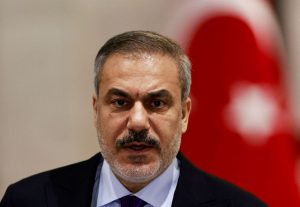
On Thursday, Turkish Foreign Minister Hakan Fidan criticised Greek Prime Minister Kyriakos Mitsotakis for repeating in Parliament that Greece would not accept Turkey in SAFE while the war threat remains.
“The fact that the Greek prime minister proudly declares in Parliament that they will not allow Turkey to join the SAFE programme is something that should be taught as a lesson,” Fidan said, accusing Greece and Cyprus of “occupying Europe’s security system” while contributing little to it.
Athens responds firmly
Greek Foreign Minister Giorgos Gerapetritis responded that Greece “pursues an active and consistent foreign policy based on the universal values of international law and is not dictated by others.” He added that Greece “will not deviate from these principles, and those who are irritated by them must simply accept that.”
The two ministers were scheduled to meet on Monday on the sidelines of the EU Foreign Affairs Council in Luxembourg, in what is expected to be a difficult conversation.
Escalating rhetoric
Ahead of the meeting, Fidan accused Greek politicians of exploiting bilateral tensions for domestic reasons, saying: “This policy is based on hostility toward Turkey. They feel compelled to say certain things to defend themselves… Neither the anti-Turkish initiatives in Europe nor those in the Eastern Mediterranean escape our notice.”
He also issued a veiled warning: “If we continue using threatening language toward each other, the outcome will not be good.”
A delicate meeting in Luxembourg
Their encounter comes only hours after Athens announced plans to explore the creation of a multilateral cooperation format in the Eastern Mediterranean (5×5) — potentially including Turkey. Gerapetritis was expected to hold talks with several regional counterparts ahead of the proposal’s presentation by Prime Minister Mitsotakis at the MED9 Summit in Slovenia.
Despite these efforts, Turkish reaction to Greece’s position is awaited with interest, as both sides navigate a period of fragile calm following years of tension.
Greece maintains a hard line
According to senior diplomatic sources in Athens, the government has no intention of softening its stance on Turkey’s participation in SAFE. Mitsotakis has reportedly also demanded that Ankara withdraw its claims over “grey zones” — disputed islets in the Aegean linked to Turkey’s demands for demilitarisation of certain Greek islands.
“It is Turkey that must prove it participates in the defence effort, not the offence,” a senior Greek diplomat told To Vima, adding: “There can be no active threat of war against an EU member state.”
Asked whether it is realistic to expect the Turkish parliament to repeal the 1995 war resolution, the same source said the issue is secondary: “Even if the threat were withdrawn, that would not automatically eliminate the risk of conflict.”
Pressure from European partners
The Greek position is complicated by mounting pressure from several European capitals and from NATO Secretary-General Mark Rutte, urging Athens not to block Ankara’s participation. Germany, in particular, has been vocal: its foreign minister recently called Turkey an “indispensable partner” for Europe’s defence autonomy — while stressing the importance of human rights and the rule of law.
Greek diplomats, meanwhile, have been briefing EU partners about Turkey’s standing war threat, with Gerapetritis visiting Estonia and Finland, both countries sensitive to security concerns given their proximity to Russia.
A complex equation
The situation leaves Athens walking a fine line. On one side are the European allies who see Turkey as a strategic necessity; on the other, a domestic political landscape where any softening toward Ankara could carry a high political cost.
As one senior official noted, “The equation is difficult. Greece cannot appear to compromise on national sovereignty, but at the same time it cannot afford another spiral of confrontation with Turkey.”