The Greek government is introducing satellite surveillance of its territorial waters through a new partnership with Global Fishing Watch (GFW), a Google-affiliated organization that monitors global seas.
A memorandum of cooperation was signed between the Greek ministries of environment, rural development and shipping, along with GFW, enabling Greece to monitor maritime activity in real time. The agreement initially covers the two newly announced marine parks in the Ionian Sea and the southern Cyclades, but could later extend across all Greek territorial waters and exclusive economic zones (EEZs).
Priorities: Illegal Fishing and Marine Protection
The initiative’s primary goal is to curb illegal fishing and enforce environmental regulations. Greece has pledged to designate 30% of its territorial waters as protected areas by 2030, a target it expects to surpass earlier. By 2026, with the declaration of the two new parks, the figure is set to reach 35%.
Satellite data will complement the Hellenic Coast Guard’s Vessel Monitoring System (VMS), which has limited capacity. Authorities noted that some fishing boats evade detection by leaving trackers on other vessels while illegally entering restricted zones. Satellite surveillance aims to close such loopholes.
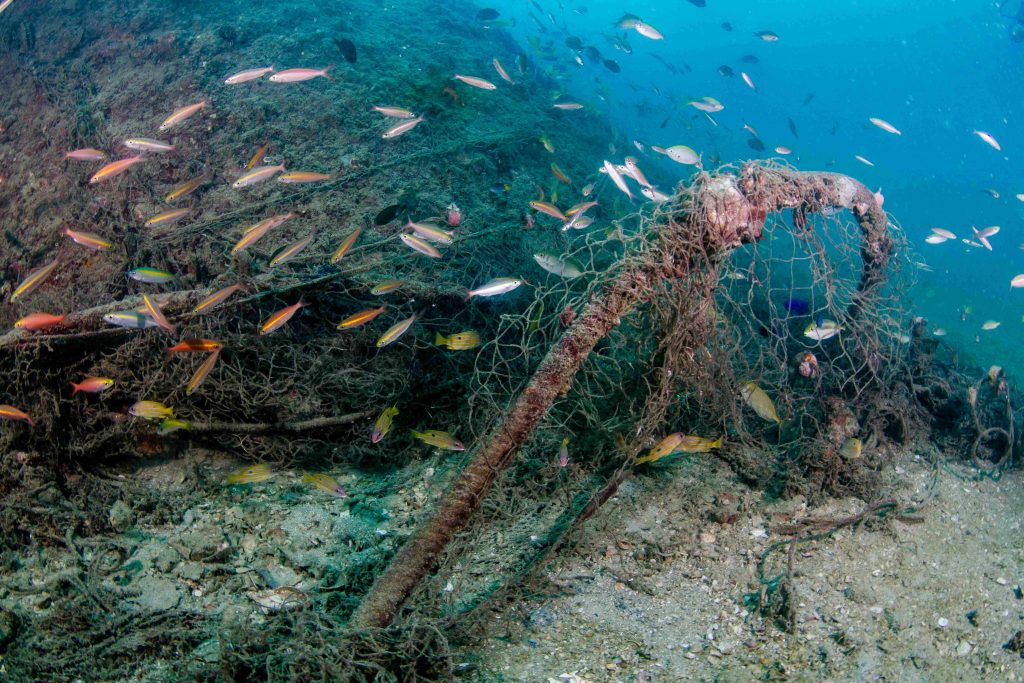
Abandoned ghost fishing net left at the bottom of the ocean that causes environmental problems and damages marine life.
Cooperation and Challenges
The memorandum involves Greece’s organization for Natural Environment and Climate Change (NECCA), which will contribute expertise, vessels, specialized staff, and access to EU funds. Officials stress that effective monitoring requires not only technology but also more Coast Guard staff and resources.
Although the agreement was signed in November 2024, implementation has been delayed due to resistance within the Ministry of Rural Development, particularly from groups opposing stricter controls on trawlers. Sources say the official government gazette publication is now imminent, with promises of targeted compensation for affected fishing vessel owners.
Wider Implications: Security and Migration
Beyond environmental protection, satellite monitoring could serve broader sovereignty and security goals. Greek officials believe the system will deter Turkish fishing vessels that frequently operate inside Greek waters under Coast Guard escort, practices that have previously sparked tensions.
The technology could also be applied to migration management, offering real-time tracking of vessels and helping the Coast Guard respond to potential increases in flows from both southern and eastern routes.
The partnership follows Prime Minister Kyriakos Mitsotakis’s engagement with U.S. climate envoy John Kerry at the 2023 Ocean Conference, which Greece co-hosted with the U.S. The prime minister expressed strong support for adopting satellite monitoring as a reliable framework for safeguarding Greek marine parks.