At 14, she made the world believe in perfection. Fifty years after scoring the first perfect 10 at the Montreal Olympic Games, Nadia Comăneci is remembered not only as the athlete who defied gravity, but also as the woman who escaped the shadow of a brutal regime.
A 64-year-old woman stands before a mobile phone camera mounted on a stand, eagerly capturing her every movement.
With a broad, natural and unselfconscious smile, she twirls in front of it.
She is wearing a lavender gymnastics leotard decorated with rhinestones, with the understated name “Nadia” written across the back.
Before the viewer has time to connect the face with the name, the shot changes. The woman is now wearing a pink leotard and performing another pose.
It could be one of the millions of videos uploaded to social media every day at a relentless pace—the kind most people would pass over with a lightning-fast scroll.
And it would be, were the woman in the video anyone other than Nadia Comăneci.
She is, in other words, the legendary gymnast who is marking the 50th anniversary of her historic achievement: the first perfect 10, awarded at the 1976 Montreal Olympic Games when she was just 14 years old.
The retired Olympic champion’s video may have a commercial purpose—Comăneci is promoting a collection of gymnastics leotards released to commemorate her achievement—but it also provides a perfect opportunity to revisit the extraordinary story of her life.
Not merely the story of the record-breaking champion who became known in Greece, quite aptly, as the “rubber girl,” but the story of a woman who managed to reclaim her own life.
From whom? From Nicolae Ceaușescu’s regime, which for years cast a heavy, suffocating shadow over the teenage Olympic champion and over the industrialized system used to manufacture sporting champions.
When the Scoreboard Could Not Display Nadia Comăneci’s Record
Let us turn the clock back exactly 50 years.
On July 18, 1976, inside Montreal’s Forum arena, the air smelled of sweat, chalk—the powder gymnasts use on their hands to prevent slipping—and the Cold War.
The Eastern Bloc had arrived at the Olympic Games determined to demonstrate the unquestionable superiority of the communist model. Gymnastics, after all, could serve as a flawless showcase for propaganda.
A 14-year-old girl from the small Romanian industrial town of Onești—until then unknown to the wider world—stepped up to the uneven bars. She was slight, expressionless, almost as though she had been created by artificial intelligence.
Her routine lasted just one minute and 20 seconds, but that was more than enough time to show that gravity was merely an inconvenience to her. She defied it, and did so with effortless grace.
As Comăneci herself would admit decades later, the only thing on her mind during those seemingly endless 80 seconds was not to make a mistake.
“The Olympic Games happen every four years. All I was thinking about was doing what I had to do during that one minute.”
At the end of the routine, she landed motionless, statuesque and perfect.
No one, however, was prepared for what followed. The judges found themselves facing an unprecedented dilemma.
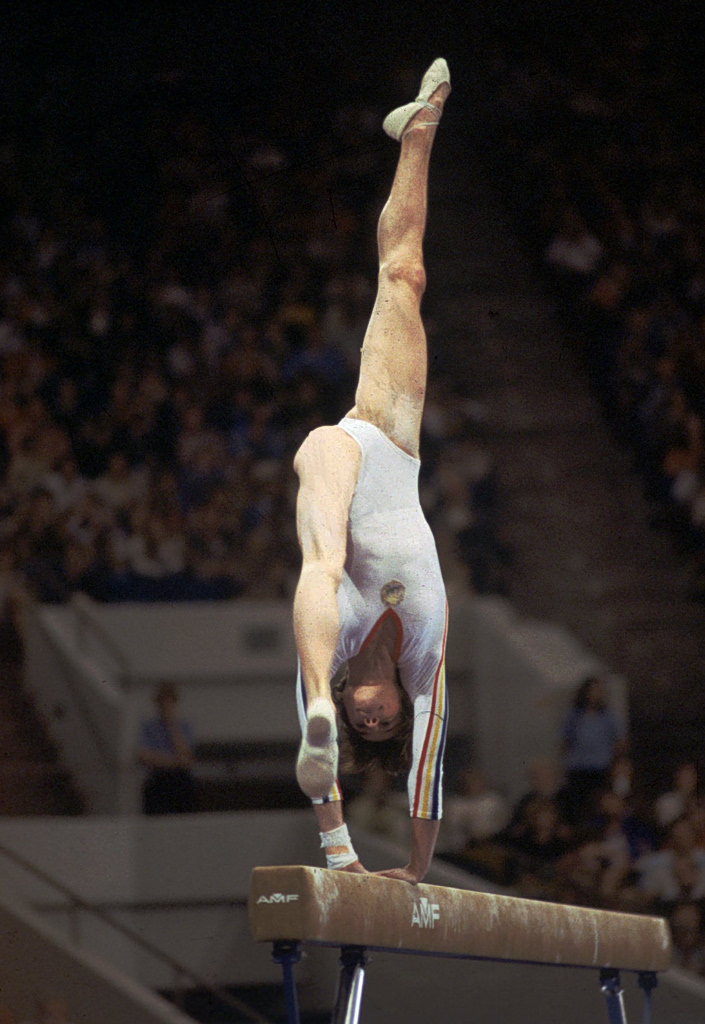
Romanian gymnast Nadia Comaneci performs during the all-around gymnastic competition at the 1976 Summer Olympics July 21, 1976 in Montreal. (AP Photo/stf)
Nadia Comăneci: The Perfect 10 That Shocked the World
When the score was announced, Omega’s impressive electronic scoreboard—the height of technological sophistication at the time—appeared to malfunction and displayed an astonishing figure: 1.00.
The crowd froze. Comăneci herself stared at the board in bewilderment, trying to understand what she had done wrong. But the problem was not athletic. It was technical.
No gymnast in Olympic history had ever achieved a perfect score.
The Swiss-made system had been programmed to display only three digits, allowing scores of up to 9.95. Before the Montreal Games, Omega had reportedly asked the international gymnastics federation whether the system needed to be upgraded. The answer was that there was no reason to do so.
That was how inconceivable Nadia Comăneci’s achievement had seemed.
The stadium announcer eventually had to take the microphone and explain to the stunned crowd that the modest-looking “1.00” was, in fact, the first perfect 10 in Olympic history.
That July evening, and over the days that followed, Comăneci received a total of seven perfect scores. She left Montreal with five Olympic medals: three golds—in the individual all-around, uneven bars and balance beam—one silver and one bronze.
The 90 “Shadows” of the Securitate
When the glitter of success faded and the triumphant headlines in the Western press subsided, Comăneci was forced to confront reality—or, more precisely, a nightmare meticulously orchestrated for her by the communist regime.
When she returned home, she was reportedly so overwhelmed by the crowds cheering her arrival that she panicked and rushed back inside the aircraft.
Her achievement became synonymous with a life sentence of suffocating surveillance.
She was no longer simply another athlete. She had become a valuable state asset. According to the regime’s logic, that meant she had to remain under constant control.
As historian Stejărel Olaru revealed in his 2021 book Nadia and the Securitate, based on declassified records from Ceaușescu’s notorious secret police, Comăneci’s life was haunted by shadows.
According to the files, a total of 90 informants recorded even her smallest movements: her moods, private conversations and even her thoughts.
These were not unknown agents in trench coats and dark glasses. They were the people supposedly surrounding her in order to protect her.
The shadows in her life included coaches, doctors, sports journalists and even fellow gymnasts.
Olaru identified three people as the most important Securitate informants in her immediate circle: Maria Simionescu, one of the most influential figures in Romanian gymnastics; coach Anastasia Albu; and choreographer Géza Pozsár—the same man who would later defect to the United States and work with her legendary coach, Béla Károlyi.
All of the reports were collected in the notorious “Sport File,” an enormous archive that eventually grew to 36 volumes.
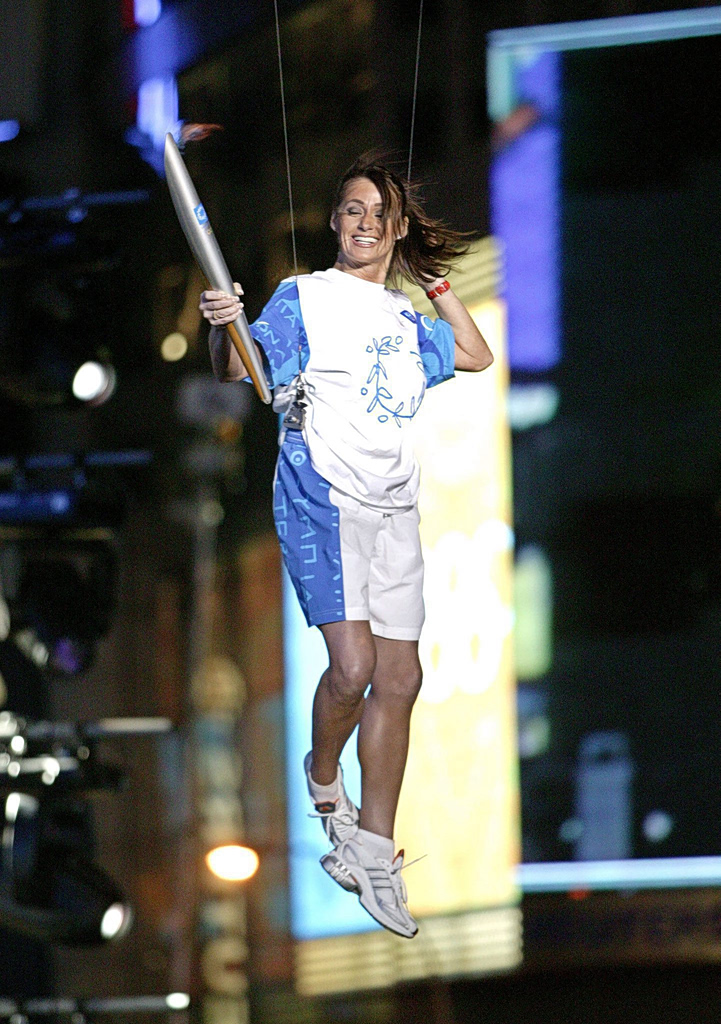
epa000215716 Olympic gymnast Nadia Comaneci holds the Olympic Flame from a Zip Line high above New York’s Times Square at a ceremony at the end of a day-long Olympic Torch relay throughout the City of New York to celebrate the upcoming games in Athens, Saturday 19 June 2004. EPA/PETER FOLEY
The Labor Camp of Deva and the Man Who “Created” Nadia Comăneci
If the Securitate was Nadia Comăneci’s invisible jailer, the people who built her sporting legend were her ever-present disciplinarians and punishers.
For decades, the Western narrative celebrated Béla and Márta Károlyi as the unmatched architects of a gymnastics miracle. Later, after their defection, they would be revered almost as sacred figures in the United States, where they settled.
But the files of Romania’s secret police record a very different and deeply disturbing reality.
At the national training center in Deva, the grace and weightlessness witnessed by audiences around the world were forged through extreme methods.
According to the documents uncovered by Olaru, Comăneci and her underage teammates were subjected to systematic physical and psychological abuse.
Károlyi allegedly beat the girls until they bled, humiliated them verbally—often calling them cows—and restricted their food so severely that they sometimes resorted to secretly eating toothpaste in their rooms or drinking water from the tap simply to ease the cramps in their stomachs.
Even though agents saw, heard and recorded the abuse of what the state considered its most valuable national assets—its champion athletes—no one intervened.
As long as the Deva “machine” continued to produce gold medals and international recognition for Romania, the state turned a blind eye to the outrageous and often inhuman practices behind those victories.
The rupture came in 1981, tightening the noose around Comăneci once and for all.
During a gymnastics tour of the United States, Béla and Márta Károlyi, together with choreographer—and informant—Géza Pozsár, defected. They requested political asylum, leaving Nadia behind, trapped by her own legend.
She returned to Romania, but her world had fallen apart.
Nadia Comăneci: Free, Yet Besieged by the Ceaușescu Family
For Nicolae Ceaușescu’s regime, the national heroine was transformed overnight into a suspect.
Terrified that the symbol of Romanian superiority might also flee to the West, the dictator imposed a complete lockdown on her life.
Gradually, her existence took the form of a gilded cage, while her competitive career officially ended in 1984.
The woman whose name was known in every corner of the world was now working as an employee of the Romanian Gymnastics Federation for a poverty-level salary of approximately $150 a month.
She could not earn money independently. She could not capitalize on her fame to help her family. She could not even breathe without her actions being recorded in a report.
“Life took on a new bleakness,” she later wrote in her memoirs.
“There was no longer any need to keep me happy. If Béla had not defected, I would still have been watched, but his escape placed a blinding spotlight on me. I began to feel like a prisoner.”
Almost a decade of despair eventually drove her to take a desperate step.
It was late November 1989. Nadia was now 28 years old, and she made the most important decision of her life.
In the darkness and freezing cold of winter, accompanied by a group of other Romanian refugees, she walked for six exhausting hours through mud, defying the danger posed by border guards who had orders to shoot to kill.
She crossed the border into Hungary. From there, she was smuggled into Austria and eventually reached the United States.
Less than a month after her escape, the Romanian Revolution erupted. On Christmas Day 1989, Nicolae and Elena Ceaușescu were executed, and their authoritarian regime passed into history.

BER02 – 20010313 – BERLIN,GERMANY: Members of the International World Sports Academy, former Romanian gymnast Nadja Comaneci (L) and the former German tennis-player Boris Becker (R), hold the Laureus Sports Award 2001 trophy Tuesday, 13 March 2001 at a press conference in Berlin prior to announcing the nominees of the “Sportsman Of The World”. The winner will be announced 22 May 2001 in Monte Carlo and receive the Laureus trophy. EPA PHOTO DPA/PEER GRIMM
The Legacy of Silence
The fall of Ceaușescu’s regime did not, however, bring an end to the culture that had shaped Nadia Comăneci.
Béla Károlyi may have left Romania, but he did not leave his coaching philosophy behind.
In the United States, together with his wife Márta, he built a new gymnastics empire at the famous Texas ranch. Generations of champions trained there, and the Romanian coach’s name once again became synonymous with Olympic success.
But that success was built on a culture of absolute discipline.
The coach had the final word. Obedience was regarded as a virtue. Questioning authority was treated almost as betrayal.
It was within this environment that the US gymnastics program developed—and where, decades later, the largest sexual abuse scandal in the history of international sport was exposed.
National team doctor Larry Nassar abused underage athletes for years without facing meaningful resistance.
The investigations that followed did not find the Károlyis responsible for his crimes. They did, however, reveal a system in which silence, fear and unconditional obedience had become an integral part of everyday life.
Nadia Comăneci’s story did not end at the borders of Ceaușescu’s Romania.
Her perfect 10 in Montreal revealed something greater than the talent and brilliance of a single athlete. It exposed the dark cost of a system that had learned to place victory above the human being.

FILE PHOTO: Larry Nassar, a former team USA Gymnastics doctor who pleaded guilty in November 2017 to sexual assault charges, stands in court during his sentencing hearing in the Eaton County Court in Charlotte, Michigan, U.S., February 5, 2018. REUTERS/Rebecca Cook/File Photo
The Golden Jubilee of an Unrepeatable Record
Today, half a century after that historic perfect 10 in Montreal, world gymnastics is still attempting to recover from its trauma.
The sport itself has changed dramatically, both technically and ethically.
In 2006, the International Gymnastics Federation abolished the perfect-10 scoring system and adopted an open-ended system, making Comăneci’s record effectively impossible to surpass.
But the greatest change has been the emergence of the athletes’ voices—voices they are now increasingly able and willing to use.
As the 64-year-old Nadia Comăneci dances in her Instagram video, wearing her glittering leotard commemorating 50 years since her perfect performance, the image could be seen as a celebration of survival.
That underage girl from Onești was not broken by the beatings in the gym.
She did not lose her mind under the gaze of the 90 Securitate informants recording her every breath.
She survived the madness of Ceaușescu’s regime, walked through the mud in November 1989 and managed to cross the Atlantic.
Today, her clothing line does not bear the name of the country that exploited her, or of the regime that oppressed her.
It bears one name:
Nadia.