Ten years ago, during the underwater archaeological survey carried out by the Ephorate of Underwater Antiquities in the Fournoi archipelago, traces of twenty-two shipwrecks dating from the Archaic period to the pre-Revolutionary years were identified and documented. Conducted in September 2015 with the support of the RPM Nautical Foundation, the project aimed to locate, record, document and study ancient and medieval shipwrecks in the island complex of Fournoi.
“This was the first systematic underwater survey ever conducted in Fournoi,” Dr. George Koutsouflakis, Assistant Professor of Underwater Archaeology at the University of Thessaly, told To Vima. Dr. Koutsouflakis directed the research, alongside archaeologist Peter Campbell, who headed the team from the RPM Nautical Foundation. The 2015 expedition also included EEA diver L. Mersenier, antiquities conservator A. Tsompanidis, RPM archaeologist S. Hutchins, and as external collaborators, divers V. Mendogiannis, M. Garras and A. Agathos.
A Key Maritime Crossroads
Owing to its strategic location, Fournoi has played a vital role through the centuries in navigation and trade across the eastern Aegean. According to the Ministry of Culture, the area investigated in 2015 represented “less than 4% of the total coastline surrounding the Fournoi archipelago.” Continued research in subsequent years “led to the discovery of an even greater number of wrecks, allowing a detailed study of navigation and the transport of goods across these waters in antiquity.”
“To date, 61 sites of underwater archaeological interest have been recorded in the Fournoi area,” Dr. Koutsouflakis noted.
Among the most significant finds are a shipwreck carrying Samian and Chian amphorae, dating to the mid-6th century BC; a late Classical era vessel loaded with Chian amphorae and storage jars; three wrecks transporting amphorae from the Black Sea region, dated between the 3rd and 6th centuries AD; another with Syrian–Palestinian amphorae from the 3rd–4th centuries AD; and a fourth from the 4th century AD carrying cargo from the Roman provinces of North Africa and Spain.
“The remarkable diversity of the cargoes, and the discovery of many wrecks with imported, non-Aegean goods, indicate that Fournoi functioned as a supra-local hub within a wider maritime trade network in antiquity,” Dr. Koutsouflakis explained. “Several of the amphora cargoes documented were recorded for the first time not only in the Aegean but across the entire Mediterranean.”
Ongoing Exploration
With the exception of a single year — 2019 — underwater research has been conducted annually in Fournoi since 2015, each expedition yielding important discoveries.
In 2021, the focus turned to excavating a late Roman shipwreck at Aspros Kavos. Fifteen buried amphorae were recovered, while fragments of timber identified as part of the vessel’s hull suggested that sections of the ancient ship may remain well preserved beneath the sediment.
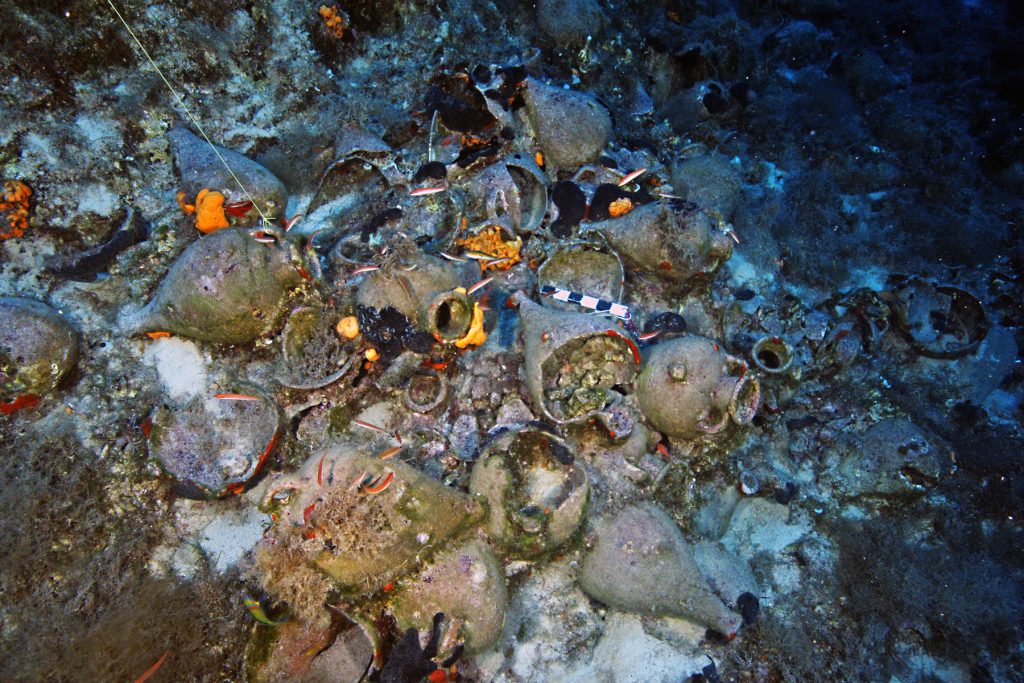
Amphorae from an Archaic-era shipwreck at Fournoi. / Greek Min. of Culture
“The wreck lies north of the settlement of Kamari, off the remote and rugged eastern coast of Fournoi,” said Dr. Koutsouflakis. “The sandy seabed slopes steeply at a depth of 41–50 metres, in one of the most exposed parts of the archipelago, battered by strong winds for most of the year.”
According to Dr. Koutsouflakis, the site was chosen as “the most scientifically significant, both for its integrity and cohesion, and for its heterogeneous cargo — eight different types of amphorae originating from Crimea, Sinope and Heraclea Pontica on the Black Sea, as well as the Aegean.” The main cargo was complemented by a secondary load of tableware from the Phocaea region in north-west Asia Minor. Between 2021 and 2024, research focused on cleaning and exposing parts of the ship’s western side, revealing extensive sections of amphora cargo embedded in the sand.
Preserving the Legacy
In 2019, the book Korsieiton Islands (published by the Municipality of Fournoi) by Maria Viglaki, Giorgos Koutsouflakis and Peter Campbell, was released. It documents the island’s terrestrial antiquities as identified and recorded by the Ephorate of Antiquities under archaeologist Maria Viglaki-Sofianou, who served for 35 years, dedicating her career to safeguarding the cultural heritage of Samos, Ikaria and Fournoi.
At the book’s presentation in Fournoi, Culture Minister Lina Mendoni referred to the creation of a museum that would combine the conservation of finds from Fournoi with public accessibility. “The Municipality of Fournoi has provided a two-storey building to house the museum,” said Dr. Koutsouflakis. “Relevant museological and architectural studies are now under way, as certain alterations are needed. The Municipality is in direct contact with the Ephorate of Underwater Antiquities, and the plan is expected to be realised within the next two years.”
The Terrestrial Riches of Ikaria
Even today, confusion often persists between Fournoi and nearby Ikaria, as many assume that Fournoi forms part of the Ikarian landmass. In fact, the Fournoi archipelago and Ikaria are two entirely distinct entities.
It is hardly news that Ikaria boasts a wealth of antiquities — though no underwater surveys have ever been conducted there. Over the past three decades, excavations have uncovered significant finds in key locations such as ancient Oinoe and the sanctuary of Artemis Tauropolos, as well as around the acropolis of Drakanos, where remains of ancient quarries, tumuli and harbour installations have been identified.
In the Iero Bay area north of Drakanos, megalithic monuments (menhirs) have been found; similar structures exist near the village of Kountoumas. In the valley of Erifis, near the settlement of Glaredo, archaeologists have discovered the remains of houses, numerous pottery sherds, ceramic vessels and obsidian fragments.
A valuable reference on Ikarian excavations is the volume The Archaeological Spade in Ikaria, edited by Dr. Koutsouflakis, which compiles sixteen papers presented at a 2006 conference in Armenistis. Focusing on the island’s cultural evolution — material and intangible — as well as the history of archaeological research itself, the volume spans a vast chronological range, from prehistory to modern times.