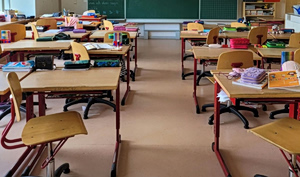
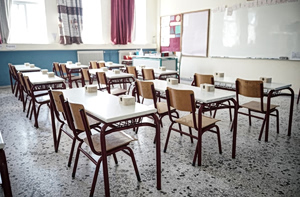
In most school classrooms, silence does not come immediately; first, it passes through a brief negotiation. The teacher enters, sets their bag on the desk, and for a few seconds the class continues as if nothing had happened. Two students finish their conversation from the break, a chair scrapes across the floor, someone giggles loudly, a voice from the back throws out one last comment. It is the familiar sound of a Greek school, the small everyday disruption before the lesson begins. In most classes, sooner or later, balance is restored. But there are also classes where silence never comes.
The story of English teacher Sofia Christidou, who passed away after a stroke in Thessaloniki, brought this hidden reality of Greek schools back into focus. For those who knew her, of course, the events of the past weeks are not the beginning of the story but the tragic end of a journey that had started much earlier.
Lawyer Giannis Athanasiadis was a friend of Sofia Christidou for decades. “We have known each other for almost thirty years; our summer houses in Halkidiki are very close,” he says to Vima. “We were not a daily group, but she belonged to my wider circle of friends.” When he speaks about her, he begins with her educational journey. “Sofia had invested heavily in her education. She had completed English Literature, a doctorate, two master’s degrees, and postdoctoral research. She had written five books.” He recalls presenting one of them himself in 2019. “It was a book on the history of translation, excellent. She was a very active person with quality and love for her work.”
The Last Conversations
In one of their last conversations, Sofia Christidou called him on February 6, 2026, to ask for legal advice. “She called because she was concerned about some incidents at school and wanted my counsel as a lawyer on how to proceed.” At that time, according to him, she was still at the school with her partner. She had previously met with parents, the principal, and other teachers. “My advice was not to escalate the issue into a legal conflict. I told her it would be better to follow the school mediation process.” From that conversation, one thing stuck with him. “She revealed to me that she did not feel supported by the school environment.” He saw her again a few weeks later, on February 22. “We met in a group for a meal. We didn’t talk much about the school incidents, but she was visibly stressed. What had affected her most was being referred to the health committee by the administration.”
In one of the reports she had sent to the educational authorities, Sofia Christidou described incidents of tension in the classroom, referring to repeated provocations and aggressive behavior by students during lessons. In one incident she recorded, she reported that while writing on the board, she was hit on the back with a full water bottle and a book thrown by students. In the same document, she requested that the situation in the school be examined and that intervention be made by the competent authorities.
“She was a person with a serious career”
Giannis Felekis, principal of the 1st Vocational High School (EPAL) of Stavroupoli, remembers her as an educator with a strong academic record. She joined his school in the summer of 2025, when she received a promotion from EPAL Lagkadas. “I met her then,” he says. “She came, completed the formalities, served for a week in July, and then we didn’t see her again because she was transferred to Eastern Thessaloniki.” The impression he retained was specific. “She was a colleague of high qualifications. She had a special background, she had studied, completed postdoctoral research, and wanted to become a school counselor.” He also recalls that she had worked in a university environment, as a collaborator in foreign language teaching. “She was a person with a serious career. She was not a typical teacher who just passes through a school and leaves.”
Her case, he says, cannot be seen in isolation from the broader climate prevailing in schools today. “The situation has become very difficult,” he notes. “It is not only what happens inside the classroom. It is also the attitude of many parents. In the past, when an issue arose, the family often acted as support for the school. Now we increasingly see the opposite. Parents enter the discussion with a confrontational attitude, and the atmosphere becomes tense.”
An even more raw picture of daily life in classrooms is described by Giannis Katradis, a retired high school principal in Gerakas, with four decades of classroom experience. “The climate in schools has changed dramatically in recent years,” he tells Vima. “We are not just talking about noise. There are incidents that previously would not have been encountered in a classroom. I have seen students throw objects in class: pliers, screwdrivers, tools they had with them. Especially after COVID-19, all control was lost, and often the problem lies with the parents themselves.”
Educators Leaving Early
According to Mr. Katradis, this tension has begun to leave its mark on the teaching staff. “There are colleagues who no longer make it to retirement,” he says. “In some areas of Eastern Attica, which I know well, about 20% of teachers choose to leave the profession early, before reaching retirement, because they can no longer withstand the pressure.” The issue, however, now concerns not only daily school life but also its administrative management.
Awaiting the findings of the Official Administrative Inquiry (EDE) into Sofia Christidou’s case, the Ministry of Education leadership appears to be moving toward a broader review of teachers’ professional files. According to To Vima, Education Minister Sofia Zacharaki has requested that the Regional Education Directorates examine over time the files of all active teachers, with particular emphasis on those currently in classrooms. At the same time, the ministry is considering a more complete record of so-called “unable” teachers—those who, for health reasons, primarily psychological conditions, are not performing teaching duties. This number, according to estimates by education officials, could reach around 2,500 teachers. Of these, 1,232 are officially registered with relevant medical certificates.
The Need for Periodic Psychological Checks
In the same context, the Minister of Education has publicly raised the need to establish periodic psychiatric and psychological evaluations for those serving in public education, possibly every five years. The assessments, according to the framework being considered, could be conducted by specialized committees of psychologists and doctors in collaboration with the Ministry of Health.
From the side of OLME (Greek Federation of Secondary State School Teachers), its president Theodoros Tsouhlos insists that the case requires full investigation, as well as calm. “It is very difficult to medically prove that such an incident is linked to a specific moment of pressure,” he tells Vima. “We do not know exactly when the stroke occurred. But this does not mean that when school ends and you leave, the tension disappears in a second.” He insists that the essential question lies elsewhere: in how the institutions acted while the situation was deteriorating. “If there were reports and memoranda about the problem, then we need to see what the school administration did and what the Education Directorate did,” he notes. “When a teacher speaks about a situation that pressures them over a long period, the system must respond in a timely manner.”
The discussion opened after the death of Sofia Christidou touches on a point that the education system often avoids facing directly, relating to the increasing tension experienced by many teachers in the classroom. With the findings of the Official Administrative Inquiry, light will be shed on the case. For many teachers, however, the remaining question is much simpler and more everyday: How does teaching continue in a classroom where tension has become part of the routine?