It was concluded that on this day 32 years ago, guitarist and singer Kurt Cobain died in his Seattle residence. His body was discovered 3 days later, on April 8th 1994, by an electrician called to service the property. He saw part of Cobain’s body unconscious on the floor inside the greenhouse, through the French doors. After the investigation by the Seattle Police Department and the King County Medical Examiner, the rocker’s death was ruled a suicide. Conspiracy theories surrounding Cobain’s passing have run rampant for decades, regardless of the case being officially closed.
Now, 6 independent specialists (Burnett et al., 2025) are questioning the scientific validity of Kurt Cobain’s suicide scenario.
In 2025, a 53-page research paper by an independent investigative team was published titled “A Multidisciplinary Analysis of the Kurt Cobain Death”. Led by forensic analyst Bryan Burnett and former music journalist Michelle Wilkins, the team are calling for the official reopening of Kurt Cobain’s case and the release of all related documents and evidence. The report contains a comprehensive analysis of the evidence publicly available, including the ballistics report released in January 2025.
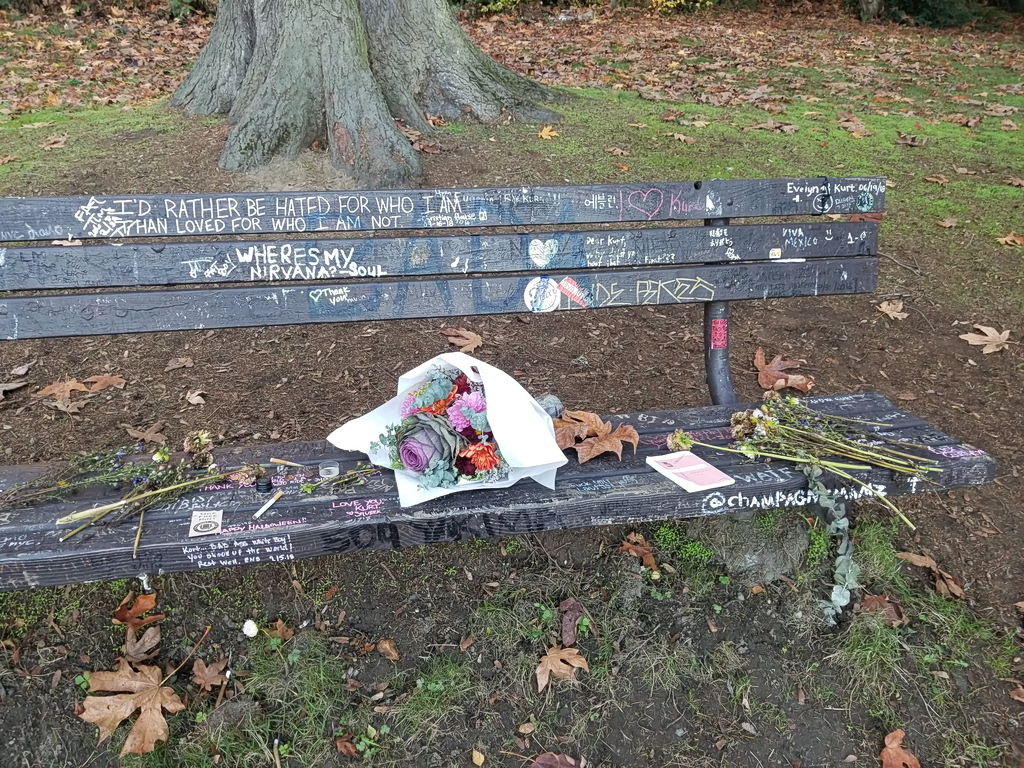
Kurt Cobain Memorial in Seattle.
The official ruling and new claims
Kurt Cobain, base solely on publicly available discovery and analyzed through a
multidisciplinary critical method, was a homicide victim. His body was moved from the site of
the homicide and staged to appear as a suicide.Abstract from “A Multidisciplinary Analysis of the Kurt Cobain Death”, Burnett et al., 2025
Officially, Kurt Cobain is said to have injected himself “with a lethal dose of heroin” and subsequently shot himself with a shotgun through his mouth. It is described by SPD Detective Ciesynski in 2014 that Cobain remained “conscious enough” after the injection to pack away his syringe, and while seated or lying on the floor place the shotgun in his mouth and pull the trigger.
In the homicide scenario proposed by the research team, Cobain was attacked near the greenhouse by two assailants and forcibly injected with heroin. Once he collapsed, the shotgun was forcibly inserted into his mouth and the trigger was pulled by one of the assailants. Cobain was then carried into the greenhouse, and the scene was staged wherein he was found days later.

Through simulations, graphic representations and comparisons with similar incidents, specialists point out inaccuracies; originally overlooked possibly due to lack of expertise. According to the new report, not only is the suicide scenario highly unlikely but physiologically improbable.
Puncture mark and Cobain’s heroin prep cigar box
In pages 23-28, Bryan Burnett and toxicologist Pietro Zuccarello go in depth about Kurt Cobain’s visible puncture wound, the heroin kit found on the scene, and his incomplete autopsy report.
Burnett describes different types of syringes and infers that the puncture mark on Cobain’s left forearm (page 24, Fig. 15A) is likely from a collared syringe. In a photograph from the crime scene, a clear view of Cobain’s heroin kit shows two insulin syringes. “The cigar box that was near Cobain’s body did not contain a collared syringe” Burnett writes.
Zuccarello comments on the peculiar location of the puncture wound, writing “Cobain was left-handed. The identified intramuscular injection site at the left dorsal forearm (Fig. 15A) is remarkable as it appears to be the only drug injection site identified on Cobain‘s left arm – his dominant side.”
Kurt Cobain’s stash box. photo taken by police after his suicide pic.twitter.com/271El2dOrF
— LUNAR C (Onepunchwilly on IG) (@LunarCFT) March 28, 2014
In the official autopsy report, it is noted that any other signs of heroin use were only found on his right arm. Additionally, Zuccarello explained that Cobain’s puncture being on his forearm is also atypical. “Intramuscular injection is very infrequently seen in heroin users”, his report reads, “This route is typically painful, more likely to result in tissue damage and infection, and reduces the intensity of the ‘high’. ”
The picture of Kurt Cobain’s cigar box (page 25, Fig. 16) containing his drug paraphernalia also reveals some abnormalities. “The black tar heroin ball found on the spoon in Cobain’s heroin kit appears unused and similar in size to the other presumably unused pieces in the kit” Zuccarello notes these heroin pieces are loose and unwrapped in the box. A rather unusual detail, as black tar heroin is “prone to degradation when exposed to air, can smear easily, and may be absorbed by dry materials–any of which could render it unusable.”
Also worth noting is that Cobain had enough heroin readily available that, if administered in full, would result in certain death.
The M-11 shotgun simulations
Pages 9-19 examine the claim that Cobain shot himself with his Remington M-11 20-gauge shotgun.
In the official report, it is said that he pulled the trigger with his right hand while his left hand was gripping the barrel of the gun “just behind the compensator”. Using an image released by the SPD depicting an officer holding the original shotgun used (page 10, Fig. 4A), the research team conducted tests with a shotgun of the same measurements. Researchers determined that on the suicide scenario, the 20-gauge shotgun casing found near Cobain’s body could not have successfully been ejected from the weapon.
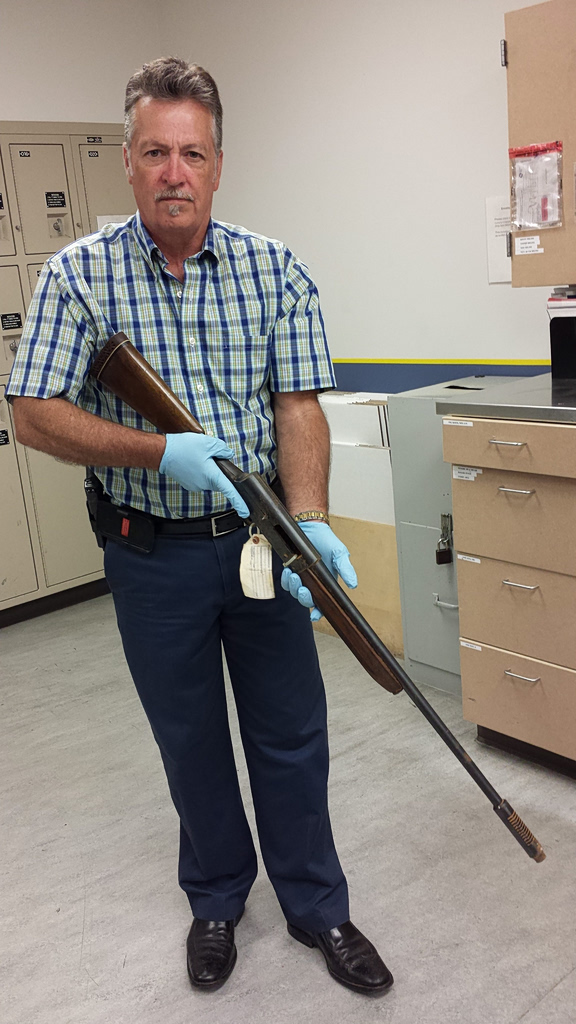
EPA05217391 A handout photo taken in June 2015 and provided by the Seattle Police Department on 17 March 2016 shows Detective Mike Ciesynski holding the shotgun that Kurt Cobain is alleged to have used to commit suicide. EPA/SEATTLE POLICE DEPARTMENT / HANDOUT HANDOUT EDITORIAL USE ONLY
The shotgun uses a long recoil process where the barrel needs to move fully forward to eject the casing. “If the barrel‘s recoiling operation is obstructed (e.g., by Cobain‘s left hand gripping the barrel as in the suicide scenario), the recoil movement of the shotgun will be impeded, and the spent casing will not fully eject.” In the official police report, it is stated that the casing was found “just to the left of the victim and under one of the stainless-steel garden trays”.
The documented 30 fired test rounds by the independent research team did not result in “one instance of successful casing ejection”. The experiment showed that the shell casing, if Cobain’s hand was on the barrel, would have remained in the weapon’s receiver.
Furthermore, the angle at which Cobain’s shotgun wound was inflicted is also rare.
“In suicide, the barrel is typically at 60 degrees to the body midline, which assumes the victim is sitting in a chair when the firearm is discharged. For homicide, the barrel is approximately 90 degrees or parallel to the horizontal plane. For Cobain, the barrel was approximately 35 degrees.” While this angle is physically achievable, it is not easy. The simulation volunteer is depicted attempting the alleged suicide position in page 34, Figure 19. He remarked that it was “definitely awkward to hold [the shotgun] and engage [the] trigger”.
Assuming that this angle was correct, the M-11 shotgun should have been found trigger up on the scene. The shotgun is officially documented as having been trigger down.
Physical limitations
The complete autopsy report on Kurt Cobain’s death has not been made available. Two pages are currently still missing according to the 2025 independent report. According to Zuccarello’s assessment, “it is possible that Cobain could have tolerated this [fatal heroin] dose and remained functional.” Even in that case, however, he would only be moderately functional for about 2 minutes. Heroin causes a euphoria followed by drowsiness, also referred to as “the nod” and the dose recorded in Cobain’s bloodstream would have likely put his body into shock. This would hinder his breathing and result “in a clinical status incompatible with that required of a suicide scenario.”

Additional anomalies
The extensive 2025 research report further argues on:
- Cobain’s suicide note, that appears to be written in an unnatural manner as well as being signed rather formally
- alleged tampering with two evidence photographs from the scene through Photoshop
- bloodspatter analysis, including Cobain’s bloodied shirts, inconsistent with the suicide scenario
- a bloodstain on his left pant leg, that also looks to be bunched up, left out of the police reports
- Cobain’s right arm was by his side at an angle, when in the suicide scenario it should have been near or on his midriff
The question of change
Throughout “A Multidisciplinary Analysis of the Kurt Cobain Death”, it is reiterated that the officers and investigators who were in charge of the case possibly lacked the experience to detect these details. It is unclear whether this could all be due to a lack of specialists, as there are several key photographs and 2 pages of the autopsy report missing. Despite the forwarding of their investigation and requests by Burnett and Wilkins, the case appears unlikely to be re-examined.
“Our detective concluded that he died by suicide, and this continues to be the position held by this department,” Seattle Police Department spokesperson told Daily Mail.