In Leda Kontogiannopoulou’s art, there is a persistent focus on tenderness. The kind that is sculpted through a slow gaze that does not settle for the external appearance of things, but draws the truth out of texture, patina, and the objects’ subtle “specific gravity”. Her new exhibition, Nights, at the Skoufa Gallery, is a curated stroll through the half-light; the hours when time translates into silence.
There are artists who use vibrant color or characteristic forms as an ally, which become their recognizable signature, and others who ally themselves with time and what is revealed by its contractions and expansions. Leda Kontogiannopoulou belongs to the second category: each of her works seems to carry hours of observation, moments of silence, memories distilled into shades so subtle they require the slow reading of a sensitive viewer. “My internal rhythm guides me in my art, and I realize that it differs from the pace of others’ reality,” she says. “The speed at which things change around us makes me feel uneasy.”
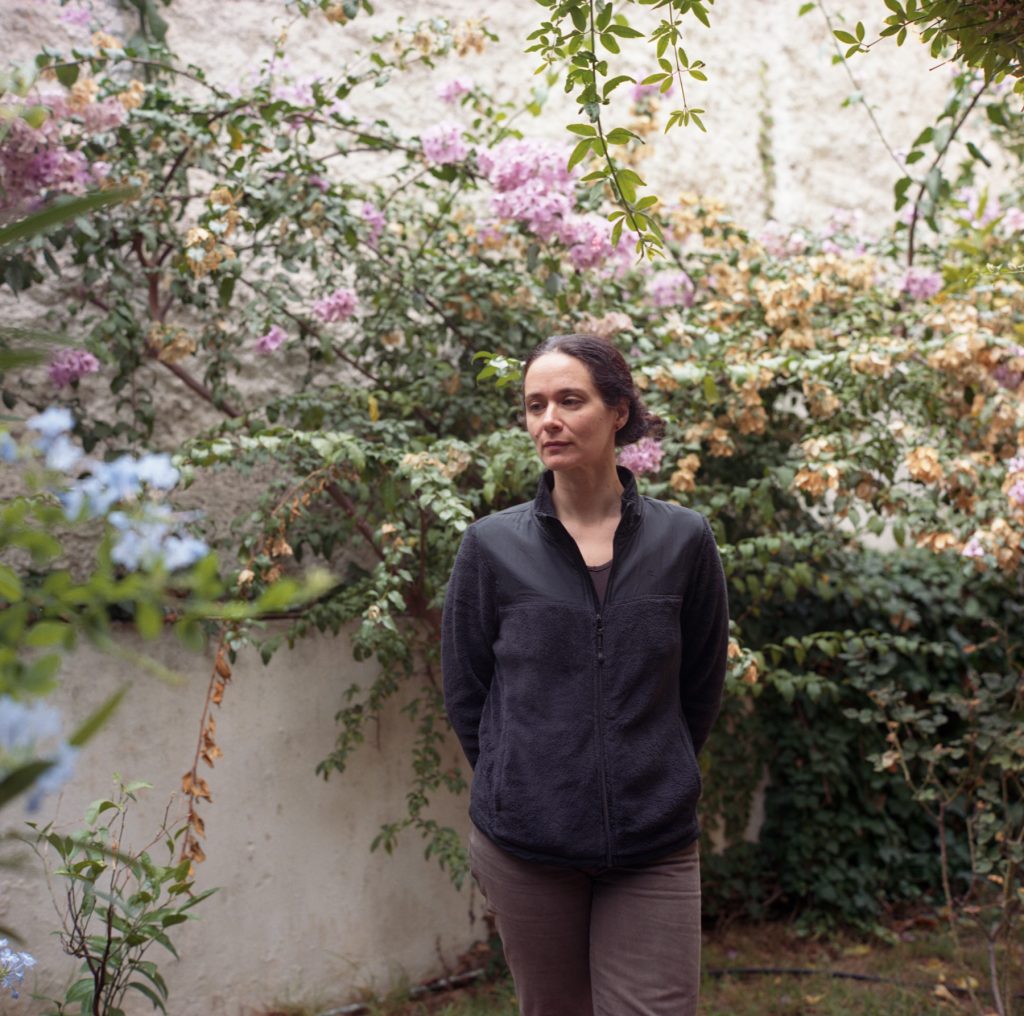
Painter Leda Kontogiannopoulou. Kontogiannopoulou’s personal connections with writers and poets (G. Seferis, I.M. Panayiotopoulos) were the foundation for her path through art.
The exhibition Nights, which opened on September 11 at the Skoufa Gallery and will run until October 11, grew out of the silence nights offer her. It brings together four groups of paintings: figures, cityscapes, compositions, and interiors. The nocturnal setting dominates, and not merely to create atmosphere. Kontogiannopoulou uses the half-light to emphasize interiority. Illuminated windows remind us that life continues even behind the curtains of our homes, where our self confronts its inner landscapes and their shades. Her figures, isolated or immersed in thought, become symbols of contemporary urban solitude, but never without tenderness: the painter’s gaze does not observe coldly, but understands and often embraces the forms.
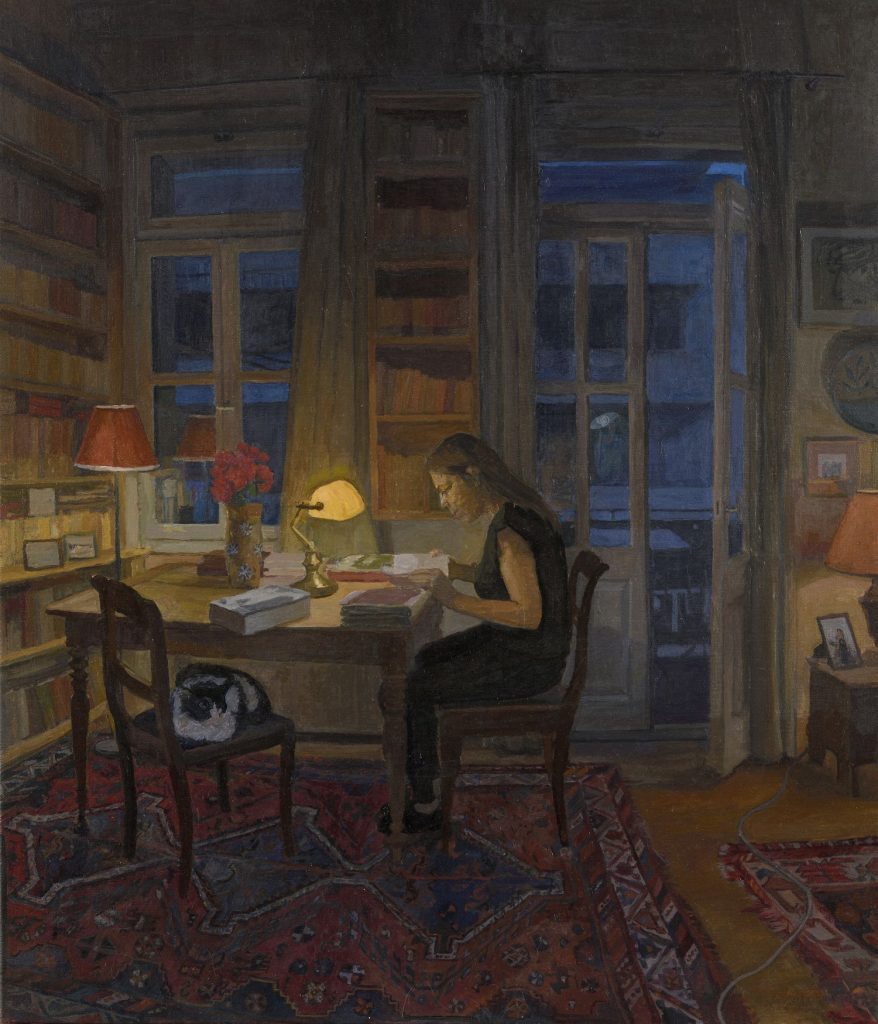
Leda Kontogiannopoulou/ Skoufa Gallery
“The night is my partner,” she explains. “I always like to work at night. Daylight, especially in Greece where it is dominant, is harsh. I love low lighting; it has its own theatricality and narrative.” It is no coincidence that blue dominates here; “as a representation of nocturnal light,” as she notes. A color that carries silence, spreading a protective veil.
The interiority of the works follows the prolonged research the artist conducted for her previous project, The House of Memory (2021, Benaki Museum). There, she worked on portraits of houses of important personalities such as Seferis and Tetsis, approaching their rooms not merely as spaces but as imprints of their lives. This exercise in observation left its mark on her new work as well: even the simplest objects in Nights are bearers of history, fragments of an undisclosed biography.
“Through the window of my kitchen,” she recounts, “I saw, besides what I truly see, memories of my childhood, dreams of my adolescence – and all of them merged and were recorded into a new, entirely fresh reality. It is like a game the present plays with the past.”
Kontogiannopoulou’s painting does not succumb to spectacle. It is restrained, graceful, but never cold. Her technique, meticulous to the last detail, reveals the finesse of Flemish still lifes, as well as the austerity of Japanese artistic philosophy.
She defends her “still lifes”: “To many, they seem outdated. I love them. For me, every object I choose to place in my composition has its own being. In that sense, I seek to distinguish it as something alive, because it is the bearer of its own story.”
The poet Giannis Antiochou notes that in her works, night is not an end but a beginning; shadows do not hide, but protect. Crystalli Glyniadaki, on the other hand, observes that the details in her paintings – a lamp, a rug, a book – function as traces of past lives. These two observations summarize the strength of her work: it is painting that narrates without raising its voice, allowing the viewer’s gaze to become a co-conspirator and co-creator.
Kontogiannopoulou recalls how her relationship with literature began: “My personal connections with writers and poets (G. Seferis, I.M. Panayiotopoulos) were the foundation for my path through art. Their spaces have been and remain a source of inspiration for me. And of course, my relationship with literature and poetry remains active always. After all, all the arts are related and interconnected.”
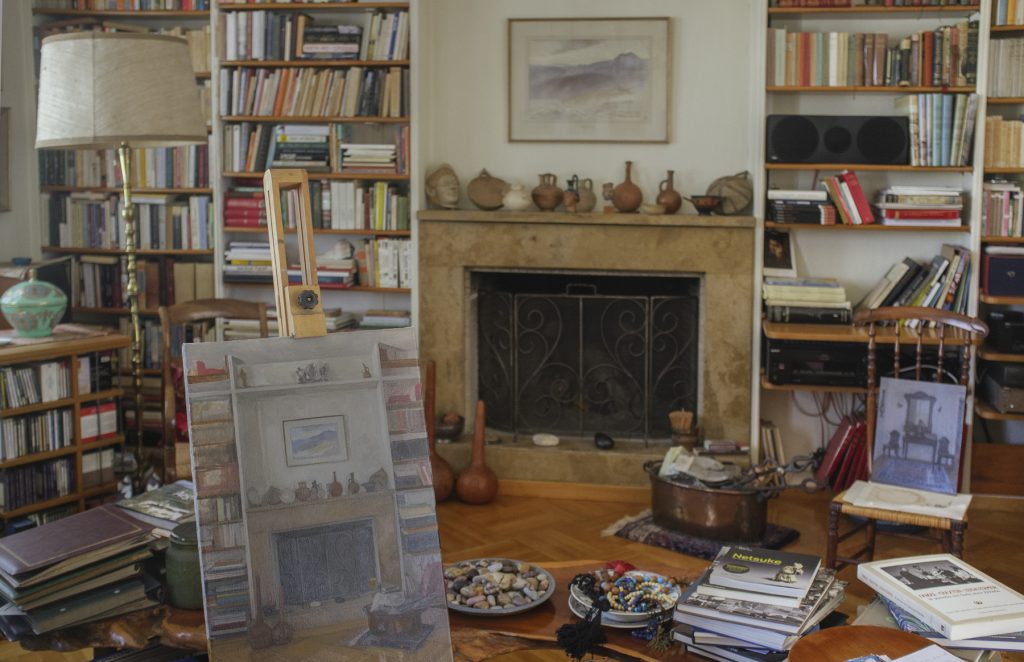
The artist’s painting at Giorgos Seferis’ home on Agras street.
Yet, despite her dedication, she is bitter about painting’s place in Greece today: “Unfortunately, the Greek state neglects the visual arts. In education, in art classes, parents and students, as well as the majority of teachers, view the subject as ‘playtime.’ The miracle of the 1960s, when Karolos Koun collaborated with Yannis Tsarouchis or Yannis Moralis, has sadly gone forever.”
Leda Kontogiannopoulou’s painting does not rush to be “consumed.” It does not need to. Since 2000, she has staged ten solo exhibitions, each of them a self-contained chapter in an ongoing quest. This attests to how carefully considered her works are: they are not products of rapid production, but the fruit of profound observation. And when the conversation turns to the future, the painter again looks to the past. Asked about her next creative challenge after Nights, she replied, “I want to return to my roots, to my family home. That space is a source of inspiration for me.”
In an era of constant noise and automated speed, where images are consumed instantaneously, Kontogiannopoulou offers the viewer an escape into quality time and reflection. Her paintings invite one to stand before them, to let one’s gaze be drawn into the blue of their nocturnal skies and the theatrical lighting of her interiors, to listen to the whispered stories of her objects and forms. As she says herself: if the night of her works could say something, the phrase would be this: “Stand still and listen to the silence.”
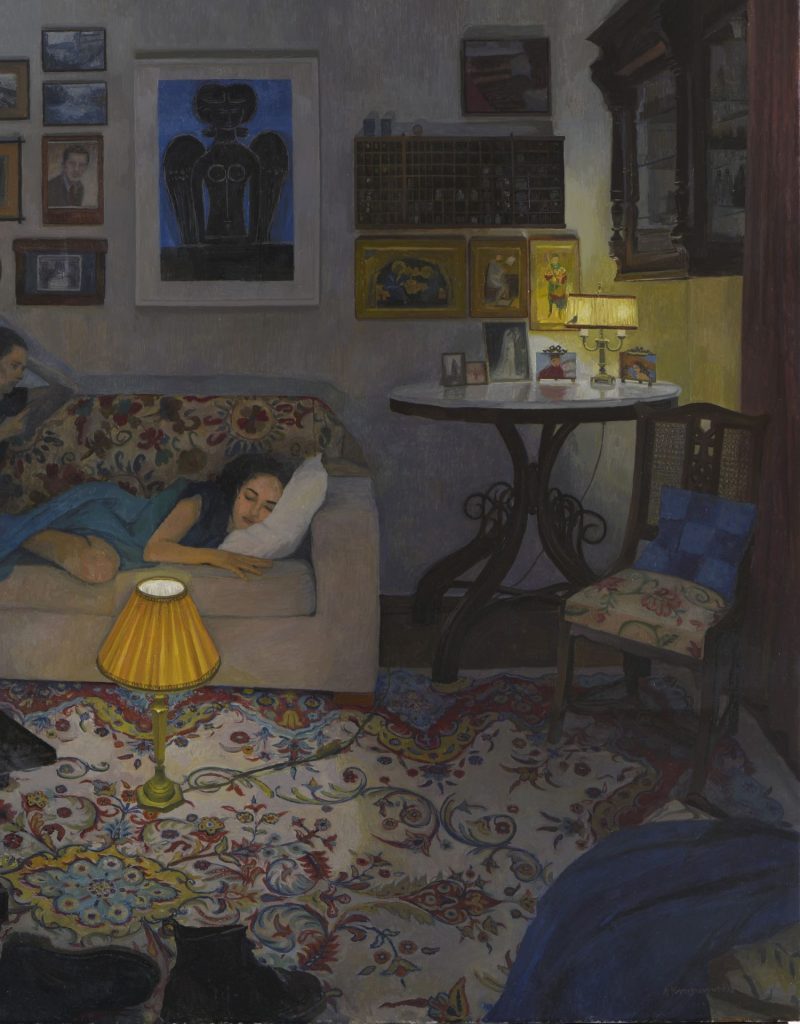
Leda Kontogiannopoulou/ Skoufa Gallery