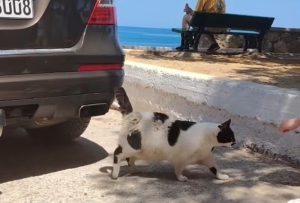
A cat lies dead on the road, its orange and white fur framed by a dark substance which, over time, seeps into the tiny grooves of the cement — a reminder that the circle of life often ends in blood, especially for stray companion animals.
The cat is near the garbage bins, which were likely one of its main options for finding food. Passersby, most of whom veer diagonally as soon as they see it, like chess pieces capturing the opponent, are informed by a woman (traditionally, from her balcony) that “they’ll pick it up soon.” “Poor little kitty…” some mutter, the shadow of their momentary sadness following them.
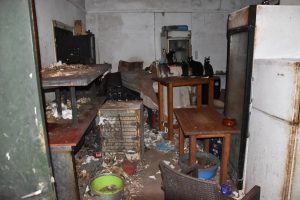
But where does a stray cat go after its death? Who exactly will pick it up and what does the law prescribe? Will it end up in a trash bin among plastic bottles and empty paper rolls, or in a special bag and from there to the crematorium? Unfortunately, the answer is: both. In the case of the capital, if a dead companion animal is found in Attica, the proper procedure is for it to pass through the doors of the Intermunicipal Center for the Care of Stray Animals (DIKEPAZ) in Schisto, Perama.
The citizen’s role and cremation
“It is tragic for someone to throw a dead cat into the trash,” says Grigoris Gourdomichalis, president of the Environmental Association of the Municipalities of Athens–Piraeus, referring to the bad — though mostly past — habit of people disposing of dead animals in garbage bins. “That’s why at DIKEPAZ we’ve had a cremator for many years, so that we can minimize this unacceptable phenomenon. Let’s not forget, it’s also a public health issue.”
DIKEPAZ, a service of the Environmental Association of the Municipalities of Athens–Piraeus that undertakes the care of stray animals, collaborates with 24 municipalities in Attica. “We function like a hospital for companion animals. We have our own ambulances, as well as the cremator,” explains Grigoris Gourdoumichalis.
According to the law, any municipality with more than 3,000 residents is required to have a shelter, a veterinary clinic, and a cremator, or to have a contract with a company that provides these services. There is, therefore, criminal liability for municipalities that fail to check off those three boxes.
As for the role of citizens in ensuring that stray city animals have a dignified end, it is small but extremely important: all they need to do is call their municipality or the Urban Fauna service, and from there the special crew will collect the animal and transport it to DIKEPAZ.
“We have large freezers and then we cremate the animal,” notes Mr. Gourdomichalis. “If a citizen wants to cremate a pet, they must pay — a transparent process. And even if a resident of Athens sees an injured animal, they must again contact their municipality.”
So far, approximately 60,000 stray animals have passed through DIKEPAZ, and as the president of PESYDAP says, “we also work on raising awareness. Schools come here so that children can take this knowledge back to their parents and peers, so that we don’t have, among other things, dead companion animals in the trash. They don’t deserve that.”
Few sterilizations, small budget
“The roughly one hundred stray dogs of Athens do exist, but they are no longer on the streets,” says Olga Dourou, Deputy Mayor of Active Ageing, Urban Fauna, and Animal Welfare of the City of Athens. “They are all in facilities, though new ones come in daily, either from prosecutorial reports or from abandonment.”
The mortality rate of stray dogs, according to the City of Athens’ official statistics for 2024–2025, has decreased by 17.09% compared to the period 2020–2023, while about 12 adoptions are carried out monthly.
Cats, however, are another story entirely, and their situation differs greatly from that of dogs. “There are truly far too many. We’ve increased the number of sterilizations by over 30%, but no matter what you do, when the City of Athens sterilizes about 500 cats a year and there are 1 million on the streets, it takes years to see any result. Their numbers have increased drastically; we cannot manage it.”
Last year, according to Olga Dourou, Urban Fauna received a total of 100,000 euros — an amount that does not cover its needs. “Our budget is over 1 million euros, and our real needs are many times that. This situation cannot continue.”
Eleni Kefalopoulou, vice president of the animal welfare organization Nine Lives Greece, believes that the situation with strays varies from municipality to municipality. “We see a difference in areas with sterilization programs or in those we monitor, like the historic center of Athens. There, animals are healthy and populations are controlled. This limits poisonings and abuse. But some municipalities do nothing, and there the situation is out of control, with animal lovers struggling.”
The dangers of illegal burials
In the Alsos of Chorafyliaki, in Kaisariani, on Hymettus, and in other areas, illegal burials of both owned and stray companion animals have been observed. “People go to gardens, ravines, or mountains and bury the animal with a few stones. After a while, the animal ends up above the ground’s surface. This should not happen,” says Theodoros Seferopoulos of the private cemetery and crematorium Animal Cemetery.
“We are pet owners ourselves; we know what loss means. We try to raise awareness, to convince people that a little cat shouldn’t end up in the garbage. Especially for stray animals that have suffered all their lives — someone should contact us. The prices are absolutely reasonable and realistic,” Mr. Seferopoulos concludes.
For Elena Dede, founder of the nonprofit Dog’s Voice, “public awareness about the dangers of burying a dead animal in parks must be strengthened. The public health risk is high. But beyond awareness, solutions are needed. I believe the City of Athens has many more capabilities than it is currently using.”