Moka presses her nose to the ground. Then her front paws dig into the soil. Within a few seconds, she traps something that looks like a stone between her teeth. With her tail triumphantly wagging to the right, she runs to the man waiting for her and drops it into his palm. It is just after seven in the morning, the sun’s rays begin to form the first cracks of light through the earthy palette of the forest, and Nikos Tsilis, with the help of his trained Springer Spaniel, places the first truffle of the day into his basket.
“It started as a hobby, although today I make a living from it,” says 33-year-old wild mushroom and truffle collector from Prespes, Nikos Tsilis. “Even if I weren’t paid, I would still do it. It’s my psychotherapy. I look for excuses to be in the forest. Just think—I even started keeping beehives.”
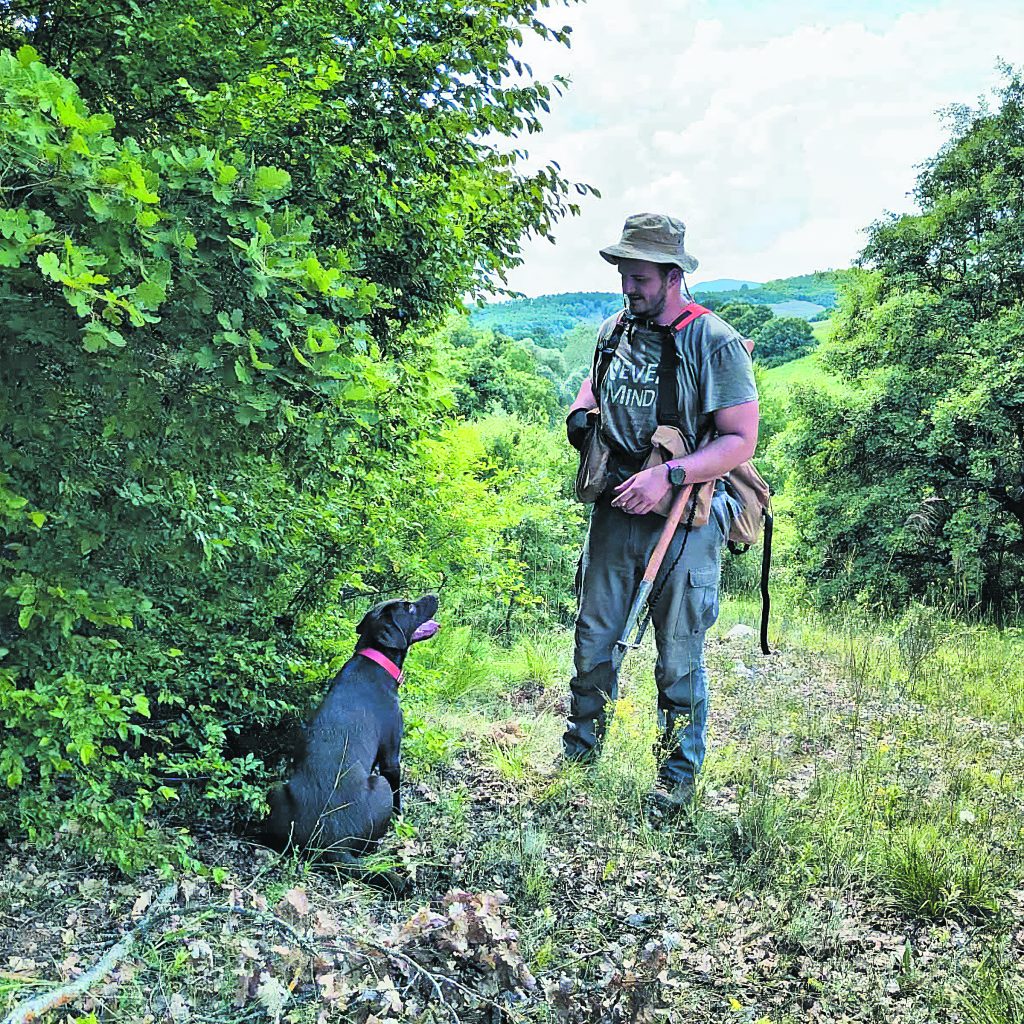
Nikos Tsilis began his journey into the world of mushrooms on his own ten years ago, without help, training his dogs himself. Since then, he has devoted himself entirely to the craft and can confidently say he has dedicated his life to mushrooms. Nowadays, he travels as far as four hours away from Prespes to locate truffles in Macedonia, Thessaly, and Epirus. “When we’re talking about commercial species, I try to secure an order in advance. I don’t like going and then not knowing what to do with the truffles afterward. We must respect the habitat.”
A very important moment, Nikos says, was his encounter with the Mushroom Lovers of Greece association, because his hunts began to serve two purposes: his livelihood and research. “As many times as I go out for marketable truffles, I go out just as often for recording and research—the scientific side of mushrooms. That’s something important, and I learned it from the Mushroom Lovers.”
The Case of Grevena
Since 2007, Grevena has been known as “the city of mushrooms.” In fact, the largest mushroom festival in Europe is held there. And since 2018, according to the president of the Mushroom Lovers of Greece, Giorgos Konstantinidis, “we train, examine, and certify people who are interested in professional involvement.”
The association was founded in 2012, and in their case, mushroom hunting has many facets. “We look for edible mushrooms. Some people keep them, others share them, and others sell them. Some members also collect samples. But we always end up celebrating together. After the hunt in the Grevena Pindos mountains, we all gather and cook—with mushrooms as the main ingredient.”
Giorgos Konstantinidis’s involvement with mushrooms began when he realized that “our knowledge ranged from minimal to almost nonexistent.” So, he collected a solid bibliography, studied, went out into the field for identification, and eventually wrote his own books. “About twenty-three years ago, I attended a seminar in Grevena—the hall was full. That’s how the idea for the Panhellenic Mushroom Festival was born, which now takes place every year.”
A Mycophobic Nation
Interest in mushrooms has now increased in Greece, even though Greeks are considered among the most mycophobic peoples in Europe. “In 2018, we were invited to a conference in Italy, and they were impressed by the number of species we had recorded,” concludes Giorgos Konstantinidis.
In Greece, besides the “city of mushrooms,” there is also the “city of truffles.” Kalabaka, due to the rich presence of this precious fungus in the area, attracts global attention, with the Meteora Natural History Museum and Mushroom Museum organizing truffle-hunting excursions on horseback.
“We all gather and set off for the forest together,” says the museum’s president, Nikos Pallas. “There, our partners—truffle hunters, truffle dogs, guides, and chefs—are waiting. At the end, they prepare truffle-mushroom pasta, and we drink wine.” These excursions are in high demand, and many participants book a year in advance—not only from Greece but from all over the world. “We are one of the most award-winning museums,” Pallas notes. “That’s thanks to our strong international outreach. The last major truffle festival brought 20,000 people to Kalabaka. It became the center of gastronomy.”
A Hunter Without a Dog
Truffle hunting—since truffles are underground mushrooms—usually requires a well-trained dog. Unless you are Panagiotis Kaounas. “I’m one of the first who dealt with underground mushrooms, and I realized they’re everywhere. I live in Artemida and even found them there. After analysis, it turned out to be a new recorded species.”
Panagiotis Kaounas was born in Zagora, Pelion, and in 1997 wrote his thesis on mushrooms at the Forestry Department of the Technological Educational Institute, where he learned about the scientific aspects and classification of fungi. “I started searching for underground mushrooms without a dog—by studying first. I wasn’t interested only in truffles or their gastronomic value. It’s enough for me that I contribute to their documentation.”
Today, Kaounas develops his bibliography together with Giorgos Konstantinidis and collaborates with institutions such as the Agricultural University of Athens, where it is well understood that fungi—beyond being tasty, and in the case of truffles, expensive—are the most important recyclers in nature.
“We’ve recorded over 3,000 species of mushrooms,” says Professor Georgios Zervakis, Director of the Laboratory of General and Agricultural Microbiology at the Agricultural University. “It’s work that has been carried out systematically for decades, in close cooperation with mushroom-lover associations, which help collect specimens.”
Regarding truffles, Professor Zervakis explains that they form symbiotic relationships, “so they always grow close to some root system, underground.” Until, of course, a nose detects them, two paws dig them up, and a mouth carries them to the palm of Nikos Tsilis—and from there, onto our plate.