The recent vitriolic attack of the Russian Foreign Intelligence Services (SVR, under Russian President Vladimir Putin’s direct oversight)) against Ecumenical Patriarch Bartholomew was completely in line with a long string of similar attacks of Patriarch Kirill of Moscow and All Russia, as well as of the Russian foreign ministry, ever since Bartholomew granted autocephaly (self-governance or independence, from Moscow in this case) to the Orthodox Church of Ukraine (with a Tomos – a canonically weighty official decree of independence) signed at the patriarchal seat of the Phanar in Constantinople on January 5, 2019.
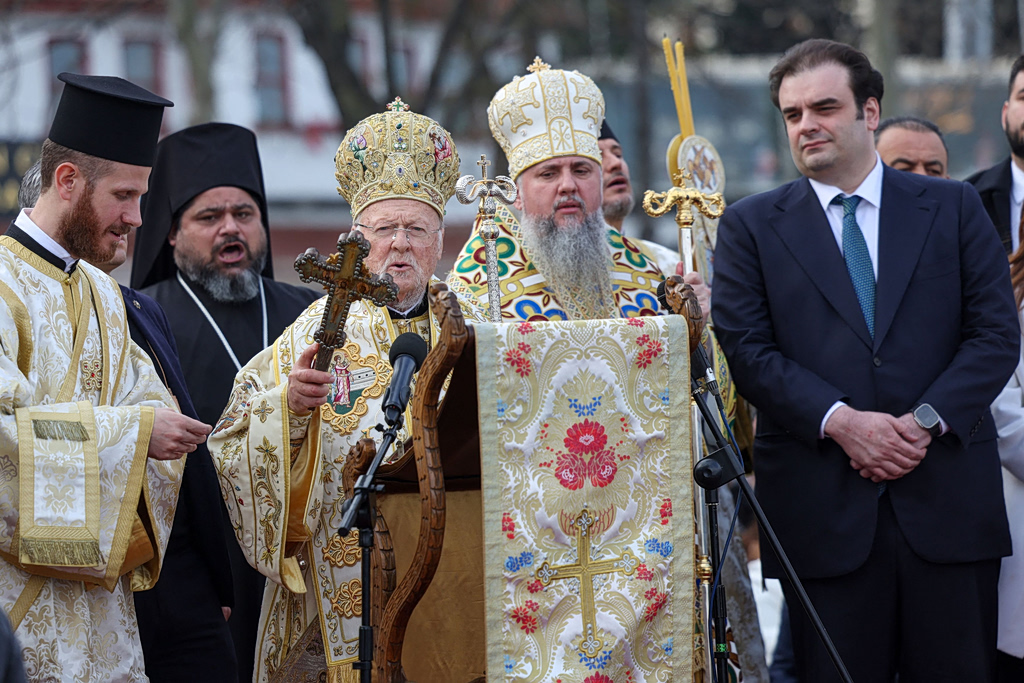
Ecumenical Patriarch Bartholomew I, accompanied by Metropolitan Epiphanius I, head of the Orthodox Church of Ukraine, and Greek Finance Minister and President of the Eurogroup Kyriakos Pierrakakis, leads Epiphany Service by the Golden Horn in Istanbul, Turkey, January 6, 2026. REUTERS/Murad Sezer
That move came five years after Russia’s annexation of Crimea and following decades of pleas from a (strong minority) segment of the Orthodox faithful of Ukraine to leave Moscow’s jurisdiction.
If anything, Bartholomew, in assessing calls for church independence, exhibited extreme caution and restraint over a very protracted period, in the hope of forging some sort of reconciliation.
The Moscow-linked (putatively autonomous) Ukrainian Orthodox Church (UOC), led by Metropolitan Onufry, was formed in 1990, and the new autocephalous Church, led by Metropolitan Theofaniy of Kiev and all Ukraine, is called the Orthodox Church of Ukraine (OCU).
Simply put, Bartholomew’s decision to exercise his canonical authority to heed the call of Ukrainians who want to break free from Moscow’s jurisdiction and have an independent Church (especially now that Russia is destroying the country) substantially weakens a crucial tool in Putin’s bid to subjugate or exercise strong influence over former Soviet Socialist Republics that have long-established Orthodox Churches (Estonia, Latvia, and Lithuania).
These are part of what Putin, in the context of his forceful, neo-imperialist irredentism (beginning with Ukraine) calls “The Russian World”, a world of which his targets want no part.
Switching allegiances
Moscow’s war against fellow Orthodox Ukrainians – and the Moscow patriarchate’s ignominious endorsement and blessing of the war – has led many parishes in Ukraine to switch allegiance from Moscow to the new autocephalous Church. But they are a minority of only 18 percent.
Yet, the official registration of parishes does not tell the whole story regarding the stance of the faithful.
According to a 2024 survey (two years after Russia’s invasion of Ukraine) by the Kyiv International Institute of Sociology, 56 percent of Orthodox Ukrainians overall – including members of one of the schismatic (breakaway from Moscow) Churches operating in 1993 – said they identify as believers of the OCU, while only six percent identified with the UOC-MP (Moscow Patriarchate).
In the same poll, 80% of surveyed Ukrainians supported the law banning the activities of religious organisations connected to Russia, and 16% did not.
Longstanding divisions
The Orthodox faithful of Ukraine have been divided for over three decades (in 1993, after the fall of the Soviet Union, there were three jurisdictions).
The autocephalous OCU is headed by Metropolitan Epiphaniy I, who was elected by a “Unification Council” in Kyiv comprised of bishops and delegates from two older Moscow breakaway churches that merged into the OCU.
The Moscow Patriarchate-aligned church is the Ukrainian Orthodox Church (UOC), led by Metropolitan Onufry, is still linked to the Russian Church.
The ‘theology’ of Russian Intelligence, soft power
The symbiotic ties between the Moscow Patriarchate and state intelligence were well-established during the Soviet era, and these strong ties continued after its collapse, especially intensively under the rule of Vladimir Putin.
The extremely rich Moscow Patriarchate is a crucial element of Russia’s soft power internationally, especially in predominantly Orthodox countries in whose church affairs it has often sought to intervene.
‘Third Rome’ and the pretence of primacy
Centuries before the Bolsheviks, the Russian Empire and Church, following the fall of Constantinople and the end of the Byzantine Empire, developed a canonically unfounded and specious theory that Moscow is the “Third Rome”, successor state to the Eastern Roman Empire (Byzantium), which was the second.
Effectively, Moscow pretended (and pretends) to be the leader of Eastern Orthodoxy, in large measure due to the overwhelming size of its flock, as compared to the Ecumenical Patriarchate, and its wealth, a large part of which it uses to advance Russia’s geopolitical designs.
Orthodox theology and ecclesiology, however, is not based on numbers, but rather on ancient rights, hierarchies and privileges.
Eastern Orthodox conciliar decision-making
Unlike Roman Catholicism, the Eastern Orthodox Church operates under a synodal (conciliar) system.
It is comprised of 17 autocephalous (independent and self-governing Churches). They have a specific hierarchy, with the Patriarch of Constantinople being the first-ranking –as stipulated by canon 28 of the Fourth Ecumenical Council (451 AD).
Though this is a primacy of honour that makes the ecumenical patriarch “first among equals”, he is also invested by church canons with a unique and crucial coordinating role in the Orthodox world. That includes the authority both to grant and revoke autocephaly.
In Russian Church, Putin is the boss
Bereft of any theological or canonical basis, Russia’s Foreign Intelligence Service (SVR) communiqué reveals who is the boss in using the Moscow Patriarchate as a geostrategic tool.
It is none other than Vladimir Putin.
For him, church affairs in Ukraine, the Baltics, and other countries are first and foremost an issue of geopolitical power and influence.
In Putin’s geostrategic expansionism – with ongoing efforts to deepen Moscow’s influence in parts of the former Soviet Union, from Ukraine and Belarus to the Baltics – ecclesiastical politics is a critical linchpin.
The diatribe released by the SVR expresses an untrammelled rage over the Ecumenical Patriarchate’s exercise of its canonical rights.
Putin views Bartholomew as impeding his neo-imperialist vision, and that is not far from the truth, even if it was not the patriarch’s goal.
Ukrainian Autocephaly and Orthodox divisions
Though Bartholomew indeed exercised a clear canonical right, his decision has divided the 17 autocephalous Churches of Eastern Orthodoxy.
Only three of them, all Greek-speaking – the Patriarchate of Alexandria (second only to Constantinople), the Autocephalous Church of Cyprus, and the Autocephalous Church of Greece – have recognised the autocephaly of the Ukrainian Orthodox Church.
Some are still wavering, years after the issuance of the Tomos of independence, but the forecast is not good.
This represents a major conundrum, not only for Constantinople, but for the entire Orthodox world.
Currently, there is no clear path to healing and reconciliation. Beyond geopolitics, that is tragic for all of Eastern Orthodoxy.
A desperate demonisation directed at the faithful
The Russian Intelligence Service in an extremely irate manner resorted to pseudo-theological epithets -extraordinary for either a state agency or an ecclesiastical entity – in a coarse attempt to turn the faithful in Ukraine and the Baltic states against Bartholomew.
Desperate demonisation a bid to sway the faithful
“Now [Bartholomew] has set his dark eye on the Baltic states. This “devil incarnate” is obsessed with ousting Russian Orthodoxy from the Baltic states, establishing in its place church structures completely under the control of the Phanar,” the SVR declared.
“Relying on ideological allies in the form of local nationalists and neo-Nazis, he is attempting to tear the Lithuanian, Latvian, and Estonian Orthodox Churches away from the Moscow Patriarchate by luring their priests and flocks into the puppet religious structures artificially created by Constantinople,” its statement said.
Now, what are the facts?
The case of Estonia
Estonia has two Orthodox jurisdictions. The Estonian Apostolic Orthodox Church (EAOC) is an autonomous church under the Ecumenical Patriarchate. The Phanar elects its primate and the local Synod elects the bishops.
The other is the Estonian Orthodox Church of the Moscow Patriarchate. Following Russia’s invasion of Ukraine, it has pursued de facto independence in 2024 – 2025 from Moscow, seeking to align with Constantinople.
Baltic states’ governments want Moscow out
As in other cases, it was the Estonian government that legislated to sever church ties with Moscow, even as the horrors of Russia’s attack on Ukraine unfolded.
“No church, congregation, monastery or religious organisation operating in Estonia may be organisationally or financially linked (through statutes, contracts, documents, or economic arrangements) with a spiritual centre, governing body, religious association, or religious leader located abroad, if that foreign entity poses a threat to Estonia’s national security…” That means Russia.
The Moscow’ Patriarchate’s fervent support and official blessing of Putin’s slaughter of fellow Orthodox Christians in Ukraine (which one might expect from a long arm of the Kremlin) has alienated the Orthodox churches in countries formerly part of the Soviet Union, and even more so their governments, who fear Russian geopolitical aggression and want to uproot the religious influence of Moscow in their countries.
Estonia, Lithuania and Latvia are EU members and acceded to NATO in the Alliance’s 29 March, 2004 eastward expansion. The accession was a clear move to protect themselves from Russian aggression.
Latvian leadership and autocephaly
Bartholomew visited Latvia in September, 2025. The country’s Orthodox Church in 2023 legally separated from the Moscow Patriarchate by a law passed that year.
In his meetings with the president and prime minister of Latvia, Bartholomew was asked to grant autocephaly, according to a reliable source with knowledge of the discussions.
There has to date been no indication whatsoever that Bartholomew intends to move in that direction. This governmental request, however, indicates how Moscow conflates the objectives of governments of Baltic states with those of Bartholomew.
Cutting the Gordian knot of Ukraine
The granting of autocephaly to Ukraine was a bold and risky move to cut the ecclesiastical Gordian knot in a country that has faced an abnormal canonical situation since 1992, with three competing local churches within the same territory.
Moscow’s ‘holy war’: Orthodox killing Orthodox
Metropolitan Epifaniy, the head of the autocephalous church of Ukraine, while on a visit to the Phanar on 5-6 January, addressed the Russian Church’s stance from the beginning of the war.
“Not only did they fail to condemn the aggression, but they also began to endorse the war against Ukraine through their Patriarch and many others, calling it a “holy war.”
In Ukraine, the conflict deepened when Patriarch Kirill publicly blessed Russia’s war, framing it in spiritual terms and promoting the ideology of the “Russian world,” which Ukrainian church leaders have condemned.
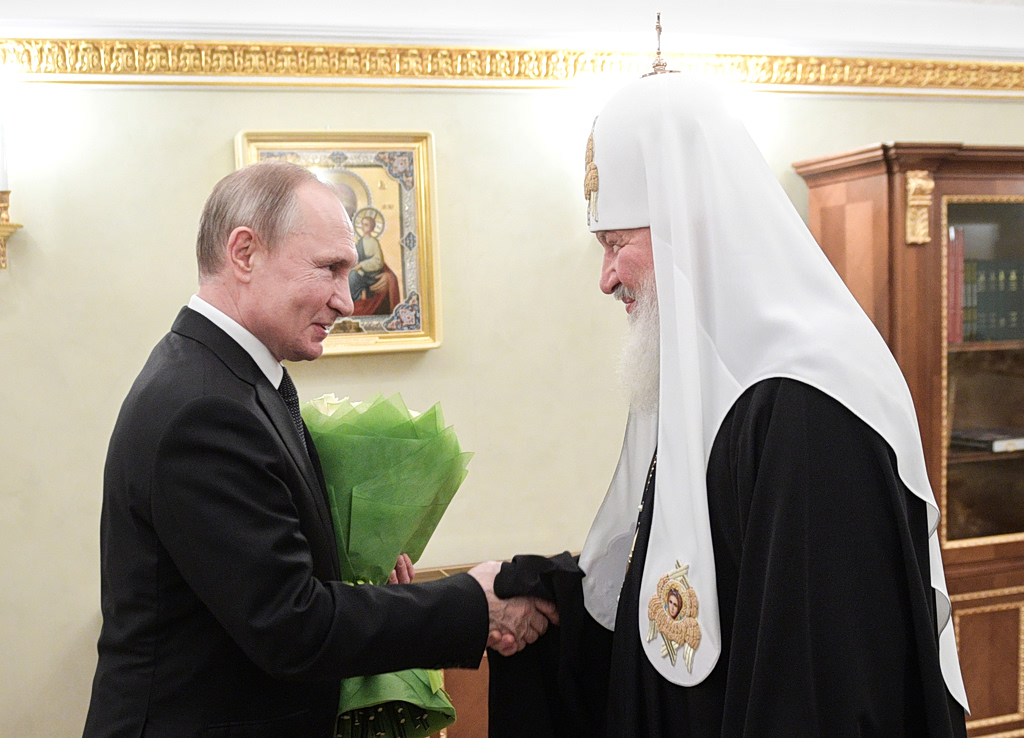
Russian President Vladimir Putin congratulates Patriarch Kirill of Moscow and All Russia on the day of the 11th anniversary of his enthronement in Moscow, Russia February 1, 2020. Sputnik/Alexei Druzhinin/Kremlin via REUTERS
Kyiv responded by investigating Moscow-aligned clergy for collaboration with Russia and passing laws allowing an Orthodox Church to be banned if it is proven to be institutionally tied to the Russian Church.
Moscow’s foreign ministry denounced these actions as religious persecution and forced “Ukrainisation.”
Violent clashes over ownership of churches, property
In August, 2024, two-and-a-half years after Mocow’s invasion of Ukraine, Kyiv passed a law essentially banning all churches with legal “ties” to Moscow.
Since the granting of autocephaly, and particularly since the implementation of the law, there have been violent clashes arising from the push of the believers of the autocephalous Church (backed by state authorities, to seize a large number of an estimated 8,000 Moscow-affiliated Orthodox churches.
The results have been paltry.
Only about 1,400 hundred parishes have officially joined the autocephalous OCU.
Moreover, state security authorities have aggressively supported OCU faithful in their violent forays to seize control of churches.
Bartholomew now urges restraint by Ukrainian authorities
On 15 January, Bartholomew publicly advised Ukrainian authorities to refrain from intervening in church affairs.
“We are inviting unity, while apologising if our silence gave the impression that we held any perspective other than an ecclesiastical one.”
That appears to have been an oblique reference to the fact that the Phanar over several years did not take a public stand to condemn the violent internecine ecclesiastical strife.
In his 34-year tenure as patriarch, Bartholomew has rarely if ever issued a clear apology for anything.
“Our motives,” Bartholomew said, “were entirely ecclesiological. We were not guided by expediency, nor did we make a hasty or superficial judgment on this long-standing issue, as some have accused us.”
“As was our duty, we reviewed repeated, urgent appeals. But even before receiving these appeals, and beyond the responsibility arising from the urgent nature of the matter, we took the initiative to mediate and bring peace to all parties.”