Annus mirabilis or annus horribilis? What will 2026 be for the global order and, in particular, for Greek diplomacy? A year of miracles or disasters? Predictions remain rather uncertain. Over the coming year, the outcome of the Russia-Ukraine war will likely be decided, a development that could trigger a chain reaction across the European security system. Some also anticipate that the foreign policy of the United States regarding the Eastern Mediterranean will become clearer, potentially including an initiative to resolve disputes among the states of the region.
Simultaneously, according to statements by Prime Minister Kyriakos Mitsotakis and Foreign Minister Giorgos Gerapetritis, Greece and Turkey will attempt to resume high-level dialogue, with the next step being the meeting of the Supreme Council of Cooperation. Amidst these developments, Athens is called to further strengthen its position in the Eastern Mediterranean to address contemporary security challenges.
A senior diplomatic source told To Vima that a major challenge for 2026 will be taking additional initiatives, emphasizing that for Athens “the IMEC project, and therefore cooperation with Israel, is now a top priority.” An experienced member of the governing party with access to the Prime Minister’s office added: “The goal for 2026 is to further reinforce the country’s security—not only its deterrent capacity but also the areas of energy, cybersecurity, and information networks.”
Acceleration of Negative Developments in Ukraine
As reported by To Vima, Athens is particularly concerned about the accelerating developments in Ukraine, since a settlement without de facto territorial concessions is unlikely to succeed. “Greece is affected because if force is imposed over legality, a fait accompli is created that will not go unnoticed,” said an independent observer close to the Prime Minister’s circle. This new reality does not suit so-called “status quo countries” that operate according to international law. “If everyone does whatever they want in their backyard, then why shouldn’t Ankara’s appetites be aroused?” he added, highlighting that international law alone no longer constitutes a comprehensive strategy.
Beyond concerns in the Foreign Ministry about changing borders through violence, there is also anxiety about the character of peace in Ukraine. “A humiliating treaty will hardly survive. The loss of territory would be a serious anachronism,” another source said, noting that “if it does happen, it breaks a European taboo. Hence our position is that any decision must be made with Ukraine at the table.” Naturally, Athens, like other regional actors, is not in a position to decisively influence developments, as only the major powers are now in the room.
Additionally, the Greek government is already facing the reconfiguration of the European security architecture, particularly regarding Turkey’s enhanced role both in the EU’s defense autonomy initiative and more broadly. For now, a government source notes: “Ankara is following a strategy of uncertainty. It cannot rejoin the F-35 program, where Greece is already included, it is finally outside SAFE, and it does not know how to handle the fact that Greece is becoming an energy hub under U.S. auspices.”
“Major Decisions” or “Under the Radar”?
In 2026, Donald Trump enters the second year of his term, and in the capitals of countries around the Eastern Mediterranean, some are waiting for official moves from the White House. The goal? To overcome long-standing problems so the region can become a manageable field for national and primarily American interests.
Although this scenario may seem difficult to implement, vigilance prevails within the Greek diplomatic corps. At the same time, the Prime Minister’s Office conveys that the relationship with Washington is “better than ever.” Within the first weeks of the new year, Athens is accelerating its moves, reactivating Greek-Turkish dialogue, and promoting an initiative to convene a five-party conference including Cyprus, Egypt, Libya, and Turkey.
Both options aim, beyond substance, to show that Greece is willing to sit at the dialogue table and to preempt external initiatives. Regarding possible U.S. intervention, the government has communicated that while American interest is welcome, Greek-Turkish disputes are addressed bilaterally. Notably, in his last public statement, Minister Gerapetritis identified mutual “political will” for Athens and Ankara to proceed “toward a more definitive resolution of issues (…) Because as long as the major underlying issue—maritime delimitation—is unresolved, tensions will persist” (Sky 100.3). This is despite the fact that in November 2024, he stated jointly with Hakan Fidan that no mutually acceptable framework exists for maritime zones. According to planning, the next round of political consultations and the positive agenda is scheduled for January 20–21, in preparation for the Supreme Council of Cooperation, to be held in Ankara by March 2026.
What has changed since last November, beyond increased fluidity and more active U.S. interest in the region? Around the Foreign Ministry, two approaches are observed: According to the first, in the spirit of acceleration, 2026 should see readiness “for major decisions,” including, of course, compromises—a term Minister Gerapetritis used at the last IDIS conference. According to the second approach, following a more static rhythm, the desirable outcome is for “Greece to continue moving under the radar”: maintaining “calm waters” with Turkey, contributing to the Western alliance as a “predictable partner,” and avoiding involvement in settlements, especially under Trump’s influence.
“We must raise the country’s overall ‘shares’ in the Western ‘stock market.’ We must build a position from which we can negotiate concessions, be flexible, but in no case submissive toward Turkey. Deterrence is valued; ambiguity is not,” a senior official in the Prime Minister’s team told To Vima, noting that since no one knows if the Americans will reveal their hand, Athens must work on multiple scenarios.
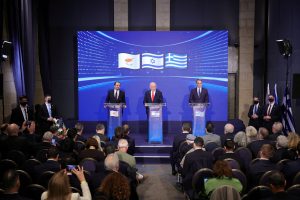
If the government’s strategy is to strengthen its relationship with Israel, both bilaterally and in the 3+1 format with Cyprus and the U.S., while maintaining constructive dialogue with Turkey, it must walk a tightrope. The accelerated confrontation between Netanyahu and Erdoğan immediately after the trilateral meeting in Jerusalem offers the clearest evidence. “We do not want Turkey under pressure, but we will strengthen our own strategic position,” the senior diplomatic source succinctly responded. No one should forget that 2026 is an election year for Greece, and in such cases, the logic of caution prevails.