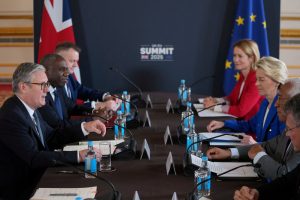
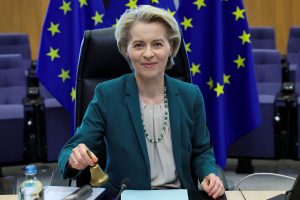
All eyes will be on Brussels tomorrow, where, after months of intense negotiations, the European Commission will unveil its proposal for the next Multiannual Financial Framework—the Union’s long-term budget covering the years 2028 to 2035.
The new financial framework is being watched with great interest, as it comes at a time of heightened geopolitical developments. Member states have decided to significantly increase defense spending in order to better shield themselves from external threats.
The Big Bargain
Although the preparation for the MFF announcement has, by all accounts, been marked by extreme secrecy—a fact analysts say exemplifies Ursula von der Leyen’s consolidation of power and the influence of her powerful chief of staff, Björn Seibert—information suggests that the negotiations were extremely tough across a range of issues.
According to a document revealed by POLITICO, Ursula von der Leyen made a series of last-minute concessions in an effort to appease two members of her Commission from opposite ends of the political spectrum: the right-wing Italian Raffaele Fitto and the Romanian socialist Roxana Mînzatu.
Von der Leyen’s willingness to compromise clearly reflects the fragile balance she must maintain to keep all members of her Commission on board, while also presenting a spending plan that can gain approval from both the European Parliament and all 27 national governments—whose unanimous support is required before the budget can be adopted by the end of 2027.
Her concession—ensuring that the Commission will continue allocating a significant share of funding to poorer regions in Europe from 2028 onwards—is considered sufficient to secure the political support of the EU’s 27 Commissioners, according to two EU officials speaking to POLITICO.
The Concession and the Original Plan
“The regional dimension has not been completely lost in the budget proposal,” said an EU official, referring to von der Leyen’s decision to back away from her original plan to significantly increase the power of central governments in managing the EU’s regional funds, which currently amount to €400 billion—roughly one-third of the bloc’s total spending.
The idea had been that strengthening national capitals at the expense of regions would serve as an incentive for implementing reforms and reducing bureaucracy. However, critics warned that such a move would only exacerbate existing inequalities within countries by sidelining regions from the decision-making process.
Two Key Questions
The current MFF (2021–2027) totals €1.2 trillion—about 1% of the EU’s GDP (excluding post-pandemic recovery funds)—and few expect this amount to change dramatically.
Instead, emphasis is expected to be placed on smarter spending and better prioritization.
Initially, the Commission considered structuring the next MFF around three main pillars: one for national funding covering agriculture and cohesion funds; another for competitiveness, innovation, and strategic investments; and a third consolidating all external instruments.
Although insiders suggest there have been some adjustments since then, the push for radical simplification remains intact. “Still, we expect surprises,” said a source inside the Commission.
It’s worth recalling that the current seven-year budget already reduced the number of funding programs from 58 to 37 in the name of streamlining.
However, the Commission still sees room for further consolidation—and one major question is how drastic this simplification will be.
The other is how far the Commission can go in increasing its flexibility to reallocate funds.
The European Parliament’s ‘Red Lines’
As mentioned earlier, the Commission’s proposal will require approval by both the European Parliament and the member states, and it is highly likely that it will undergo several revisions and compromises before a final vote.
At a joint press conference earlier today, the two lead MEPs representing Parliament—Siegfried Mureșan from the European People’s Party (EPP) and Carla Tavares from the Socialists—outlined the issues that constitute “red lines” for the only EU institution directly elected by citizens.
According to them, the Common Agricultural Policy (CAP) and Cohesion Policy “must remain distinct and separate programs,” and they “expect the same level of funding” as in the current budget, “adjusted for inflation.”
Accordingly, the two MEPs rejected the idea of a single fund that would merge resources for agriculture and territorial development.
“Negotiations will not begin unless there is a clear distinction between the Cohesion Fund and Agriculture,” Mureșan and Tavares stressed—a joint EPP–Socialist stance that will be hard for the Commission to ignore.
Then there is the issue of numbers. While both MEPs acknowledged that the priority now is to agree on the structure of the next seven-year budget—meaning that specific figures will be negotiated later—they made their expectations clear.
Providing the same level of funding implies a demand of at least €386.6 billion for CAP and €392 billion for Cohesion, due to inflation. “These figures may be hard to secure in a framework where defense and competitiveness are top priorities,” Mureșan noted. “But still,” Tavares added, “it’s clear we cannot do more with less money.”