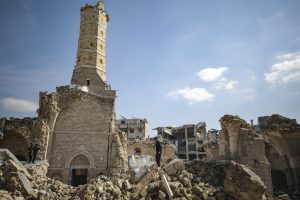
The second day of the ceasefire in Gaza has brought a mix of relief, grief, and deep uncertainty. As thousands of Palestinians are making their way back to Gaza City, many on foot, along roads choked with dust and debris, the scale of the destruction is overwhelming. Whole neighbourhoods lie flattened with little life left in them. For the people of Gaza who spent months displaced, often moving from one place to another, the return brings as much heartbreak as hope.
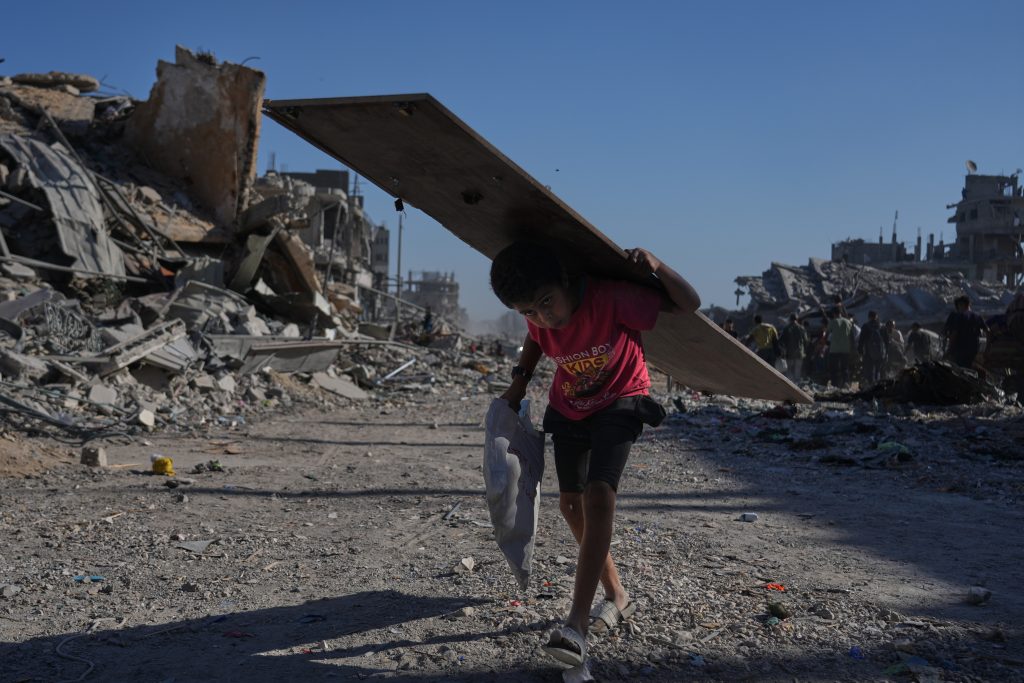
A displaced Palestinian boy carries a wooden board as he walks along the heavily damaged Al-Jalaa Street in Gaza City, Saturday, Oct. 11, 2025, after Israel and Hamas agreed to pause their war and release the remaining hostages. (AP Photo/Abdel Kareem Hana)
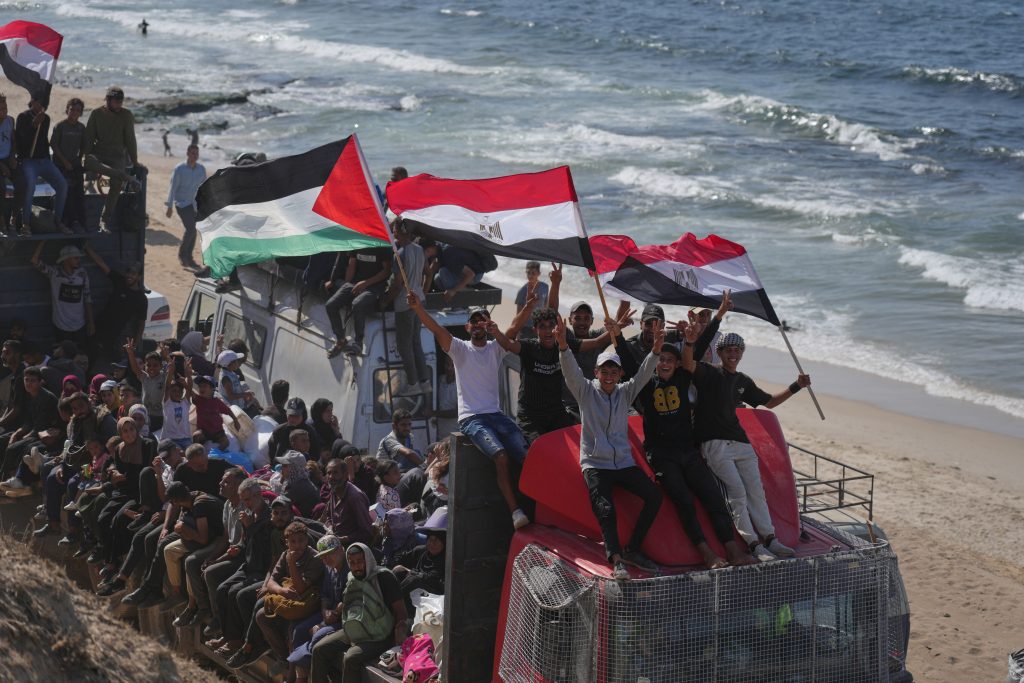
Displaced Palestinians ride on trucks loaded with belongings and wave Egyptian and Palestinian flags as they travel along the coastal road near Wadi Gaza in the central Gaza Strip, moving toward Gaza city, Saturday, Oct. 11, 2025, after Israel and Hamas agreed to a pause in their war and the release of the remaining hostages. (AP Photo/Jehad Alshrafi)
Some are sifting through the wreckage of their homes, searching for anything that survived, a photograph, a book, a child’s toy, to find nothing left. Medical teams are still uncovering bodies beneath the ruins, with more than a hundred recovered so far while over 9,500 Palestinians are still missing across the Strip. Gaza’s civil defence agency said that over 500,000 people have now returned to Gaza City since the truce began on Friday.
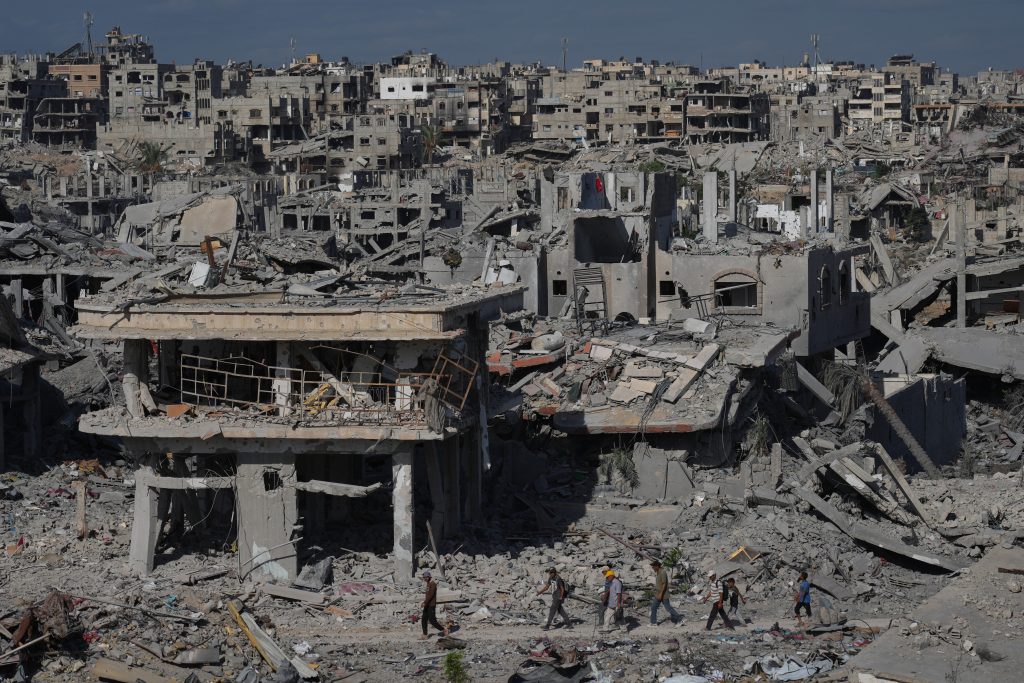
Displaced Palestinians walk through an area surrounded by destroyed buildings in Khan Younis, in the southern Gaza Strip, Saturday, Oct. 11, 2025, after Israel and Hamas agreed to a pause in their war and the release of the remaining hostages. (AP Photo/Jehad Alshrafi)
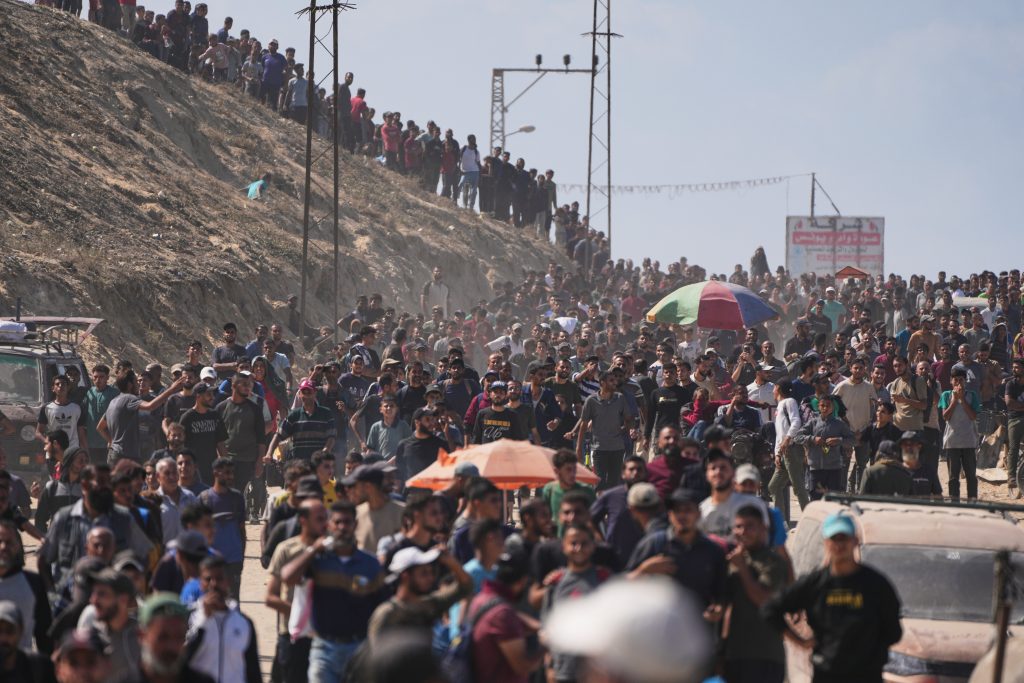
Displaced Palestinians walk along the coastal road near Wadi Gaza in the central Gaza Strip, moving toward northern Gaza, Friday, Oct. 10, 2025, after Israel and Hamas have agreed to a pause in their war and the release of the remaining hostages. (AP Photo/Abdel Kareem Hana)
The ceasefire has brought a fragile calm but little clarity. The agreement’s terms are vague, and few details have been released about how it will be implemented or who will govern Gaza once the dust settles. Uncertainty over the next phase of political control hangs heavily over the territory, adding to residents’ unease.
While Gazans pick through what remains of their homes, US President Donald Trump and his allies are hailing the ceasefire as a diplomatic breakthrough. He is expected to arrive in Israel on Monday morning, where he will be received by Prime Minister Benjamin Netanyahu and President Isaac Herzog before addressing the Knesset. Families of Israeli hostages, many critical of Netanyahu’s handling of the crisis, are due to meet the US president to express their gratitude for his role in brokering the deal.

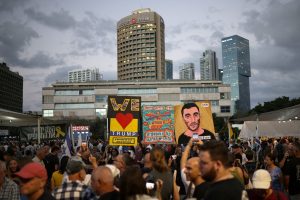
Holding up a sign with an image depicting the U.S. President Donald Trump a woman takes part in a rally in support of hostages kidnapped by Hamas at a plaza known as hostages square, in Tel Aviv, Israel, Saturday, Oct. 11, 2025, ahead of the expected release of the hostages held in the Gaza Strip. (AP Photo/Francisco Seco)
From Israel, Trump will travel to Cairo for a signing ceremony attended by several world leaders, including France’s Emmanuel Macron, Italy’s Giorgia Meloni and Spain’s Pedro Sánchez. Representatives from the UK, Germany and Qatar are also expected.
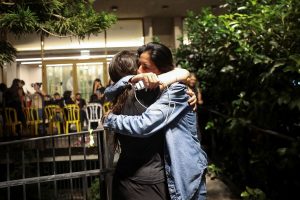
Israel has begun transferring prisoners to the Ofer and Ketziot facilities as part of preparations for the return of Israeli captives. The prison service said overnight operations were carried out by thousands of staff and that further steps await political approval. In Tel Aviv, there is a sense of palpable excitment and relief for the hostage families. Crowds have already gathered at Hostages Square for what they hope will be the last of the weekly rallies here calling for the release of the hostages.
Many people are holding the Israeli and US flags, and photos of the hostages who remain in Gaza.
Inside the enclave, Hamas is moving to reassert its control. Around 7,000 members of its security forces have been called back to duty, and new governors, all with military backgrounds, have been appointed to oversee key areas. Armed units have been seen patrolling several districts, some in uniform and others in civilian clothes. Hamas leaders have rejected calls for disarmament, insisting their weapons remain a tool of resistance “as long as the occupation continues.”
In a parallel development, the United Nations has resumed control over food distribution in Gaza, ending months of reliance on the Gaza Humanitarian Foundation (GHF), a body created by Israel and the US to bypass UN channels. Hundreds of UN aid trucks are now expected to enter the territory each day. Footage circulating online shows residents scavenging through the wreckage of former GHF sites, which have now been shut down. Prime Minister Netanyahu, who had previously maintained there was no food crisis in Gaza, has agreed to allow full UN oversight of humanitarian aid. The GHF, once central to Israeli strategy, appears to have been quietly dismantled.
As leaders will gather in Cairo to celebrate a tentative peace, Gaza remains on edge. The guns have fallen silent, but for many returning home to shattered streets and lost lives, the ceasefire feels less like an ending than a fragile pause in a story that is far from over.