Israel’s parliament on Monday passed a law introducing the death penalty, by hanging, for Palestinians convicted of deadly attacks in military courts, fulfilling a long-standing demand from far-right members of Prime Minister Benjamin Netanyahu’s governing coalition.
The legislation was promoted by National Security Minister Itamar Ben-Gvir and passed with 62 votes in the 120-seat Knesset. It mandates execution within 90 days of sentencing, with limited provisions for delay and no right to clemency, though it allows life imprisonment in unspecified “special circumstances.”

Israel’s far-right National Security Minister Itamar Ben-Gvir celebrates after Israel’s parliament passed a law on Monday making the death penalty a default sentence for Palestinians convicted in military courts of deadly attacks, at the Knesset, Israel’s parliament in Jerusalem, March 30, 2026 REUTERS/Oren Ben Hakoon ISRAEL OUT. NO COMMERCIAL OR EDITORIAL SALES IN ISRAEL
Law applies mainly to Palestinians in military courts
According to critics, the law will primarily apply to Palestinians tried in military courts in the occupied West Bank, where defendants can already be sentenced to death, although such sentences have not been carried out.
The legislation applies to cases involving attacks intended to “end Israel’s existence,” a provision critics say effectively creates a distinction between Palestinians and Jewish Israelis convicted of similar crimes.
International criticism and legal challenges
The law has drawn strong condemnation from international actors, including foreign ministers from Germany, France, Italy, and Britain, who warned it could undermine Israel’s democratic principles and appear “de facto discriminatory.”
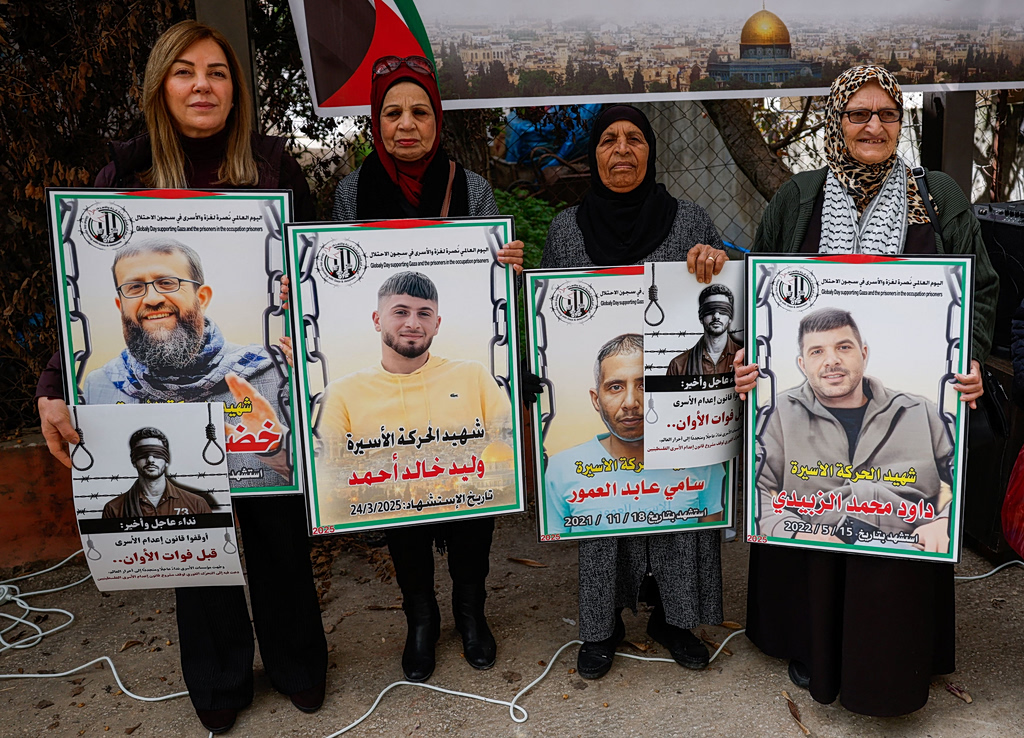
Palestinians hold placards as they take part in a protest against the execution of the Israeli death penalty law for Palestinians convicted of lethal attacks, in Ramallah in the Israeli-occupied West Bank, March 31, 2026. REUTERS/Mohammed Torokman
Israel’s leading human rights organizations also criticized the measure as discriminatory, and the Association for Civil Rights in Israel has filed an appeal to the country’s Supreme Court.
A group of United Nations experts said the legislation’s definitions of “terrorism” are vague and could allow the death penalty to be imposed for acts not genuinely meeting that threshold.
Palestinian leadership and armed groups react
Palestinian President Mahmoud Abbas condemned the law, calling it a violation of international law and an attempt to intimidate Palestinians. His office said it would not weaken Palestinian resolve or their pursuit of an independent state with East Jerusalem as its capital.
Militant groups Hamas and Islamic Jihad called for revenge attacks in response to the legislation.
Domestic political backing and controversy
Ben-Gvir described the vote as “a day of justice for the murdered” and said the law would strengthen deterrence. He has long supported the introduction of capital punishment and has previously been convicted of racist incitement.
Prime Minister Netanyahu backed the bill, though reports indicate he sought to soften certain provisions amid concerns about international backlash. The revised version allows life imprisonment as an alternative sentence.
Broader implications and legal uncertainty
Israel abolished the death penalty for murder in 1954, and the only civilian execution in its history was that of Adolf Eichmann in 1962. Legal experts within Israel have argued the new law may be unconstitutional, increasing the likelihood of a Supreme Court challenge.
Rights groups, including Amnesty International, say there is no evidence that the death penalty is more effective than life imprisonment in preventing crime. They also note that global trends continue to move toward abolition, with a majority of countries no longer using capital punishment.