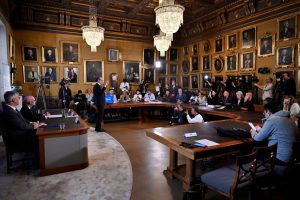
Hungarian author Laszlo Krasznahorkai has won the 2025 Nobel Prize in Literature for what the Swedish Academy described as his “compelling and visionary oeuvre that, in the midst of apocalyptic terror, reaffirms the power of art.”
As seen in Reuters, the Academy hailed Krasznahorkai as “a great epic writer in the Central European tradition that extends through Kafka to Thomas Bernhard, characterised by absurdism and grotesque excess.” It added that his work also draws on Eastern influences, adopting “a more contemplative, finely calibrated tone.”
A voice of Central Europe
Krasznahorkai, born in Gyula, southeastern Hungary, becomes the second Hungarian to win the Nobel Prize in Literature, after Imre Kertész in 2002. His 1985 breakthrough novel Satantango — later adapted into a film by long-time collaborator Béla Tarr — portrayed the bleak existence of villagers on a decaying collective farm during Hungary’s communist decline.
“The novel portrays, in powerfully suggestive terms, a destitute group of residents on an abandoned collective farm in the Hungarian countryside just before the fall of communism,” the Academy said.
Acclaimed collaborations and legacy
Krasznahorkai’s creative partnership with Tarr also produced the acclaimed film The Werckmeister Harmonies. His other celebrated works include The Melancholy of Resistance, which won the German Bestenliste Prize in 1993.
His books have been published in Greece for many years by Ekdoseis Polis, which congratulated the author on social media following the announcement of the award.
The literature prize, worth 11 million Swedish crowns ($1.2 million), is one of several Nobel awards founded in the will of Alfred Nobel, the inventor of dynamite. Previous literature laureates include William Faulkner, Orhan Pamuk, and Han Kang, who won last year.
While the Nobel Prize in Literature has often sparked debate — from Bob Dylan’s 2016 win to controversy over Peter Handke’s 2019 award — this year’s recognition of Krasznahorkai highlights the enduring influence of Central European literature and its reflection on humanity’s struggle amid despair.