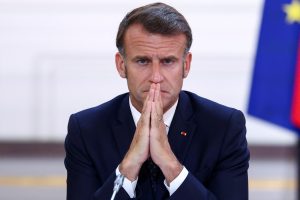
French President Emmanuel Macron has appointed Sébastien Lecornu as the country’s new prime minister, following the departure of François Bayrou after a failed austerity budget. At 39, Lecornu becomes Macron’s fifth prime minister in less than two years.
Lecornu, previously France’s defense minister, is a longtime Macron ally and considered one of his closest protégés. His appointment signals the president’s determination to push forward with pro-business reforms, including lowering corporate and wealth taxes and raising the retirement age.
Born in Normandy in 1986, Lecornu began his political career at just 19 and was once a member of the conservative Republicans before joining Macron’s movement in 2017. Known for his political resilience, he has remained in government through multiple reshuffles and is often described as a skilled political “survivor.”
During his tenure as defense minister, Lecornu oversaw a €413 billion military modernization plan and strengthened defense ties with Germany, particularly in the wake of Russia’s 2022 invasion of Ukraine. Despite his growing influence, he has kept a low public profile, often avoiding personal exposure in the media.
Macron’s choice has sparked immediate backlash. Far-right leader Marine Le Pen called the appointment “the final blow to Macronism,” while leftist leader Jean-Luc Mélenchon denounced it as “a sad comedy of contempt for Parliament.” Green leader Marine Tondelier also condemned it as “a provocation” and “a complete disrespect toward the French people.”
Le Président tire la dernière cartouche du macronisme, bunkerisé avec son petit carré de fidèles. Après les inéluctables futures élections législatives, le Premier ministre s’appellera Jordan Bardella.
— Marine Le Pen (@MLP_officiel) September 9, 2025
In contrast, conservative leader Bruno Retailleau welcomed Lecornu’s appointment, expressing willingness to cooperate in building what he called a “national majority.”
The handover ceremony between Bayrou and Lecornu is set to take place tomorrow at the Hôtel de Matignon. The timing coincides with large-scale protests organized by the movement Bloquons tout (“Block Everything”), widely compared to the “Yellow Vests,” raising tensions in an already polarized political climate.