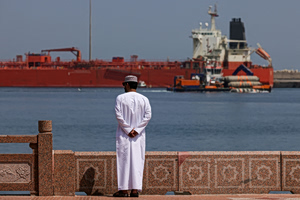
Oil prices surged more than 7% on Monday, with both Brent and US crude benchmarks climbing above $100 a barrel after Washington said it would begin blocking ships to and from Iran through the Strait of Hormuz.
The move followed unsuccessful negotiations between the United States and Iran to reach a deal aimed at ending the ongoing conflict, raising fears of renewed disruption to global energy supplies.
Prices jump as supply risks return
Brent crude futures rose $6.67, or 7.0%, to $101.87 a barrel, while US West Texas Intermediate gained $7.26, or 7.5%, to $103.83 a barrel.
The gains reversed recent declines and brought oil back into triple-digit territory as traders priced in heightened geopolitical risk and potential supply constraints from Iranian-linked exports.
US moves to enforce maritime blockade
US President Donald Trump said on Sunday that the US Navy would begin a blockade of the Strait of Hormuz, a key global oil transit route, after talks with Iran failed to produce an agreement.
US Central Command said the operation would begin on Monday and target maritime traffic entering and leaving Iranian ports, while stating that vessels transiting to non-Iranian ports would not be impeded.
The statement added that enforcement would apply to all ships regardless of nationality.
Iran warns against military escalation
Iran’s Revolutionary Guards warned that any military vessels approaching the Strait of Hormuz would be treated as violating the ceasefire and would be met with a “harsh and decisive” response.
The warning added to concerns that the fragile truce could collapse, further threatening global oil flows.
Markets react to renewed geopolitical risk
Analysts said the price spike reflected a rapid return of geopolitical risk premiums after brief optimism over a ceasefire.
“The market is now largely back to conditions before the ceasefire,” one analyst said, noting concerns that Iranian-linked oil flows of up to 2 million barrels per day could be affected.
Despite tensions, shipping data showed several oil tankers had still passed through the Strait, though many vessels were reportedly steering clear amid rising uncertainty.
Broader energy stability remains fragile
Saudi Arabia also said it had restored full capacity on its East-West pipeline, helping offset some regional supply concerns after recent disruptions.