U.S. President Donald Trump vowed to “do everything we can to make Syria successful” after landmark White House talks on Monday with Syrian President Ahmed al-Sharaa, the former rebel commander once labeled a terrorist by Washington.
The meeting marked the first-ever visit by a Syrian president to the White House, capping a dramatic year for Sharaa, who toppled longtime ruler Bashar al-Assad last December and has since led efforts to rebrand Syria as a unified, internationally engaged nation.
A muted welcome for a controversial figure
The visit unfolded with little of the pomp typical of state occasions. Sharaa — who once had a $10 million U.S. bounty on his head — entered through a side door rather than the West Wing entrance usually reserved for foreign leaders.
As reported in Reuters, Trump spoke to reporters as he described Sharaa as a “strong leader” capable of steering Syria toward stability. “We’ll do everything we can to make Syria successful,” he said, while acknowledging Sharaa’s militant past. “We’ve all had rough pasts.”
The U.S. Treasury Department simultaneously announced a 180-day extension of its suspension of enforcement of the 2019 Caesar Sanctions Act, maintaining a freeze on penalties tied to human rights abuses during Assad’s rule. However, Congress must act to repeal the sanctions entirely.
Syria’s rapid political realignment
Since taking power, Sharaa, 43, has steered Syria away from its former allies Iran and Russia and toward a new bloc involving Turkey, Gulf states, and the United States. His administration has moved quickly to restore ties with Western nations and joined the U.S.-led Global Coalition to Defeat Islamic State, signaling a dramatic geopolitical shift.
Security cooperation dominated Monday’s agenda. The U.S. is reportedly brokering a potential security pact between Syria and Israel, and planning to establish a military presence at a Damascus airbase, according to Reuters sources.
Assassination plots and security concerns
Hours before the talks, officials revealed that two Islamic State assassination plots against Sharaa had been foiled in recent months. Over the weekend, Syria’s interior ministry launched a nationwide operation targeting IS cells, arresting more than 70 suspects, state media reported.
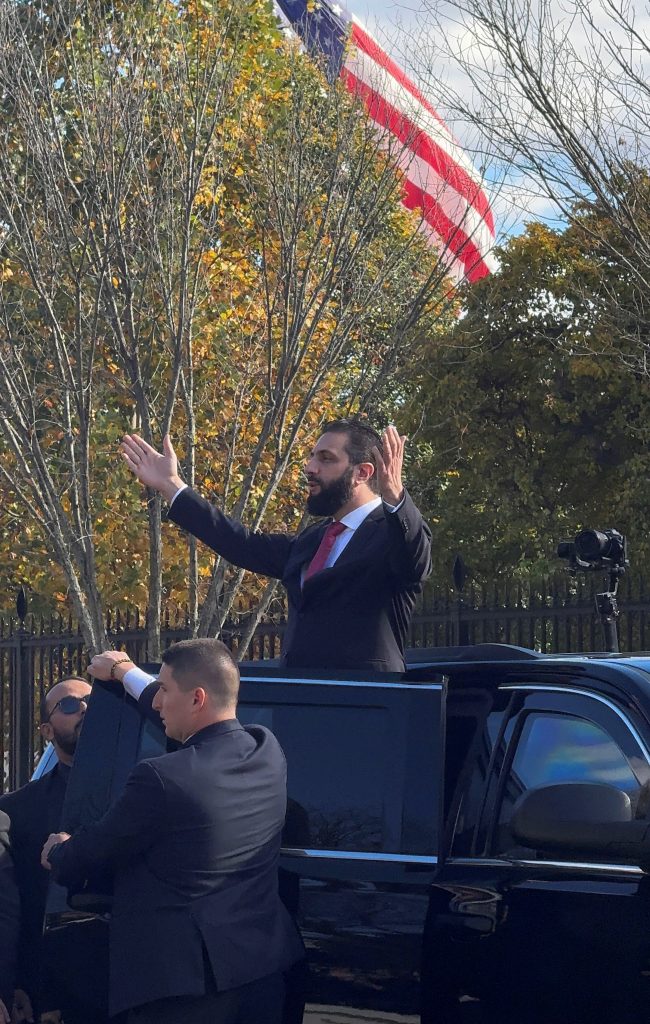
Syria’s President Ahmed al-Sharaa greets supporters after meeting with U.S. President Donald Trump at the White House in Washington, D.C., U.S., November 10, 2025. Lubna Allababidi/Handout via REUTERS THIS IMAGE HAS BEEN SUPPLIED BY A THIRD PARTY
As Sharaa left the White House, he briefly greeted a cheering crowd of supporters waving Syrian flags — a moment symbolic of his transformation from insurgent commander to head of state.
Sanctions debate in Washington
A key objective of Sharaa’s visit was lobbying for the repeal of the Caesar Act, which continues to deter foreign investment in Syria. The World Bank estimates that rebuilding the country after 14 years of war will require over $200 billion.
Several U.S. lawmakers, including some Republicans, have signaled openness to lifting sanctions if Syria continues its pivot away from extremist elements and authoritarian practices.
Following the meeting, Trump pushed back on criticism from Republican Representative Marjorie Taylor Greene, who argued that domestic issues should take priority. “I have to view the presidency as a worldwide situation,” Trump said. “We could have a world on fire where wars come to our shores very easily.”
From militant to statesman
Sharaa’s rise remains one of the most remarkable political transformations in recent Middle Eastern history. A onetime al Qaeda member and U.S. prisoner in Iraq, he broke ties with jihadist networks in 2016 and consolidated control over Syria’s northwest.
In December, the U.S. removed his terrorist designation, followed by the U.N. Security Council’s decision to lift sanctions against him and his interior minister, Anas Khattab.