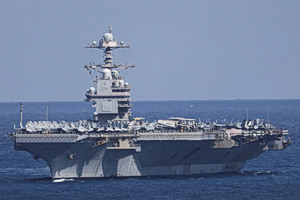
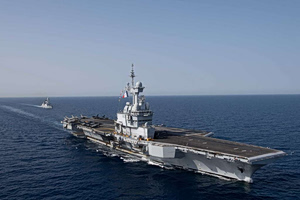
The U.S. Navy is investigating whether a fire that broke out aboard the aircraft carrier Gerald R. Ford last week was an act of sabotage by members of its own crew, according to an exclusive report by TA NEA.
Eight investigators from the U.S. Navy are expected to arrive Monday at the Souda Bay naval base on the island of Crete, where the carrier is scheduled to dock for inspection through Thursday, April 2. Once aboard, investigators will begin taking statements from officers and crew members believed to have relevant knowledge of the incident.
A Fire in the Laundry Room
The fire broke out on March 12 in the ship’s main laundry area — an industrial space housing high-capacity washers and dryers, steam systems, ventilation ducts and a linen storage room. Two sailors were injured, one of whom was transferred off the ship for medical treatment, while roughly 200 others experienced smoke-related symptoms.
The blaze left approximately 600 crew members without access to their regular sleeping quarters and forced the use of temporary accommodations. With the laundry facility out of service and smoke having infiltrated the ship’s ventilation systems, living conditions aboard deteriorated significantly in the aftermath.
According to the Pentagon, the ship’s propulsion system was not damaged and the carrier remained operationally capable following the fire. Nevertheless, the severity of the incident prompted the decision to return the vessel to Souda Bay for further inspection and investigation.
Sabotage Not Ruled Out
Preliminary inquiries have identified 20 crew members who had access to the laundry area at the time the fire started as persons of interest. Investigators are examining whether the fire was started deliberately — possibly by overloading the industrial dryers with an excessive amount of clothing, which could have caused overheating and ignition.
A possible motive under investigation is crew dissatisfaction. The Gerald R. Ford, which carries approximately 6,000 sailors, had reportedly been deployed continuously for months without the scheduled rest rotations that personnel are normally entitled to.
A Busy and Demanding Deployment
Before the fire, the Gerald R. Ford had been on a demanding operational schedule. The carrier had been deployed to the Caribbean in connection with a U.S. operation targeting Venezuelan President Nicolás Maduro, before heading directly to the Persian Gulf. It made only a brief stop at Souda Bay in late February, during which weapons systems and missiles were loaded, before transiting the Suez Canal on March 5 — the first time the ship had made that passage — and proceeding toward the Red Sea, where U.S. naval forces were already operating.