In a television landscape often driven by consumption and quantity over quality, one Greek series managed to stand apart this past week — not for its production scale, but for its courage and innovation.
The acclaimed drama Serres, written by beloved Greek screenwriter, actor, and presenter Giorgos Kapoutzidis, made history by introducing the first intersex character ever to appear on Greek television. It also marks the first time the word “intersex” has been spoken in a Greek TV production — a groundbreaking moment that sparked thousands of posts, headlines, and conversations across the country.
Giorgos Kapoutzidis: A Voice for Change
Few creators in Greece have shaped modern television as much as Kapoutzidis. Known for hit series such as Sto Para Pente — voted by viewers as the best comedy in Mega Channel’s 20-year history — he’s not only a skilled storyteller but also a public figure who consistently uses his voice to highlight stories from the margins.
As he once said in an interview with To Vima:
“The goal of my work is always to move people toward a better direction. My stories are written with love and kindness — and kindness, for me, is the greatest human virtue.”
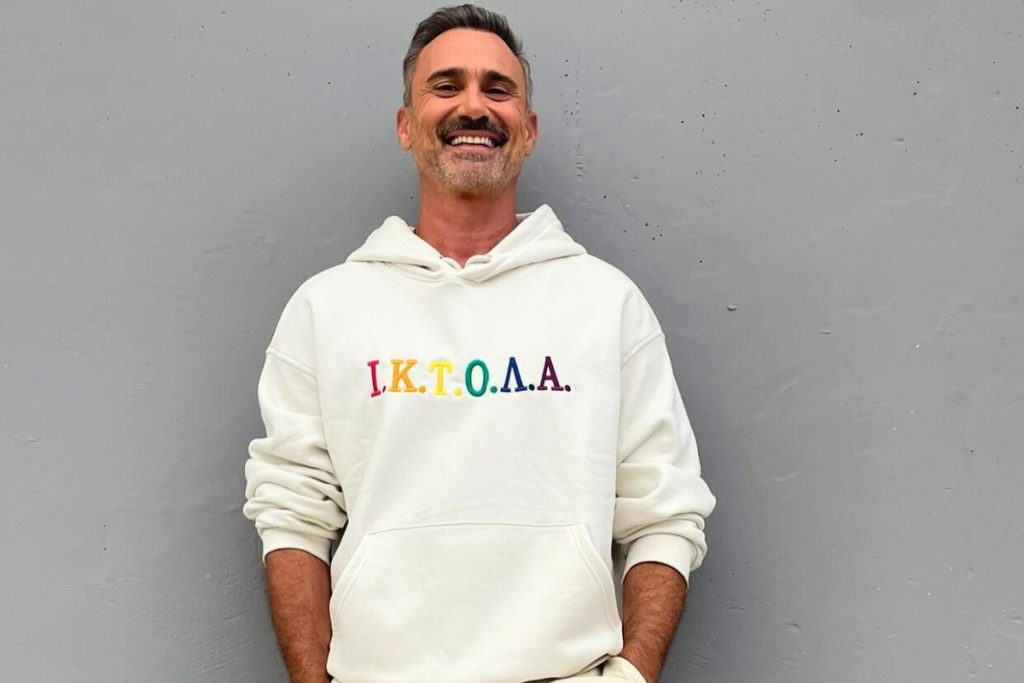
That philosophy runs through Serres, a show inspired by Kapoutzidis’ own hometown in northern Greece. Though not autobiographical, it’s deeply personal. “It’s the most personal thing I’ve ever written,” he has said.
Aunt Stamatina Is the “I” in LGBTQI
Now in its second season, Serres follows Odysseas, a young man living in Athens, estranged from his father Lefteris. When his mother dies, he returns home to Serres, where father and son — two strangers under the same roof — are forced to start again, navigating loss, love, and reconciliation.
In the eighth episode, a doctor’s visit reveals a secret that had been hidden for six decades: Lefteris’ sister, Aunt Stamatina, is intersex — something neither she nor anyone in her family had ever known.
In a moving scene, the doctor explains:
“Intersex people are those born with various natural variations in their sex characteristics. She was raised as a woman, but her anatomy is not exclusively female nor exclusively male — it is the anatomy of an intersex person. Unfortunately, no one ever told her, and you didn’t know either.”
Through this revelation, the audience learns alongside Stamatina — portrayed with warmth and humor by Giouli Tsagaraki — that intersex variations are a natural part of human diversity, which can be physical, hormonal, or chromosomal.
Later in the same episode, Stamatina comes across the term LGBTQI for the first time. In that moment, Kapoutzidis delivers a simple, heartfelt explanation of what each letter stands for — the kind of explanation one might give to an elderly aunt in a Greek village. It’s this mix of tenderness and directness that gives the scene its quiet power.
The episode resonated deeply with viewers. Social media lit up with praise and emotion:
“It’s a unique series! The messages are powerful — it puts you in someone else’s shoes in a magical way.”
“Intersex on Greek television — such a modern series, I can hardly believe it myself.”
As always, some online reactions veered into ignorance or hostility — but the overwhelming response was one of admiration and pride.
Intersex Greece: ‘A Moment of Historic Significance’
The scene was warmly celebrated by Intersex Greece, the country’s national collective of intersex adults, parents, allies, and professionals.
In a public statement, the group expressed its gratitude:
“The Greek Intersex Community expresses its deep gratitude to creator, screenwriter, and actor Giorgos Kapoutzidis for his decision to include an intersex character in the second season of Serres — revealing in the eighth episode that Aunt Stamatina, already beloved by the audience, is an intersex woman.
This is the first time that the term ‘intersex’ has been officially used in a Greek television production — a fact of historic significance for intersex visibility in our country. Through his moving and sensitive presentation of the subject, Giorgos Kapoutzidis contributes significantly to making our voice and truth heard, reaching more homes with respect, humanity, artistic responsibility, and scientific accuracy.”
The group also noted how the scene, in which Stamatina’s intersex variation is revealed by a doctor, subtly comments on the medicalization of intersex bodies — a mindset that still dominates much of the world, when in fact it is a completely natural and normal diversity in human sex characteristics.
The statement continued:
“Warm thanks, therefore, to the entire team for the completely realistic and inclusive result, and especially to the wonderful actress Giouli Tsagaraki, who plays the corresponding role. We already loved Aunt Stamatina, but now we have one more reason to love her.”
Positive and loving portrayals of intersex people remain rare in film and television. Historically, representations have ranged from stigmatizing stereotypes — portraying intersex people as medical anomalies, outcasts, or even villains — to a handful of more nuanced but still uncommon depictions.
“For the first time, I saw an intersex character on Greek television who is not ‘strange,’ ‘wrong,’ or ‘mysterious,’ but a person with love, humor, and strength,” said one community member. “Aunt Stamatina, as written by Giorgos Kapoutzidis, is not just a role; she is a light where for years there was silence — she is an ‘I see you’ to all of us who grew up without mirrors.”
The group concluded:
“Giorgos Kapoutzidis, we thank you warmly for helping our voice be heard more clearly and more widely through your voice and your work. The fight for intersex human rights continues with ever more meaningful alliances on our side. Nothing about us without us.”
The Fight for Visibility Continues
Intersex Greece is a nationwide collective led by intersex adults and parents of intersex children, supported by allies and professionals. The group works to promote visibility, inclusion, and accurate understanding of intersex physiology — and to secure full legal recognition and protection among others.
In July 2022, after months of collaboration with the Greek Ministry of Health, Intersex Greece achieved one of its most significant statutory goals: securing legal protection for intersex children against abusive “normalization” procedures. These interventions, often carried out secretly and without consent, aimed to make intersex infants’ and children’s bodies conform to “typical” male or female anatomy — practices that had long stigmatized and harmed them, sometimes for life.
Greece, following European developments, became the 5th country in the world and the 4th in the European Union after Malta, Portugal, Germany and Iceland to ban IGM (Intersex Genital Mutilation) and other “normalization” interventions on intersex infants and children.
The present law may not solve all the rights’ violations suffered by intersex persons in Greece, but it is an excellent starting point to ensure the well-being and the free development of intersex children, for it recognizes their right to bodily integrity, thus confirming that Intersex Rights are Human Rights.
Through Serres, Greek television takes a small but historic step — one that affirms not just visibility, but dignity, empathy, and the right to be seen.