The genocide in Gaza will one day end. What will remain are the narratives, memories, and lived experiences of its people. And art—created even in the midst of devastation—will endure, preserving those stories and bearing witness for generations to come.
The voices of Palestinian artists stand as testaments to struggle and resilience. This is art’s enduring power: to survive the worst horrors imaginable and still plant seeds of hope for humanity.
Today, even amid ongoing devastation, Palestinian voices reach the world through the works of more than 40 artists participating in the Gaza Biennale. The project spans 14 international pavilions, including Athens, where the Lofos Art Project is hosting the exhibition “In the Line of Fire. Miracles amidst Ruins – The Gaza Biennale, Greek Pavilion” from September 18 to November 4.

The Gaza Biennale, a Movement
The Gaza Biennale began in April 2024, when artists from Gaza, defying unimaginable challenges, came together to create works that remind us that art is not a luxury but essential to life—and to our survival as a species.
“They are artists, they need to create art,” organizers told The Guardian. Identifying themselves as “the Forbidden Museum,” they added: “We need to help artists stand up for themselves with their skills. Just because you are an artist in the middle of a genocide doesn’t mean you don’t have anything to do.”
Despite the sorrow and pain, and even under the shadow of death, Gaza’s artists continue to plant seeds of hope through creativity and innovation. At the heart of the Biennale lies not only art but the struggle of a people to endure.
“We discussed with each artist that we didn’t know how their work is going to be exhibited,” the Forbidden Museum explained at the Guardian. “We don’t know exactly how we’re going to reinvent it, recreate it—not make a copy—so that the work can exist in this ‘displaced state’.”
By moving outside traditional frameworks, the Gaza Biennale transcends barriers. It ensures Palestinian artists’ voices reach audiences worldwide, illuminating a path of humanity and resilience and proving that no war can silence the dreams of dreamers.
The Biennale is currently on view in New York, Istanbul, Valencia, and Dublin, alongside Athens, and continues its journey across the globe. It is organized collectively by artists and curators in Gaza, in partnership with the Forbidden Museum, based on Al Risan Mountain in Palestine.
The Greek Pavilion and Two Special Events
At the Greek Pavilion, hosted by the Lofos Art Project in Kypseli and opening on September 18, the exhibition “In the Line of Fire. Miracles amidst Ruins – The Gaza Biennale, Greek Pavilion” presents selected works by artists who live and work in Gaza during the genocide or who originate from Gaza.
Curators Faye Tzanetoulakou and Dimitris Sarafianos explain that the exhibition is dedicated to the resilience of Palestinian art in the face of ongoing violence, and to its priceless role in rebuilding the cultural identity of Palestinian land and people in response to genocide. The title itself is a call to action, acknowledging the untold suffering and trauma endured by the Palestinian people.
On Saturday, September 20, at 19:00, a discussion event will take place under the title Bearing Witness: How Art Breaks the Siege. Participants include Palestinian visual artists MaryAnn Jairasy and Lamis Shawwa, Palestinian poet Nasim Alatras, and Costas Manolidis, Professor of Architecture and member of Forensic Architecture (UK). The discussion will be moderated by Dr. Faye Tzanetoulakou.
Artists from Gaza participating in the exhibition will join via livestream, alongside a live connection to the opening of the Turkish Pavilion of the Gaza Biennale, part of the Istanbul Biennale.
On Saturday, October 4, at 19:00, Diary in the Time of Genocide by Sohail Salem will be presented, courtesy of the English Pavilion of the Gaza Biennale.
The exhibition is accompanied by a digital catalogue, with a limited number of printed copies also available.
Participating artists include: Ahmed Adnan, Ahmad Aladawi, Ahmad Muhanna, Alaa Abu Saif, Alaà Al Shawa, Ashraf Sahwiel, Aya Juha, Bassel Aklouk, Diana Alhosary, Emad Badwan, Fadel Tafesh, Hala Eid Alnaji, Jehad Jarbou, Ghanem Al Den, Ibrahim Al Sultan, Khaled Hussein, Lamis Dajani Shawwa, Liza Madi, Maisara Baroud, Mary Ann Jaraisy, Maysa Yousef, Motaz Naim, Osama Naqqa Hussein, Rasha Alrayes, Ruba Mahmoud Hassan, Ola Al Sharif, Sohail Salem, Yasmeen Al Daya, Yahya Alsholy, and Yara Zuhod.
The Artists’ Works Through Their Own Words
Can the art world turn its attention to Gaza today? Should Gaza’s artists continue creating under the weight of genocide? Will the art world honor this work rather than exploit it? These are the questions the Biennale raises.
Some of the artists featured in the Greek Pavilion include:
Ruba Mahmoud Hassan
Born 1996, Beit Hanoun, Gaza. Displaced in Egypt
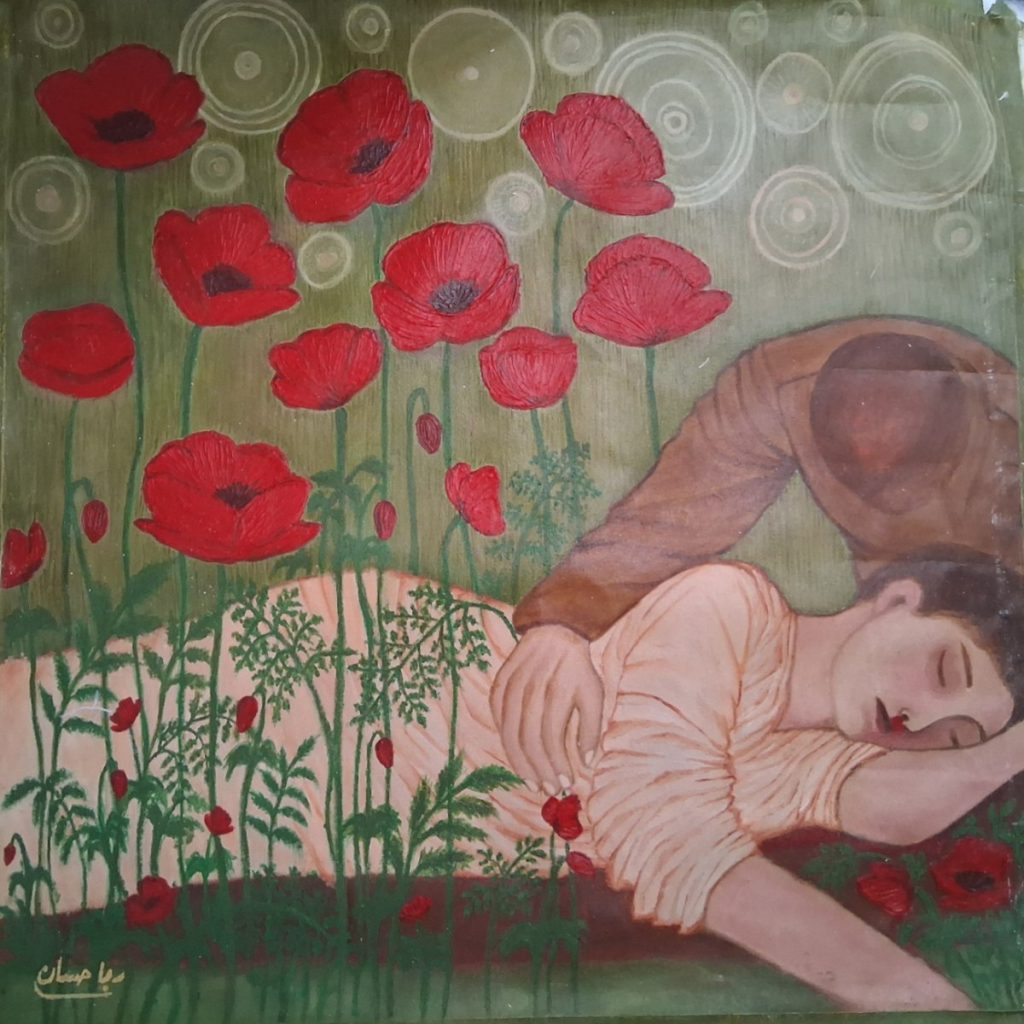
Ruba Mahmoud Hassan, Courtesy of the artist/ Gaza Biennale
Ruba Mahmoud Hassan’s paintings approach the representation of emotional pain with striking sensitivity. An artist as well as a dentist, she has participated in two exhibitions on a limited basis. Originally from Beit Hanoun, on the northern border of the Gaza Strip, she has been displaced six times during the war, eventually ending up in Cairo.
“There is a silent pain and sorrow that quietly burns the heart, as well as the shock and loneliness—emotions that cannot be captured by camera and are often overlooked by media, who focus on dismembered bodies as if they were mere dolls, neglecting the real human suffering and the loved ones left behind.”
The Palestinian poppy flower (hanoun) frequently appears in her work. In Palestine, it has become a ubiquitous symbol of martyrdom. Its roots lie in Persian mythology—said to have grown from the blood of King Khosrow’s victims—but in Palestine, it blooms annually as a reminder of those who died on this land.
Fadel Tafesh
Born 1995, Gaza, Palestine. Displaced in North Gaza
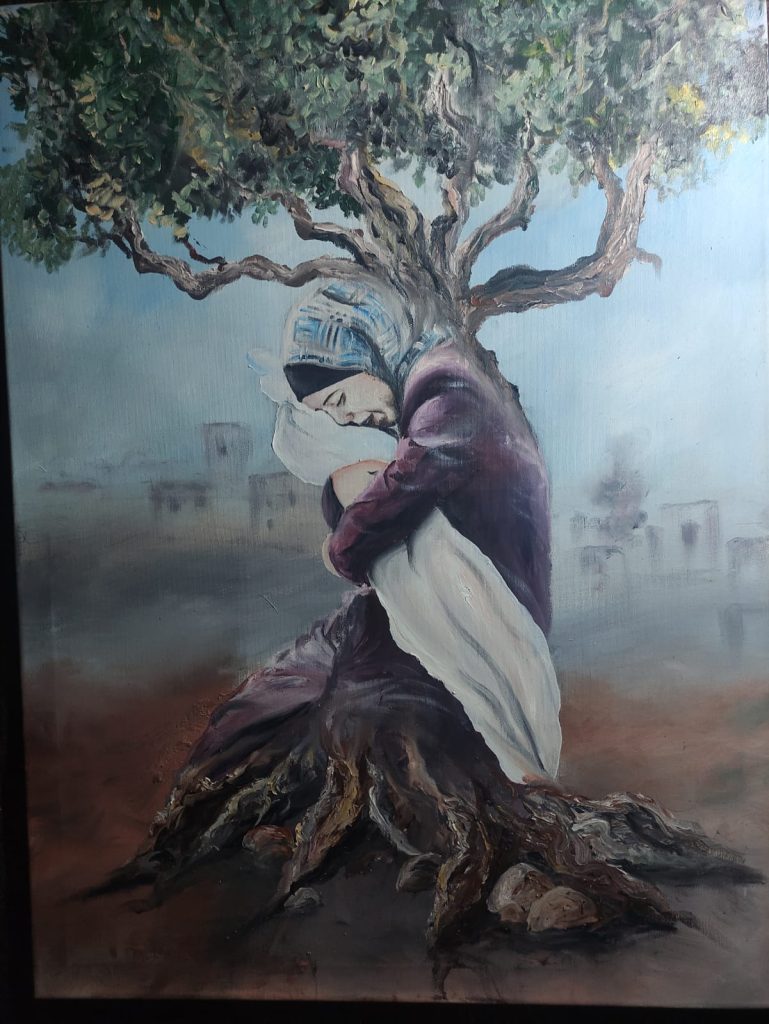
Fadel Tafesh, Steadfast as an Olive Tree’, Courtesy of the artist/ Gaza Biennale
Fadel Tafesh’s work revolves around a single theme: the patience and endurance of Palestinian mothers. Among all the horrors inflicted by this genocide, the assault on mothers and children remains perhaps the most brutal, yet it is rarely addressed directly.
Tafesh explains:
“Yesterday I saw a child cut in half. I saw the mother there, so calm and so patient—my hair jumped … ‘My kids are for Palestine,’ she said, ‘for the homeland.’ I have heard other mothers cry and sing like a celebration. I don’t think any other mothers in the world are doing that.”
In Steadfast as an Olive Tree, Tafesh portrays a Palestinian mother embracing her martyred child, standing firm like the olive tree—strong, resilient, and rooted.
Ahmad Muhanna — Devoid of Hope
Born 1984, Deir Al-Balah, Gaza
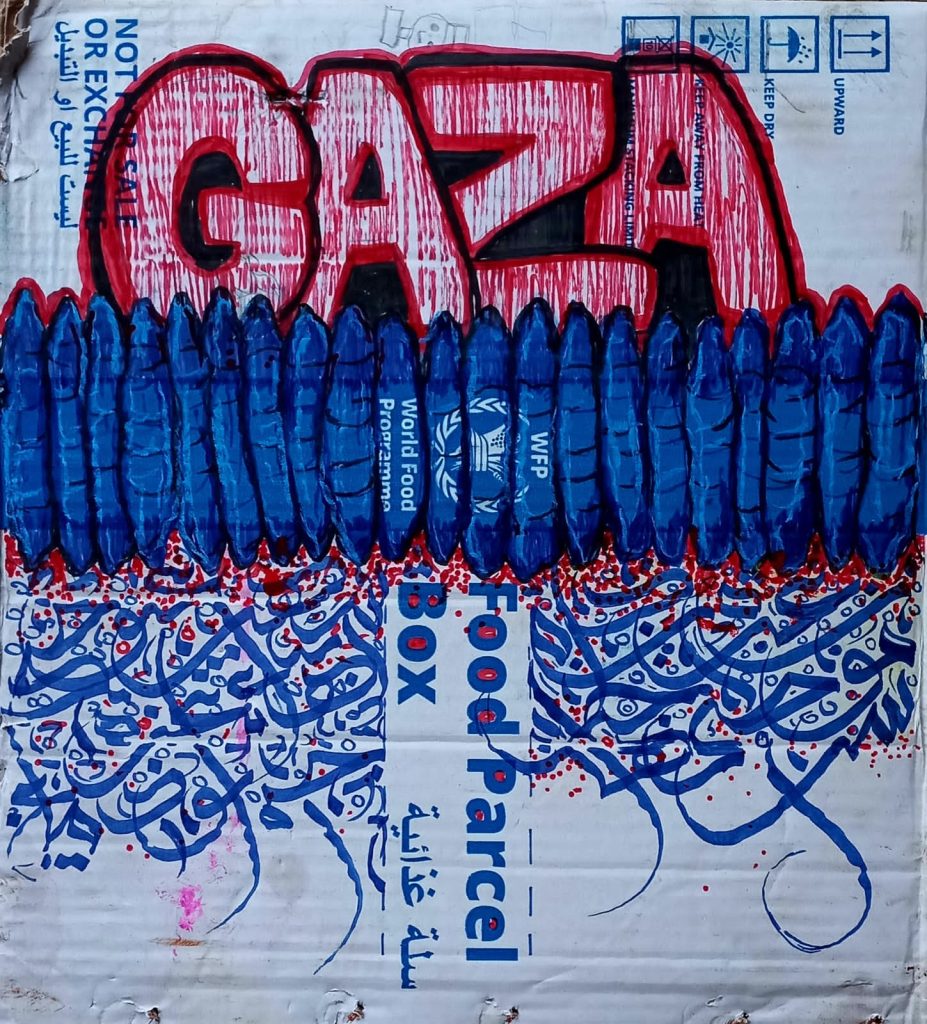
Ahmad Muhanna ‘Devoid of Hope’, Courtesy of the artist/ Gaza Biennale
Ahmad Muhanna explains:
“Before the war, I worked as an artist in local institutions, practicing psychotherapy through art. This stopped as life suddenly changed and I became an artist without hope. That’s where the title of my exhibition came from.
I painted many of the scenes I experienced daily: waiting in long queues for water and food, the politics of starvation, genocide, forced displacement, and the terrifying stories and details that unfolded during this war.
It is the responsibility of the artist living under such conditions to record the daily life of war and express people’s suffering, sending a message to all nations that there is an innocent people enduring everything happening to them.
As I began to document these events, I started drawing on international aid boxes. This became a philosophical artistic theme, showing how these boxes—objects we had never encountered before—became familiar through war. I painted scenes of war and daily life on them. Due to the lack of art supplies, I also drew on pages torn from books and magazines, using simple materials such as charcoal and coffee grounds.”
Ahmad Aladawi — By Fire and Blood
Born 1983, Gaza
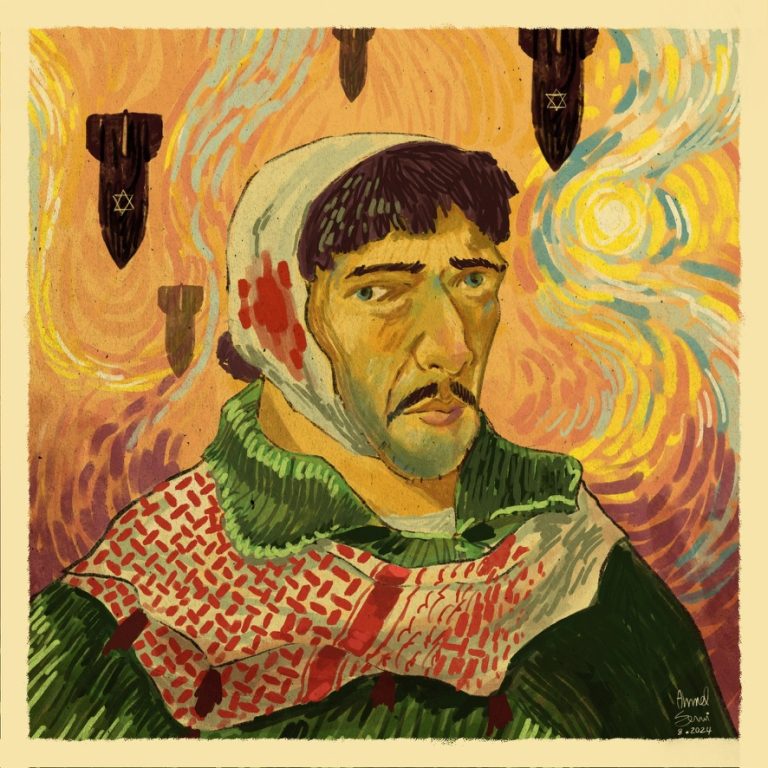
Ahmad-Aladawi, ‘By Fire and Blood’, Courtesy of the Artist/ Gaza Biennale
By Fire and Blood functions as a visual outcry, capturing the profound human experience that violence attempts to erase. It confronts viewers with the collective massacre of Gaza, using art to render a tragedy that cannot be conveyed through words or numbers alone.
These digital works do not merely depict tragedy—they immerse the viewer in pain, loss, and resilience. Symbols and visual expressions merge in layered compositions, reflecting Palestinian life under bombardment, death, and destruction. Faced with annihilation, art becomes a form of resistant memory.
Aladawi was born in Gaza and graduated from the School of Fine Arts. His artistic identity was shaped in the refugee camps during the First Intifada, deeply influenced by the revolutionary murals and posters adorning camp walls. This legacy led him to embrace art as both expression and resistance.
He began his career focusing on animation and stories for children and teenagers. He co-founded a production company specializing in animated films, which was later destroyed by the war in Gaza. Yet Aladawi continued developing his practice, blending expressionism and symbolism while exploring both modern and contemporary art, ultimately shaping a distinctive personal style.
Aya Juha — Human, Not a Number
Born 1991, Gaza, Palestine. Displaced in North Gaza
Aya Juha’s work seeks meaning in the relentless suffering of Palestinians subjected to imprisonment, torture, and martyrdom.
For the Biennale, she presents two works in situ—Prisoner and Anas—which will be exhibited inside her fragmented home. The house becomes both the subject and the setting of her art, merging the story with the space itself. Located in North Gaza, she is among the few who refused to leave. The exhibition will be documented and later shown outside Gaza, its “ex-situ” presentation reflecting the fragmentation of her work and reality alike.
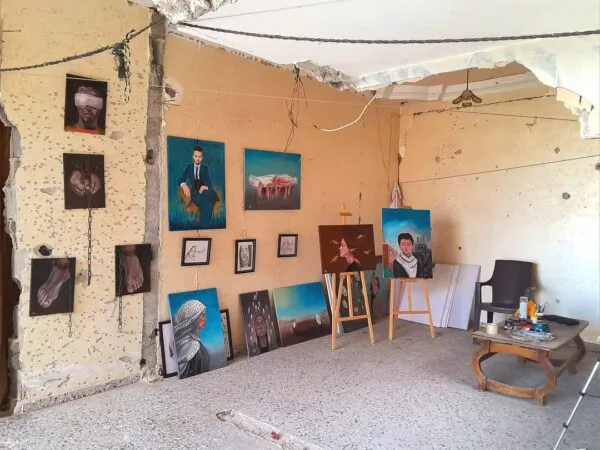
© Juha Aya. Courtesy of the artist./ Gaza Biennale
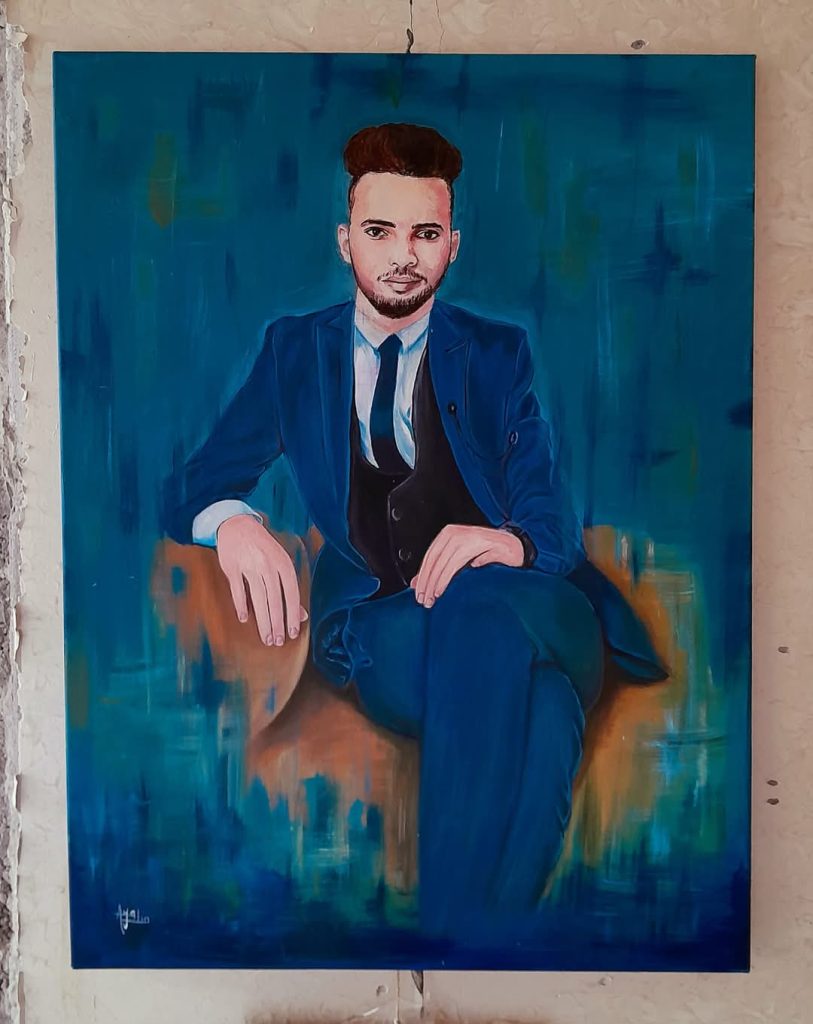
© Juha Aya. Courtesy of the artist, ‘Anas’ /Gaza Biennale
Anas is about a shy, introverted man who didn’t like to talk much with people; he preferred his work and his life. He lived through every war that took place in Gaza and continued with his life and work despite all the oppression, injustice, and siege. Anas wanted to get married and start a family, like all young men. He got engaged to a beautiful girl and was about to get married, but everything changed after October 7, 2023.
During the war that followed, Anas transformed into someone more open, warm, and connected to others. He laughed, shared conversations with his displaced relatives, played with children, and took photos. No one realized he was leaving behind final memories.
On November 16, 2023, Israeli tanks suddenly surrounded their home and fired shells. Anas and another relative were killed instantly—just one month before his wedding. Nineteen people, including Aya, were trapped in a room without food or water, as Anas’s body and the girl’s lay before them for two days under fire. His father managed to bury them in a shallow grave on their small plot of land. After a few days, the family escaped and later moved the bodies to a cemetery.
Juha received the Woman of Palestine Award in 2018 from the Ministry of Women’s Affairs.
Bassel Aklouk — Triangle of Freedom
Born in Gaza. Displaced in Cairo, Egypt
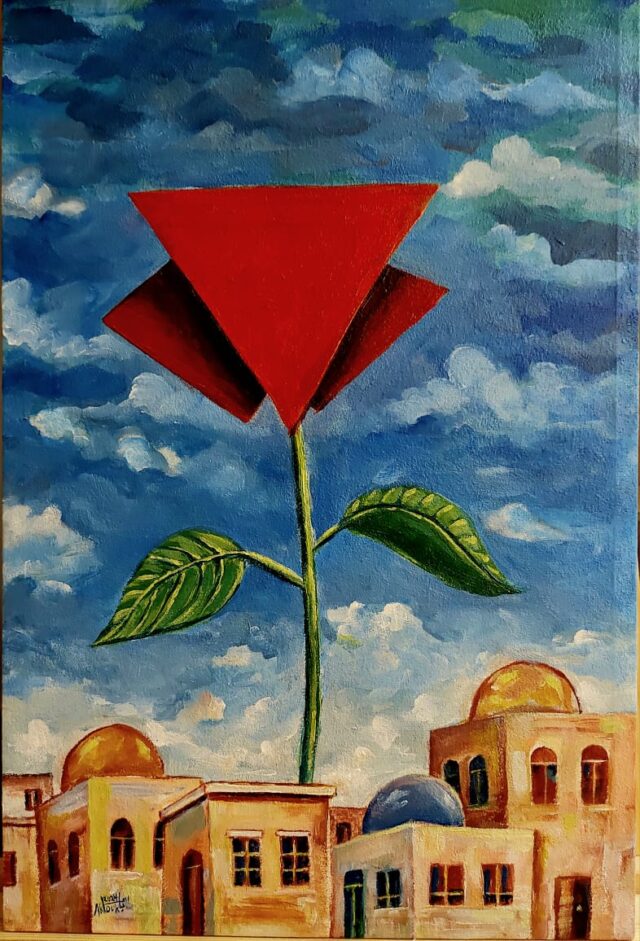
Basel Aklouk, Triangle of Freedom, Courtesy of the artist/ Gaza Biennale
Bassel Aklouk has lived and worked through every war in Gaza. During this war, however, all of his paintings were destroyed—every single one. After six months, just before the borders closed, he managed to leave for Cairo. Left with nothing, he wrestled with the question: how does one work again after a lifetime’s creations vanish from the earth? For months, he could not bring himself to paint.
He turned instead to research—reflecting on the war, his repeated displacements, global complicity, and the silences of media. What, he wondered, could painting possibly do against all this? A concept emerged: that visual art speaks a language needing no translation, capable of reaching the entire world. His paintings would become letters of survival and testimony: “We are a Palestinian community, and we have the right to live.”
Limited in materials, Aklouk created a series of ten works that emerged with a raw, almost primal power—artifacts resembling the earliest gestures of humanity. These paintings carry healing energy, rooted in form’s eternal and symbolic qualities. Art, since humanity’s beginnings, has been an act of resistance—against death, against erasure.
As Aklouk says: “We are alone fighting the occupation. It is healing to know there are people fighting for us.” His work is a tribute to visual forms capable of carrying a people’s struggle into history.
Info
Dates: September 18 – November 4
Opening Hours: Tuesday – Sunday, 18:00–21:00
Location: Lofos Art Project, 39 Velvendou Street, Kypseli
Admission: Free