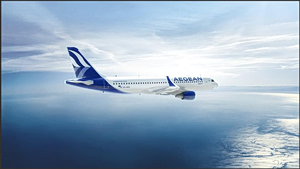
Aegean Airlines recorded another strong financial year, with balanced growth across its domestic and international network, according to company chairman Eftichios Vassilakis during the presentation of the airline’s annual results to investors. However, the positive performance was accompanied by mounting challenges, including geopolitical tensions in the Middle East and rising regulatory costs affecting the European aviation sector.
Balanced Growth in Passenger Traffic
Vassilakis described 2025 as “another strong year” for the Greek airline, highlighting steady expansion across both domestic and international routes. Passenger traffic increased by about 6 percent in both segments, reflecting what the company described as balanced growth across its network. Overall, Aegean carried 17.3 million passengers during the year, while seat capacity also expanded at a similar pace.
The company’s financial results reflected this growth. Total revenue reached approximately €1.86 billion, up 5 percent year over year, largely tracking the rise in passenger numbers. Profitability also improved during the year. Operating earnings (EBITDA) rose by about 4% to €421 million, while pre-tax profits increased more sharply, climbing roughly 17% to €192 million. Net profit after taxes reached approximately €148 million.
Rising Regulatory Costs in Europe
Despite the strong results, Aegean’s management emphasized that operating performance was significantly affected by rising regulatory costs. Vassilakis noted that 2025 marked the first year of a mandatory rule requiring airlines to increase staffing by 2%, adding pressure to the company’s cost structure.
Another major factor was the gradual phase-out of free emissions allowances under the European Union’s Emissions Trading System (ETS). The change added about €20 million to the airline’s operating costs, bringing the total regulatory burden for the year to approximately €43 million.
Operational challenges related to air traffic management in Greece also continued to affect the company’s performance.
Some external factors helped offset these pressures. Fuel prices were about 10% lower than the previous year, providing some cost relief. Exchange-rate movements also had a positive impact on the airline’s financial results.
Fleet Challenges From Engine Issues
Operational pressures were also heightened by technical problems affecting Pratt & Whitney GTF engines used in newer aircraft in Aegean’s fleet. At times during the year, as many as 13 to 14 aircraft were grounded, forcing the airline to adjust operations. According to company management, the issue is expected to gradually ease as technical repairs continue and partial support is provided by the engine manufacturer.
India Expansion Delayed
The airline also adjusted its fleet plans, affecting its timeline for launching direct flights to India. Aegean recently canceled an order for two Airbus XLR aircraft, replacing them with two LR aircraft, which can also serve long-haul routes. The company had initially ordered the XLR jets last year to accelerate its expansion toward India starting this spring. However, certification delays for the XLR aircraft would have pushed deliveries toward the end of the year, delaying the planned launch of direct routes.
As a result, the airline exited the XLR contract and will operate six LR aircraft in total—four previously planned and two replacing the canceled order. The direct connection between Greece and India is now expected to begin in spring 2027, about a year later than initially planned. The change will also result in a more uniform fleet of LR aircraft, which the company sees as an operational advantage.
Middle East Conflict Creates Uncertainty
Geopolitical developments are also beginning to affect Aegean’s operations. The escalation of conflict in the Middle East has already created uncertainty for aviation in the region. Vassilakis said passenger flows have declined about 8 to 10% compared with previous weeks, although there are signs of gradual stabilization.
Since Feb. 28, 2026, Aegean has canceled flights to and from Israel, Lebanon and Iraq and adjusted routes to destinations in the United Arab Emirates and Saudi Arabia. These markets represent roughly 4 to 5% of the airline’s total capacity, according to the company.
The impact is also being felt in nearby markets not directly involved in the conflict. For example, bookings to and from Cyprus have dropped by more than 10%.
Despite uncertainty in global energy markets, Aegean remains partially shielded from fuel price volatility. The airline has hedging contracts covering about 60% of its fuel consumption, limiting exposure to sudden increases in fuel costs.
Investment in Volotea
Vassilakis also addressed Aegean’s investment in the European airline Volotea. Aegean’s investment has reached €37 million, giving it a 20% stake in the company. An additional €10 million investment is planned for this year.
Volotea continues to improve its EBITDA each year, although it still reports net losses due to high financial obligations from the past. The airline’s operations are mainly concentrated in France, Italy and Spain, and it has no exposure to the Middle East market.
Higher Dividend for Shareholders
Aegean also announced an increased dividend of €0.90 per share.
Looking ahead, Vassilakis said it remains too early to predict how developments in the Middle East will affect the airline’s results in the coming weeks. However, he emphasized that Aegean has built the flexibility to adapt to changing conditions.
Short-term developments may affect performance, he said, but they will not jeopardize the company’s ability to serve customers or continue growing in the future. Maintaining competitiveness, he added, remains the company’s main priority.
Source: ot.gr