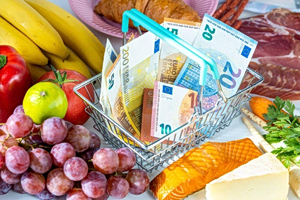
Inflation in Greece remains persistently high, even as price pressures ease across much of the eurozone, according to a detailed analysis by Alpha Bank. The bank points to strong domestic demand, fueled by employment growth, record tourism and rising wages, as the key forces preventing faster disinflation.
Based on the Harmonized Index of Consumer Prices (HICP), Greece’s inflation rate averaged 2.9% in 2025, only marginally lower than 3% in 2024. While the headline figure shows slight improvement, the underlying drivers reveal why price pressures remain resilient.
Services Are the Main Inflation Driver
Alpha Bank notes that inflationary pressures in 2025 were sustained mainly by a faster increase in service prices, which rose by 4.8%, up from 4.4% in 2024. This acceleration more than offset the easing seen in other categories.
By contrast, prices for non-energy industrial goods increased at a much slower pace, rising 0.7% in 2025 compared with 1.7% a year earlier. Food prices also showed moderation, climbing 2.1% versus 2.8% in 2024. Energy prices fell for a third consecutive year, declining by 0.7%, although the pace of decline slowed compared with a 1.4% drop in 2024.
Greece vs. the Eurozone
At the eurozone level, inflation averaged 2.1% in 2025, down from 2.4% in 2024. The highest HICP increases were recorded in Estonia, Croatia and Slovakia, while Cyprus and France saw the lowest rates.
Greece’s higher inflation, Alpha Bank argues, reflects domestic economic conditions rather than imported price shocks.
A Positive Output Gap Signals Overheating
Central to Alpha Bank’s analysis is the concept of the “output gap,” which measures the difference between actual economic output and the economy’s potential output, expressed as a percentage of the latter.
Potential GDP represents the level of production an economy can sustain when capital and labor are fully and efficiently employed. When actual GDP exceeds this level, the output gap is positive, indicating excess demand relative to productive capacity—a condition that typically fuels inflation.
According to Alpha Bank, Greece’s output gap has been positive since 2023, signaling an economy operating above its sustainable capacity. This excess demand is partly supported by a surplus in the services balance of external transactions, reflecting the country’s strong tourism performance.
From Crisis to Demand Pressures
During the deep recession of the previous decade, Greece experienced a sharply negative output gap, driven by soaring unemployment and widespread disinvestment. Weak demand and excess supply translated into subdued or even negative core inflation, which excludes volatile energy and food prices.
As the recovery in real GDP began in 2017, the output gap gradually narrowed, though it remained negative for several years. Core inflation recovered as well, with the exception of 2020-21 due to the COVID-19 pandemic.
From 2023 onward, however, the output gap turned positive. Alpha Bank says this shift explains the current environment of elevated core inflation.
Jobs, Tourism and Wages Fuel Demand
Several factors are sustaining strong demand. Employment growth is a major one. Between January and November 2025, employment rose by an average of 1.6%, marking the fifth consecutive year of expansion. In November, the number of employed people exceeded 4.4 million for the first time since 2010.
Unemployment fell below 400,000 for the first time since 2008, while the number of people outside the labor force dropped to 2.9 million, the lowest level since 2004.
Tourism has also played a decisive role. In the first 11 months of 2025, Greece recorded 36.7 million tourist arrivals and €23 billion in travel receipts, already surpassing the full-year results of 2024. This marked the third consecutive year of record highs in both arrivals and revenues, contributing to rising prices in tourism-related services.
At the same time, wages have been increasing rapidly. The seasonally adjusted wage cost index published by Greece’s statistical authority rose by 7.6% in the first nine months of 2025, adding further momentum to consumption.
Investment and Credit Add Momentum
Demand has also been reinforced by increased investment activity, partly linked to the absorption of funds from the EU’s Recovery and Resilience Facility. Stronger bank lending has further supported economic activity, amplifying demand-side pressures.
Outlook: Inflation to Ease, but Stay Elevated
Looking ahead, Alpha Bank expects Greece’s output gap to remain positive in 2026, at around 3% of potential GDP—the highest in the eurozone, according to European Commission forecasts. This suggests that strong demand conditions will persist.
In this context, both headline and core inflation are expected to ease in 2026, but they are likely to remain higher than the eurozone average.
Energy prices remain a key risk factor. Although they made a slightly negative contribution to inflation in 2025, their future path is highly uncertain. Alpha Bank highlights recent geopolitical tensions involving two major global energy players Venezuela and Iran, as a source of increased uncertainty for international energy prices.