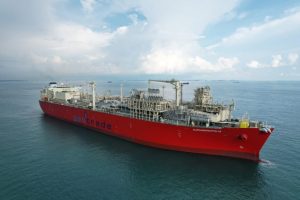
The environmental permitting decision for a second Floating Storage and Regasification Unit (FSRU) in Thrace was signed on Tuesday, Jan. 27, by the Director General for Environmental Policy at the Ministry of Environment and Energy (YPEN). Gastrade, a subsidiary of the Copelouzos Group, thus secured environmental approval for a second floating LNG import terminal.
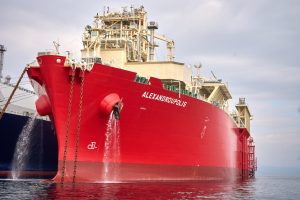
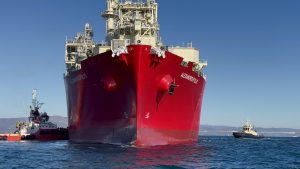
Like the Alexandroupolis FSRU already in operation, the new facility will be installed offshore near Thrace’s largest city and is planned to enter service in 2028—the first year of the EU ban on Russian gas imports.
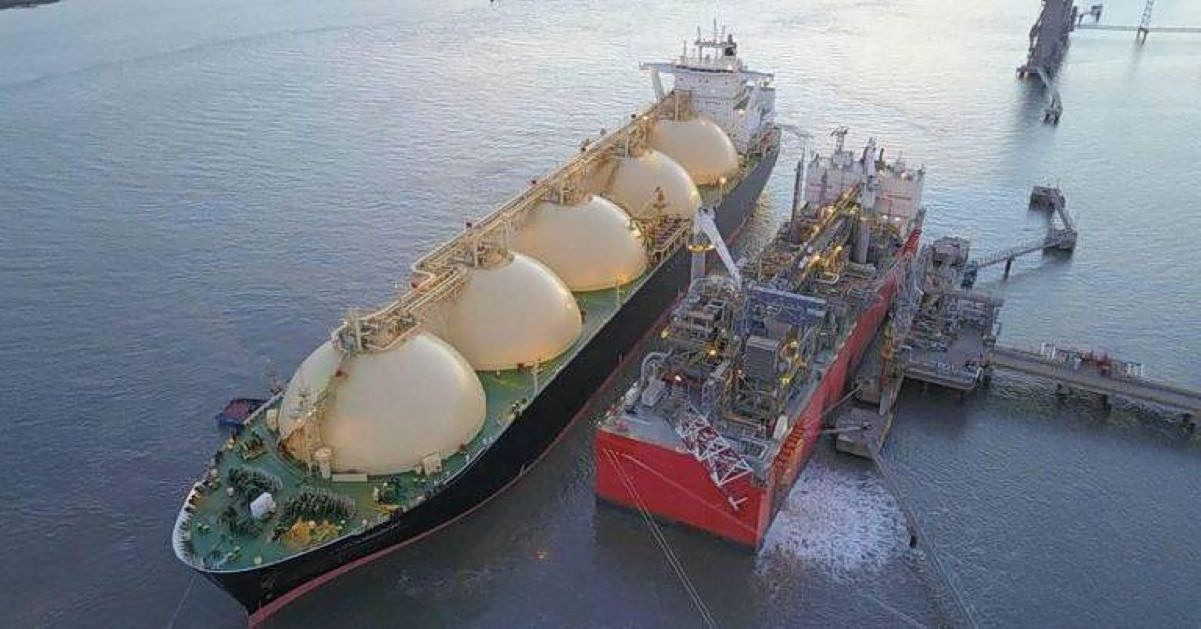
According to YPEN’s decision, the Independent Natural Gas System of Thrace will include a permanently moored offshore FSRU equipped with four LNG storage tanks, regasification facilities, pipelines and pumps, LNG loading and unloading systems for carrier vessels, a Boil-Off Gas (BOG) management system, and supporting auxiliary installations.
The unit will be located about 9 kilometers southwest of Alexandroupolis and roughly 8 kilometers from the nearest coastline, in waters around 35 meters deep. Its maximum annual capacity is estimated at 6 bcm of natural gas, comparable to the Alexandroupolis FSRU’s 5.5 bcm.
Despite its technical readiness, the project’s implementation depends on economic viability. With an estimated cost of at least 650 million euros—higher than that of the first FSRU—and no access to European Investment Bank subsidies or preferential financing, higher usage tariffs would be required.
This comes amid strong competition from other LNG entry points in Eastern and Southeastern Europe. Recent capacity-booking auctions for the US-backed Vertical Gas Corridor highlight this pressure, underscoring the need for lower corridor tariffs, long-term volume commitments, and sufficient guarantees for the investment to proceed.