Greece’s annual inflation rate ultimately came in at 3.1% in February, according to Eurostat’s final data.
The figure was slightly higher than the initial flash estimate, which had pointed to inflation of 3%.
Across the euro area, annual inflation stood at 1.9% in February 2026, up from 1.7% in January and in line with Eurostat’s preliminary reading. A year earlier, the rate had been 2.3%. In the European Union as a whole, annual inflation rose to 2.1% in February 2026, from 2% in January. A year earlier, it stood at 2.7%.
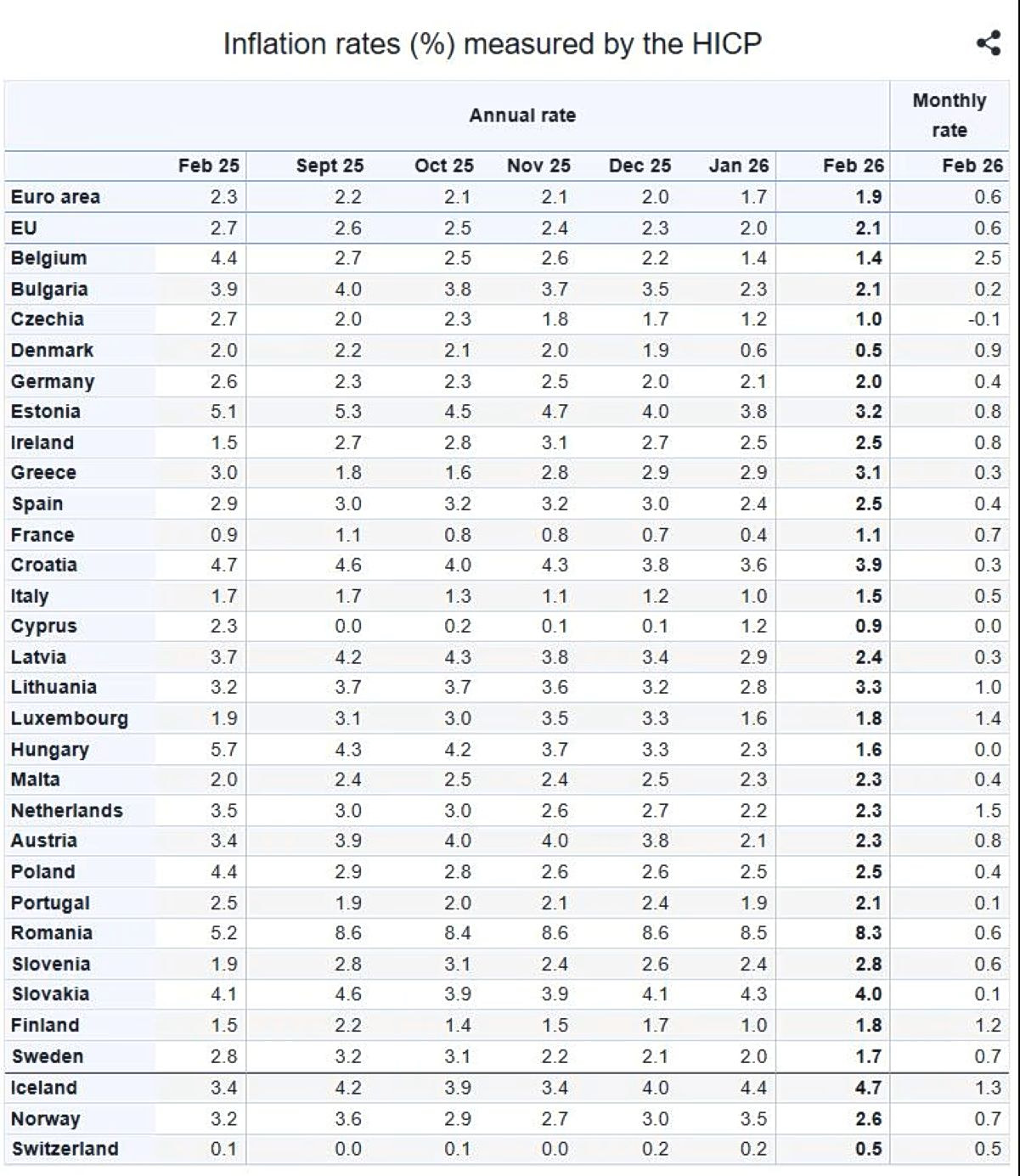
The lowest annual rates were recorded in Denmark (0.5%), Cyprus (0.9%) and the Czech Republic (1%). At the other end of the scale, the highest inflation rates were seen in Romania (8.3%), Slovakia (4.0%) and Croatia (3.9%).
Compared with January, annual inflation fell in 11 member states, remained unchanged in four and increased in 12.
In February, services made the largest positive contribution to annual euro area inflation, adding 1.54 percentage points. Food, alcohol and tobacco contributed 0.48 percentage points, while non-energy industrial goods added 0.17 percentage points. By contrast, energy exerted a downward effect, subtracting 0.30 percentage points.
Core inflation, which strips out the more volatile prices of energy and unprocessed food, edged up to 2.3% year-on-year in the euro area, from 2.2% in January.