Few sectors of the Greek economy can claim a history as long and storied as shipping. Since the Treaty of Küçük Kaynarca won Greek shipowners the right to fly the Russian flag in 1774 and served as the unofficial starting point of modern Greek shipping, shipping has been one of the primary pillars of the national economy. It is a national asset that has withstood the test of time, crises, and geopolitical upheavals. And it continues to yield benefits of incalculable value to Greek society.
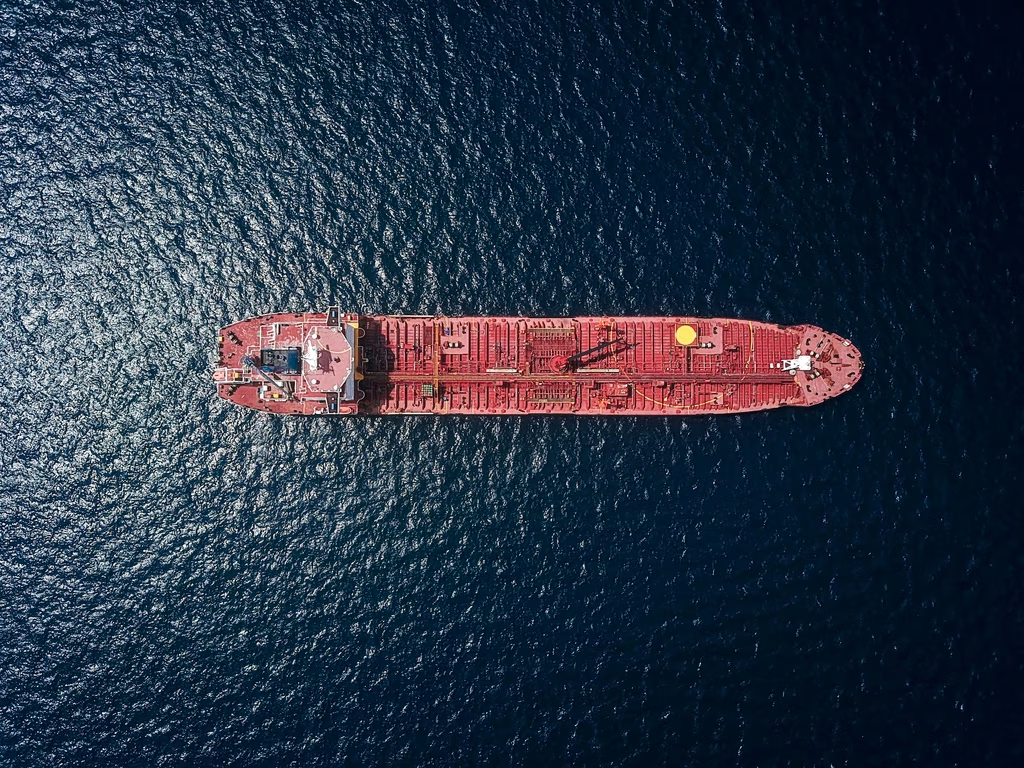
Greece consistently holds the top position globally in ocean-going shipping, controlling approximately 20% of the global merchant fleet’s capacity in terms of deadweight tonnage (dwt). Greek shipowners control over 5,500 vessels, with particular dominance in tankers, dry bulk carriers, and LNG carriers. More specifically, our country controls nearly 30% of the global tanker fleet and over 25% of the bulk carrier fleet. And this dominant presence is no accident. It is the result of the entrepreneurial audacity, strategic foresight, and expertise developed over time by Greek shipping families. It is also proof that when Greek entrepreneurship operates in a competitive international environment, it can not only hold its own; it can also lead the way.
Shipping accounts for approximately 7-8% of Greek GDP, while foreign exchange inflows from the sector consistently exceed 15 billion euros per annum. This is a crucial source of foreign exchange that bolsters the current account balance and contributes to the macroeconomic stability of the country. This contribution proved particularly valuable during the difficult periods of the fiscal crisis.
Our relationship with the maritime community must be based on a stable, predictable, and internationally competitive tax framework. The tonnage tax system, aligned as it is with European guidelines and international practices, remains a cornerstone of this framework. The voluntary shipping contribution, which has been repeatedly renewed since 2014, demonstrates the sector’s responsibility and commitment to the national economic effort. It has yielded hundreds of millions of euros for the public coffers.
Beyond macroeconomic figures, shipping directly and indirectly supports approximately 200,000 jobs. Seafarers, shipping company executives, classification societies, shipbrokers, specialized lawyers and accountants, banking and insurance officials, and workers in shipyards and port services make up a dynamic ecosystem centered on Piraeus. Piraeus is emerging as one of the top maritime clusters worldwide, alongside London, Singapore, and Shanghai. At the same time, islands such as Chios, Andros, Kasos, and Oinousses keep the maritime tradition alive through their academies and educational institutions.
The future of shipping lies in two major transitions: the green and the digital. The Increasingly stringent International Maritime Organization (IMO) environmental regulations necessitate significant investments in alternative fuels and new low-emission technologies. At the same time, the digitalization of processes, automation, and the utilization of artificial intelligence are opening up new horizons for productivity and competitiveness.
Greek shipowners are at the forefront of these investments, placing continuous orders at shipyards in Asia and Europe for next-generation vessels. The government actively supports these transitions by molding an institutional framework that encourages innovation. It is leveraging resources from the Recovery Fund to upgrade port infrastructure and is investing in the ongoing training of personnel through the Merchant Marine Academies.
In today’s international environment, Greek shipping is facing unprecedented challenges. The conflict in Iran and the de facto closure of the Strait of Hormuz since late February 2026 have radically reshaped global maritime routes. Traffic has subsided, while war risk insurance premiums are skyrocketing.
Greek shipowners, with their long experience in geopolitical crises, are managing the situation with composure and professionalism. Concurrently, the Greek government is closely monitoring developments and cooperating with international partners to guarantee the safety of crews and vessels.
Greek shipping is, and will remain, one of the most vital sources of national power. Our duty is to support it with prudence, to reinforce maritime education, to maintain a competitive institutional framework, and to promote Piraeus as a premier global maritime center. History teaches us that, for nearly 250 years, the sea has been the greatest ally of the Greek economy. With vision, a clear plan, and consistency, we can ensure that it remains so in the decades ahead.
Mr. Kyriakos Pierrakakis is Minister for the National Economy and Finance.