“Blessed is he who comes in the name of the LORD; we have blessed you from the house of the Lord” Psalm 118:26
Greek politics has entered a messianic phase with former PM Alexis Tsipras’s (re) appearance as the only man who is able to successfully challenge the ever more unpopular conservative Prime Minister Kyriakos Mitsotakis.
Conservative New Democracy’s polling numbers have plummeted since he was re-elected in 2023 – when ND received 40 percent of the popular vote – for a variety of reasons, from galloping inflation to scandals that were papered over by parliament and the judiciary until now.
Still, ruling New Democracy’s polling numbers today are more than double those of main opposition PASOK (25.2 percent versus 12.6 percent). Mitsotakis’s political advantage derives from the fact that the political spectrum both to the right (and particularly the left) of ND are completely fractured and disorganised.
In fact, many pundits say that Mitsotakis benefits from the fact that he essentially has no credible opposition, and he thus asserts that he is the only political leader that can ensure “political stability”, a claim rendered doubtful by the fact that the numbers prove that he will have to govern with an ineluctably fragile coalition of other parties.
Filling the void
Enter Alexis Tsipras. In a much-advertised 3 December event that was ostensibly a presentation of his book Ithaca (a rather ironic title for a politician planning a comeback, as the island was the rather bitter end of a tumultuous journey of the Homeric hero Odysseus to whom it alludes).
Tsipras, however, uses it to imply that in 2018 he steered the country to the “Ithaca” of freedom of the exit from bailout memorandums, leaving 38bn euros in the state’s coffers (largely the product of major over-taxation) to boot.
Ithaca, which has sold 30,000 copies in less than 10 days, is a political “Apologia Pro Vita Sua“, focusing on the exceedingly tumultuous first six months as the country’s first left-wing PM.
It is the period of his prime ministership that he would most like citizens enraged by his blundering management of the debt crisis to forget, or at least to see in a more forgiving light.
A platter of platitudes
In his speech to an audience of over 1.000 in Athens’ Pallas Theatre, Tsipras declared that Mitsotakis’s continuing political hegemony is based on the fact that there is no credible alternative and that a nationwide “self-organization” of citizens with a progressive platform is needed.
The problem with that is that none of the centrist (PASOK) or left wing parties have organised and disciplined party branches across the country as did Andreas Papandreou’s socialist PASOK of yesteryear – SYRIZA never did – and the declaration that anti-Mitsotakis progressive citizens (basically centrists and centre-leftists) can on their own coalesce into a powerful political force – by organizing themselves as the constituent elements of a new (Tsipras-led) party – is by all appearances simply a pipe dream.
That does not mean, however, that Tsipras himself is incapable of patching together the remnants of the left and grabbing a noteworthy chunk of Nikos Androulakis’s PASOK, which is currently the main opposition part with only 12.6 percent in the polls, and the disgruntled part of ND’s base.
Tsipras called for Allagi (change), once the electrifying mantra that swept to power in 1981 socialist Andreas Papandreou, from whom he has often borrowed.
He asserted that his new party could have a shot at coming to power, and to this end he marshalled catchphrases like “radical restructuring of the progressive political space [which he says has closed its political cycle]”, “a great, multi-coloured movement [another Papandreou borrowing]”, “embracing all leftwingers, democratic and sensitive people”, whatever the latter two may mean.
Yet, beyond slogans and platitudinous declarations of noble social objectives, like distributive justice, the former prime minister failed to present concrete elements of a coherent platform that could actually pose a powerful challenge to Mitsotakis, who responded harshly to Tsipras.
“Who will trust a captain who led to a shipwreck and blamed the crew?” he said, referring to the former PM placing the blame for key political mistakes on his close associates and ministers, like Varoufakis, in his memoir.
‘Ithaca’ as Whitewash
For Tsipras’ first six months in power (January-June 2015), his finance minister, the highly unconventional Yanis Varoufakis [whom Tsipras harshly blames in his book] was negotiating with the triumvirate of Greece’s European Commission-European Central Bank-IMF bailout creditors, with virtually no progress and with the extraordinary belief, or rather delusion, that the creditors could never expel Greece from the eurozone (Grexit), as it would harm them most, and perhaps even destroy the eurozone.
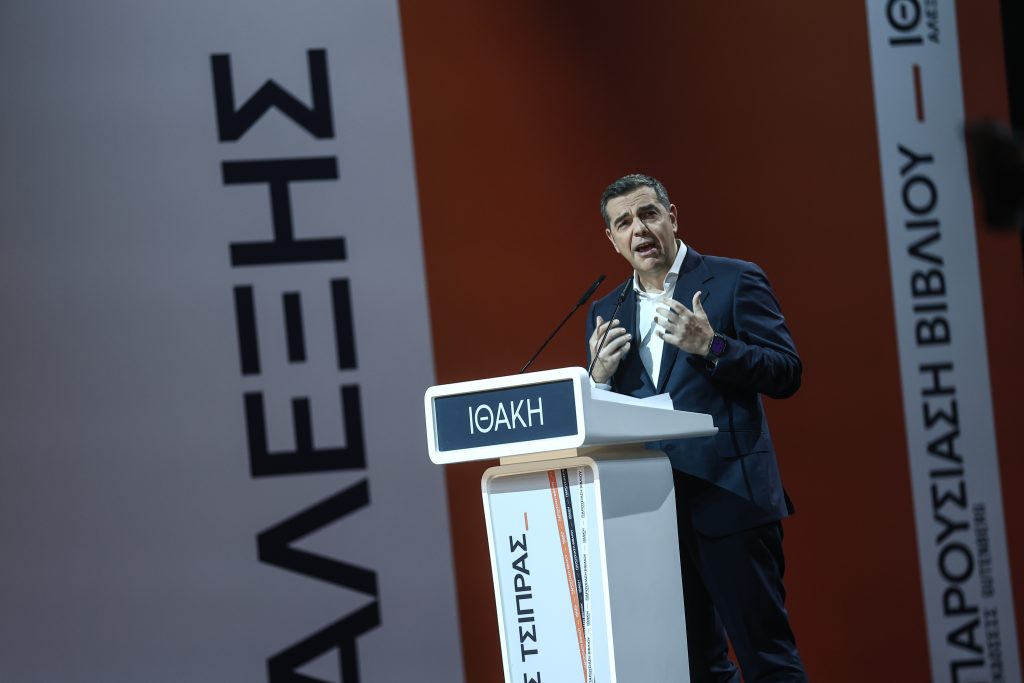
Presentation of his book titled Ithaki by Alexis Tsipras, at the Pallas Theatre, on December 3, 2025.
In that six-month period the Europeans, and more specifically Germany’s hugely powerful finance minister, Wolfgang Schäuble, quietly endured Varoufakis’s apparent refusal to accept new harsh terms in the negotiations on the bailout memorandum.
But by the end of June, 2015, and with his back against the wall, Tsipras called a referendum on whether to accept the updated bailout deal (about which hardly anyone in the electorate knew any specifics) placed on the table by the creditors.
Citizens followed the government’s urging, with a whopping 61.3 percent delivering a resounding “No”.
Tsipras thought he had secured the trump card in the harsh poker game and showdown with Merkel, the leader who by imposing five years of extremely harsh austerity on Greece (2010-2015) ironically was responsible for sweeping him to power.
When ‘No’ means ‘Yes’
In no time, he single-handedly overturned the result of the referendum and in August signed the new bailout memorandum, that was to last three years.
A superlative tactician, arguing that he did all he could to ease Greeks’ pain, played all his cards and lost, he called a snap election in September and won.
Tsipras’s reckless move brought harsh punishment on the country’s people with the European Central Bank imposing draconian capital controls – with a bank withdrawal ceiling of 420 euro per week (60 euro per day).
Greeks were furious and have not forgotten that this was a great fiasco for him as a leader and for the country.
What followed was the infamous 17-hour meeting (on 13 July, 2013) with creditors that are said to have kept Greece in the eurozone.
Then French PM Francois Hollande later said the talks were difficult, but that “Tsipras was the one who unblocked the situation. With our [France’s] support, but he did it.”
The Greek PM had accepted the terms of the creditors.
Τhe rise and fall of Tsipras has core elements of ancient drama: A tragic hero whose achievements – a meteoric political rise that brought a left-wing party to power for the first time in Greek history (oddly in a coalition with a right-wing populist party that handed him a parliamentary majority )- that is destroyed by a fatal flaw or sin.