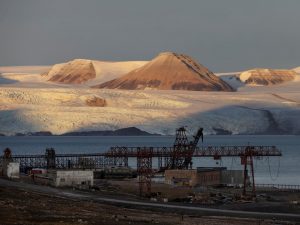
While the artillery rhythms of Ukraine consume the world’s headlines, the collapse of Gaza’s skyline, whispers of war over Taiwan and an actual conflict in the wider Middle East, a quieter and more decisive frontier is forming, slowly, almost invisibly, at the top of the world. It is not framed in the conventional language of conflict. It does not scream, explode, or burn. But the Arctic is shifting (physically, politically, strategically) and with it, the entire geometry of power.
The Arctic is not a frozen void. It is a geopolitical accelerant. It is where supply chains collapse or consolidate, where cables are poised to carry the backbone of global finance, where launchpads for satellites stare silently skyward. The melting of Arctic ice, long discussed in the anxious tones of climate science, now functions as a trigger in the harder language of statecraft. The ice is receding, and great powers are advancing.
Russia, with the largest Arctic coastline, has moved decisively. Over fifty military outposts have been reopened or constructed since 2014. Nuclear-powered icebreakers patrol its Northern Sea Route, a passage that slashes transit time between Europe and Asia. Massive investments in Yamal LNG and the Vostok Oil Project (supported by China) anchor a long-term vision in which Moscow sells energy to the East while asserting maritime sovereignty over new polar corridors. For the Kremlin, the Arctic is not just a flank; it is the center. A theater of deterrence, a corridor of wealth, a sanctuary for second-strike capabilities. It is where geography, ideology, and energy meet.
China, famously without Arctic territory, has nevertheless claimed the label “near-Arctic state”, a narrative that initially provoked smirks but now commands strategic attention. Beijing’s attempts to invest in ports, mines, and fiber-optic cables across the Nordic Arctic have met with mixed results. The much-hyped Arctic Connect cable from Finland to China has been suspended, and land acquisitions in Iceland and Svalbard were ultimately blocked. Yet China has found traction where transparency is absent: in Russia. It now holds a 20% stake in Arctic LNG 2 and has emerged as a quiet partner in developing Russia’s Polar Silk Road. Chinese icebreakers have traversed the central Arctic Ocean, gathering data. Its “scientific” stations in Svalbard are dual-use by nature, ideally placed to support polar-orbiting satellite systems. As Edström, Hauksdóttir, and Lackenbauer argue, Chinese Arctic strategy is not overblown; it is misunderstood. It is not about immediate ownership but long-term influence. It is not visible empire-building but strategic osmosis. To that, Harvard’s Arctic Initiative provides us with an interactive map of Chinese investments in the Arctic from 2007 to 2025.
The United States, paradoxically the only superpower (one of two if we count Russia) with true Arctic geography and global reach, remains strategically somnolent. Two icebreakers (one built before disco) are a poor showing for a nation with ambitions to compete in polar and orbital domains. A coherent Arctic strategy remains elusive, caught between sporadic Congressional enthusiasm and the inertia of underinvestment. Trump’s repeated obsession with purchasing Greenland, most recently resurrected in 2025, has drawn ridicule and alarm in equal measure. But even that absurd spectacle conceals a strategic truth: Greenland matters. It houses the Pituffik Space Base (formerly Thule), a critical U.S. outpost for missile warning, satellite control, and space surveillance. It is no coincidence that both Washington and Beijing have vied, overtly and covertly, for influence in Greenland. If outer space is the final frontier, then Arctic territory is its staging ground.
Because space, quite literally, begins in the Arctic. Satellites that orbit the Earth in polar trajectories (those that enable weather forecasting, global surveillance, navigation, and reconnaissance) must pass over the poles. They require high-latitude ground stations to receive data and correct their paths. The Arctic enables this infrastructure. It is not just a theater of Earth-bound competition but the foundation of orbital command. In this sense, Arctic sovereignty is space sovereignty. Conley calls this the “orbital architecture” of the north. Control of these nodes (of Svalbard, of Greenland, of Alaskan radar sites) is essential for maintaining both civilian and military dominance in space.
Beneath the surface, too, the Arctic is transforming from icy abyss to cableway. The global internet increasingly depends on subsea cables that now cross or are planned to cross Arctic waters. These are not neutral lines; they are state assets. The Far North Fiber project, now underway between Japan, Finland, and Alaska, is a Western counter to China’s failed Arctic Connect initiative. These cables carry financial data, military communications, and cloud infrastructure for the world’s largest economies. To command them is to command the nervous system of global commerce. To compromise them is to induce paralysis. In a future conflict, it is not hard power or ideology that will matter first—it is whether data flows or dies.
Even the minerals beneath the Arctic seabed point skyward. Rare earth elements essential for satellites, missiles, electric vehicles, and next-generation computing lie beneath Greenland and Siberia. Their control is a prerequisite for industrial sovereignty in an era of weaponized supply chains. The Arctic is one of the few places on Earth where state-backed exploration is still expanding. The logic of strategic resource control, born in the 19th century and refined in the 20th, has not faded; it has migrated north.
This is not a frozen replay of the Cold War. It is colder, deeper, and more interconnected. The Arctic is a domain where kinetic warfare is unlikely, but strategic competition is constant. It is the ideal theater for what scholars now call “gray-zone operations”: sub-threshold maneuvers that involve drones, cables, orbital jamming, and diplomatic lawfare. In the Arctic, war is not declared. It is embedded in contracts, in ports, in icebreaker hulls, in seabed mining licenses, in the orbital footprint of a polar satellite.
And yet, despite all of this, the Arctic remains treated as peripheral by many policymakers. It is viewed as a climate question, a scientific curiosity, or a backwater of national security. This blindness is strategic negligence. The Arctic is not the margin. It is the hinge.
What happens in the Arctic will define whether space is peaceful or contested, whether data is secure or vulnerable, and whether supply chains are diversified or brittle. It will determine whether China becomes a truly global power and whether Russia survives the West’s containment. And it will show whether the United States still understands what it means to be a geographic superpower.
We often speak of space as the final frontier, invoking a horizon that lies forever beyond. But the Arctic is where that journey begins. It is where satellites rise and cables fall, where power is projected and power is prevented. It is not empty. It is occupied, sometimes by ice, increasingly by ambition. And like all frontiers, it does not wait for us to notice. It moves.
Dimitris Kollias
Junior Research Fellow, ELIAMEP