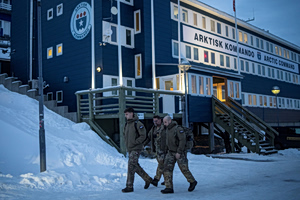
Commentaries marking the first anniversary of Donald Trump’s return to office are filling the newspapers these days. A common thread is hard to miss: at home, the United States is drifting toward authoritarian rule, while in foreign policy Trump has taken major steps toward dismantling the rules-based international order he so openly despises. Trump’s maneuvers to annex Greenland by force – against international law and the will of its population – provide ample material for this bleak assessment. That includes his direct challenge to those who stand in the way of his annexation plans. Among them are the governments of Germany, Denmark, France, and the United Kingdom, which have dispatched small contingents of soldiers to the island in a symbolic gesture. In retaliation, Trump has announced new punitive tariffs. The president invokes security arguments to justify his claim; international treaties and alliance commitments mean little to him. In Trump’s foreign-policy worldview, might makes right. In this respect, Trump and Putin are disturbingly similar. Trump promised his supporters that he would make America great again – and geographically larger. On that path, Greenland is a largely defenseless target.
“We agreed to disagree,” the Danish foreign minister said after his talks in Washington. In the coming weeks, the parties intend to negotiate over the future of the Arctic island. That Trump has so far refrained from seizing Greenland in a military coup de main – and thereby delivering a final death blow to NATO – should not be overestimated. The announcement of new tariffs against the island’s most important allies shows that he aims to force their capitulation. The threat of tariffs is a tried-and-true method. Until now, it has proven effective in dealing with America’s (still) European allies. The Europeans have been markedly restrained in their public criticism in the case of the U.S. military intervention in Venezuela, which, according to experts, violates international law. Europe’s unprincipled tendency to duck and cover is easily understood. The web of dependencies – above all in military and economic terms – makes a rupture with Washington difficult – and costly. To keep Vladimir Putin in check in Ukraine, Europeans rely on cooperation with the United States. For them, Kyiv is closer – and therefore more important – than Caracas.
Trump’s threats against Greenland’s sovereignty create a new and unprecedented situation for NATO. There are signs that American annexation plans could be the proverbial last straw that breaks the camel’s back – that Europe’s leaders no longer want to be pushed around like schoolchildren. “We are not victims of external circumstances. We are not a plaything of great powers,” said German Chancellor Friedrich Merz, calling – like other European leaders – for greater unity as the best response to provocations from across the Atlantic. The call for a change in tactics toward Trump’s provocations stems from the realization that the previous approach of submissiveness and flattery has had little effect.
In European media, Trump is compared to a mafia boss who applies the tools of a protection racketeer in foreign policy. From criminology, we know that giving in to extortionists is rarely a good idea. Applied to Greenland and European politics, this means that Europeans must stop smiling through a bad deal, rediscover their own strengths, and finally overcome the often-paralyzing disunity on key issues. Recent months also show that those who confront the extortionist in Washington with their heads held high tend to fare rather well. This is evident in the examples of Brazil, China, and Canada, which recently concluded a trade agreement with China – America’s archrival.
The European Union is moving in a similar direction with the Mercosur agreement, finally concluded after decades of negotiations. This is not just about cheaper beef from Latin America, but about a vast free-trade zone and potentially a significant building block in an evolving new world order. Given the deep interdependence built up over decades, diversifying and reducing reliance on the United States is a monumental process. Yet the decoupling has already begun. More than mere symbolism is the threat from a senior politician of Germany’s governing party that Europe should consider boycotting the FIFA World Cup in the United States “to bring President Trump to his senses on the Greenland question.”
Dr. Ronald Meinardus is a senior research fellow at the Hellenic Foundation for European and Foreign Policy (ELIAMEP).