1. Introduction: Myth, Modernity, and Nation-Building
Recent tensions in the Middle East highlight the importance of stability, neutrality, and carefully coordinated institutional strategies, reminding me of my time in Oman. With roots in Volos, a Greek port shaped by maritime commerce and outward-looking enterprise, I have long observed how geography shapes economic destiny. This perspective accompanied me to Oman, where I witnessed firsthand how the deliberate development of regional universities and economic zones can transform societies. The trading traditions of Jason’s departure from ancient Iolcus near Volos and Sinbad the Sailor navigating Oman’s waters reflect older narratives of mobility and exchange. Today, these impulses are institutionalized in universities, human capital formation, and special economic zones — structured engines of regional growth rather than symbols of maritime heritage.
Oman’s stability was critical. Widely regarded as the “Switzerland of the Middle East”, it has pursued diplomatic neutrality, maintained friendly relations with Iran and Western powers, acted as a regional mediator in conflicts like the Yemen peace talks, and deliberately avoided military entanglements to preserve independence (YaleGlobal Online).
I witnessed this during 2007–2009 with the Ministry of Higher Education, when the University of Technology and Applied Sciences (UTAS) was established under Royal Decree 62/2007, consolidating several public colleges, including the College of Applied Sciences and the Colleges of Technology. I served under Dr Rawya Saud Al Busaidi, the first Omani woman minister and a visionary head of the Ministry, whose commitment to reform fostered innovation and institutional growth.
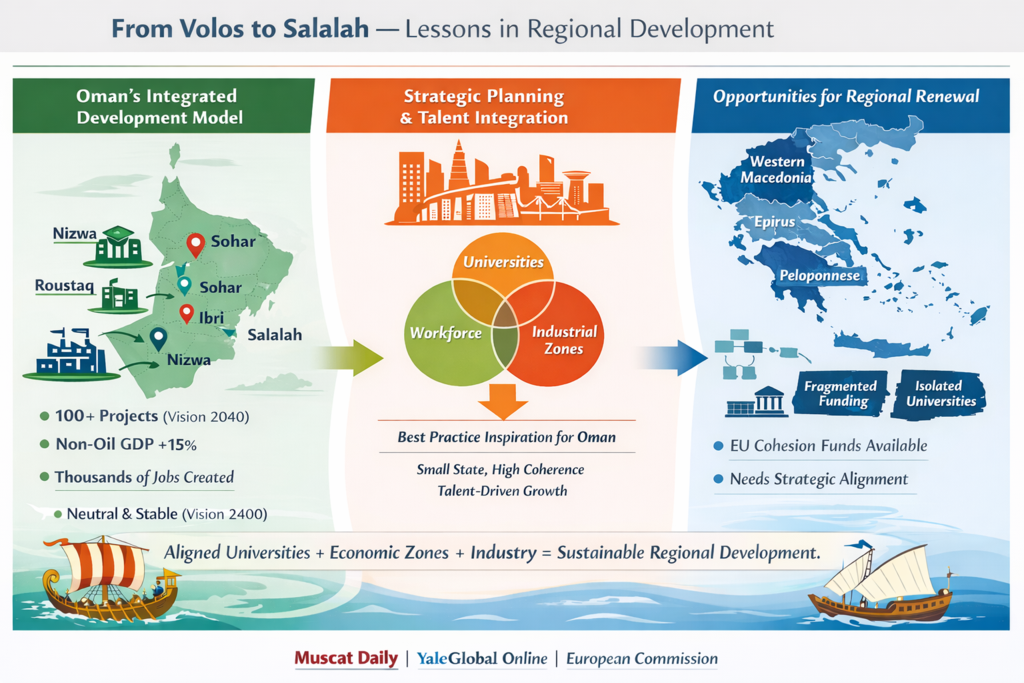
Since 2007, Oman has launched over 100 national projects under Vision 2040, increased non-oil GDP contribution by more than 15%, and expanded special economic and free zones, particularly in Salalah and Sohar, generating thousands of jobs and attracting foreign investment (Muscat Daily). These achievements demonstrate how aligning education, workforce development, and industrial policy can transform regional economies.
Reflecting on Oman sharpened my understanding of Greece’s regional challenges — not a question of resources, but of strategic alignment and institutional coherence.
2. Building Institutional Capacity in Oman
I was directly involved in establishing the Business Faculty across UTAS’s multi-campus structure — Nizwa, Roustaq, Sohar, Sur, Ibri, and Salalah — and recruiting qualified staff from neighboring countries, including India, Egypt, Turkey, and Jordan. This ensured expertise transfer, high-quality teaching, and accelerated program development.
In my Ministry role, I enjoyed the freedom to explore innovative practices, design curricula, and tailor programs to Oman’s regional campuses. I quickly recognized the country’s relational culture, where trust and face-to-face dialogue outweighed email communication. Progress relied as much on personal engagement as on formal directives — a lesson as crucial as any technical reform.
Higher education expansion ran alongside special economic and free zones, integrated with local industries and supported by private-sector partnerships. Universities supplied talent, research, and technical know-how; businesses absorbed graduates; and the state provided coordination. Oman’s model shows how education, industrial policy, and regional incentives form a mutually reinforcing ecosystem.
I also recall my connections with an entrepreneurial Greek Cypriot community, whose energy contrasted sharply with Greece’s institutional fragility at the time.
3. Greece at a Different Crossroads
While Oman was building capacity, Greece entered a deep economic crisis. Following the 2008 global financial downturn, leadership in 2009 revealed a budget deficit exceeding 12–15% of GDP, far larger than reported, triggering a loss of market confidence and borrowing pressures (CFR, Britannica). The subsequent recession, austerity, and demographic strain deepened regional inequalities.
Over a decade later, Western Macedonia, Epirus, and the Peloponnese remain trapped in low-productivity equilibria and depopulation. Universities are disconnected from local economies. Industrial initiatives are fragmented. EU structural funds have supported infrastructure and discrete projects, yet long-term institutional coordination to anchor sustainable ecosystems remains absent.
The problem is not lack of resources. Greece has capital, EU funding, and talent. The issue is the absence of strategic alignment, institutional coherence, and integration — precisely the conditions enabling Oman’s success.
4. Lessons for Greece’s Regions
Oman demonstrates that development accelerates when education, economic zoning, and investment strategies align. Special economic zones thrive when universities provide graduates, research capacity, and innovation support. Private-sector engagement ensures employment absorption, while the state acts as strategic coordinator rather than passive financier.
Oman’s approach is sometimes compared to Singapore, in terms of planning, institutional coherence, and talent-driven growth. While differing in scale, Oman has deliberately integrated universities, workforce development, and free zones, engaging external expertise to accelerate capacity building. Vision 2040 and Singapore partnerships illustrate how smaller states can create ecosystems where human capital, infrastructure, and investment mutually reinforce one another — a lesson highly relevant to Greece.
Greece possesses similar tools via EU cohesion funding (European Commission, Cohesion Fund), yet these often operate as dispersed streams rather than coordinated platforms. Regions like Western Macedonia, or Peloponnese and Epirus, could anchor integrated zones linking universities, technical institutes, and industries such as renewable energy, advanced logistics, maritime services, and agri-tech.
Without institutional coherence, funding produces motion without direction. Oman shows that aligned universities, economic zones, and industry, guided by strategic state coordination, create sustainable growth. Greece has the talent and resources, but success depends on integrated ecosystems rather than fragmented initiatives.
5. A Strategic Imperative
Nation-building today requires coordination. Greece’s challenge is not a lack of talent, capital, or EU support — it is the absence of sustained alignment between education, industry, and regional planning.
To reverse stagnation, Greece must:
- Align universities with regional economic strategies.
- Develop integrated economic zones linking education, vocational training, and targeted industries.
- Coordinate EU funding, municipalities, and private investors under long-term strategic frameworks.
Without these steps, regional decline will accelerate. Demographic contraction, brain drain, and underutilized infrastructure will compound into structural irreversibility. Greece cannot afford another decade of fragmented initiatives.
The lesson from Volos to Salalah is clear: development happens by design, not allocation. Abundant funding without coherence produces motion without direction. When universities, industry, and regional policy move together under strategic leadership, transformation becomes measurable and lasting.
Greece stands at a maritime crossroads. The question is not whether we have ships, resources, or talent. The question is whether we have the strategic discipline to navigate them toward a shared destination.