Yachting is not short of innovation. New fuels, propulsion systems, and digital tools are rapidly reshaping how vessels operate. The direction is clear, and the ambition is visible.
But some of the most important changes are not happening in the technology itself. They are happening to us, because of it.
For a long time, yachting, like much of maritime activity, operated on partial knowledge. We knew there was impact, but we could not see it clearly, measure it consistently, or respond to it in a practical way. So we carried on.
That is what is breaking down now.
Innovation is not just improving how vessels perform. It is making impact visible, measurable, and increasingly actionable and in doing so, it is changing what responsible behavior looks like.
(c) Joe Snowdon Photography
Anchoring in the Mediterranean: From Habit to Decision
Anchoring offers a clear example.
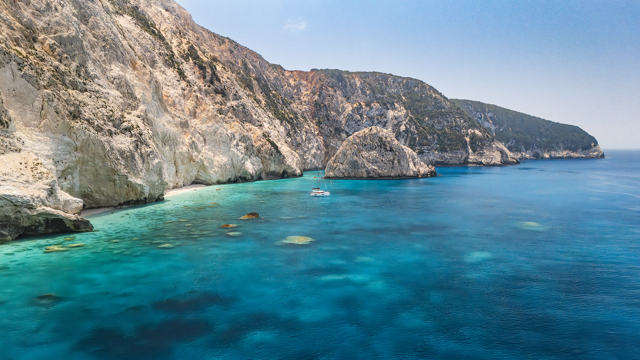
There is a moment that feels instinctive: the engine cuts, the anchor drops, the boat settles into stillness. It signals arrival, and for decades it has been part of the experience itself, rarely questioned.
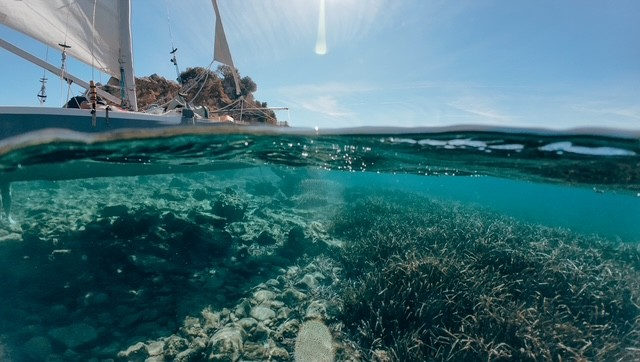
Across the Mediterranean, that moment is repeated thousands of times each day during the summer season. What feels like an individual action becomes, at scale, continuous pressure on the same environments.
Much of this pressure falls on Posidonia seagrass meadows, one of the Mediterranean’s most important and most fragile ecosystems. They can store up to 15 times more carbon per hectare than tropical forests, support biodiversity, stabilize coastlines, and improve water clarity. They also grow extremely slowly, often just a few centimetres per year, meaning that damage from anchoring can take decades to recover, if it recovers at all.
This is not new information.
What is changing is that anchoring is no longer an invisible act. It is a decision and increasingly, one with clear consequences.
Eco-Moorings and Marine Parks
In parts of the Mediterranean, that decision is already being reshaped.
France has spent more than a decade putting in place systems that combine designated no-anchoring zones with eco-mooring infrastructure in environmentally sensitive areas. The result is not simply restriction, but organization: where vessels can stop, how they can stop, and what supports those decisions in practice.
In Greece, the picture is still emerging. With roughly 40 eco-moorings installed in recent years, most locations continue to rely on anchoring as the default. The issue is not awareness, it is availability.
That distinction matters. Behaviour does not change because people are informed. It changes when the better option is accessible, visible, and easy to choose.
This becomes particularly relevant as Greece advances the designation of two new National Marine Parks in the Ionian Sea and the South Aegean. These areas will not be defined by boundaries alone, but by whether everyday practices such as anchoring are managed differently within them.
Eco-moorings are part of that transition but only part. They work when they are embedded in a system that aligns infrastructure, incentives, and user experience.
(c) Joe Snowdon Photography
Ocean Data, AI, and Yachting: Expanding Who Participates
A second shift is happening alongside this, not entirely new, but newly scalable.
Citizen science and distributed observation have existed for years. What is changing now is the combination of low-cost sensors, connected platforms, and artificial intelligence that allows these contributions to be standardized, aggregated, and used in real time.
Through initiatives such as the Ships of Opportunity Program, vessels that are already moving- commercial ships, ferries, and increasingly non-scientific platforms- are being equipped to collect oceanographic data as part of their normal operation.
This changes the role of maritime activity itself.
A vessel is no longer only a means of access. It becomes a point of observation. Efforts such as SOOP and 10,000 Ships for the Ocean are lowering the barrier to participation, standardizing measurement systems, and enabling data to be collected across a wide range of vessels.
For yachting, this opens a new role. Operating in areas where scientific coverage is often limited, leisure vessels can contribute information that is currently missing, from temperature and noise to biodiversity observations and early signals of environmental stress.
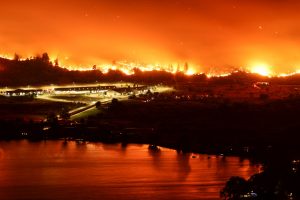
In Greece, this gap became particularly visible through “Smoke on the Water”, an interdisciplinary effort that was recognized at the EMODnet Open Sea Lab 4.0 hackathon, exploring how wildfire residues may affect marine conditions. By combining satellite observations with in situ ocean data, it identified early signals of change including shifts in key indicators such as nutrient concentrations, dissolved oxygen, and chlorophyll levels in the Aegean Sea.
The infrastructure for observation, in other words, is already partly in place.
What Innovation Is Really Changing
Taken together, these developments point to a deeper shift.
For a long time, environmental awareness struggled with a practical limitation: it focused on individual behaviour without meaningfully changing the systems shaping that behaviour. The gap between understanding and real response remained wide.
Innovation is beginning to close that gap.
In that sense, the shift is not unlike what social media did in the late 2000s for public communication: expanding who could participate, and making issues visible in ways that were harder to ignore. But here, the shift goes further. It does not only expand awareness; it expands capability.
We now have the visibility to understand impact, and increasingly, the tools to respond to it whether through better anchoring systems, structured marine management, or distributed data collection.
That combination changes the equation.
Because when awareness is matched with practical options, behaviour is no longer constrained by what is possible, only by what is chosen.
As someone who has spent two decades working in environmental communication, I have seen how difficult it is to ask people to change behaviour when the systems around them remain unchanged. Awareness alone rarely moves action.
What is different now is not that we are asking more of the public or the sector, but that we are enabling different choices. To use a mooring instead of dropping anchor. To contribute data rather than simply consume the sea. To operate within systems that make better decisions possible.
That shift, from asking to enabling, may be the most important role innovation is playing.
Jenny Ioannou is the founder and director of Humanitas, an impact-driven communications agency focused on public awareness, science communication, and ocean protection.