There was a time when every aesthetic modernization was dismissed as a “showpiece project.” Even the lighting of the neoclassical Trilogy on Panepistimiou Street did not escape the nemesis of supposed extravagance. Critics said that Athens’s neighborhoods were left to their foul fate while spotlights illuminated the Academy, the Propylaea, and the National Library.
No such accusation has been made against the renovated façade of the Ministry of National Defense. Perhaps that era has passed. Or perhaps the ministry’s new look escaped the label of a “showpiece project” because it was described as “bioclimatic”—a term that seems to pardon even the new heights of apartment buildings. But mainly because this aesthetic intervention came hand in hand with the promise of a broader modernization of the armed forces and their firepower. We are not just talking about a modernized Pentagon, but a modernized army and modernized weaponry—something beyond what an artist’s pencil might design for the architectural harmony of a building.
Modernization is, of course, necessary. No one wants an army whose soldiers fight heroically and sleeplessly behind rocks and trees with old muskets. But one might ask: what are the limits—not of a military industry that produces, but of a defense market that consumes? In other words, what is the cost of the arms race, and how far can we go?
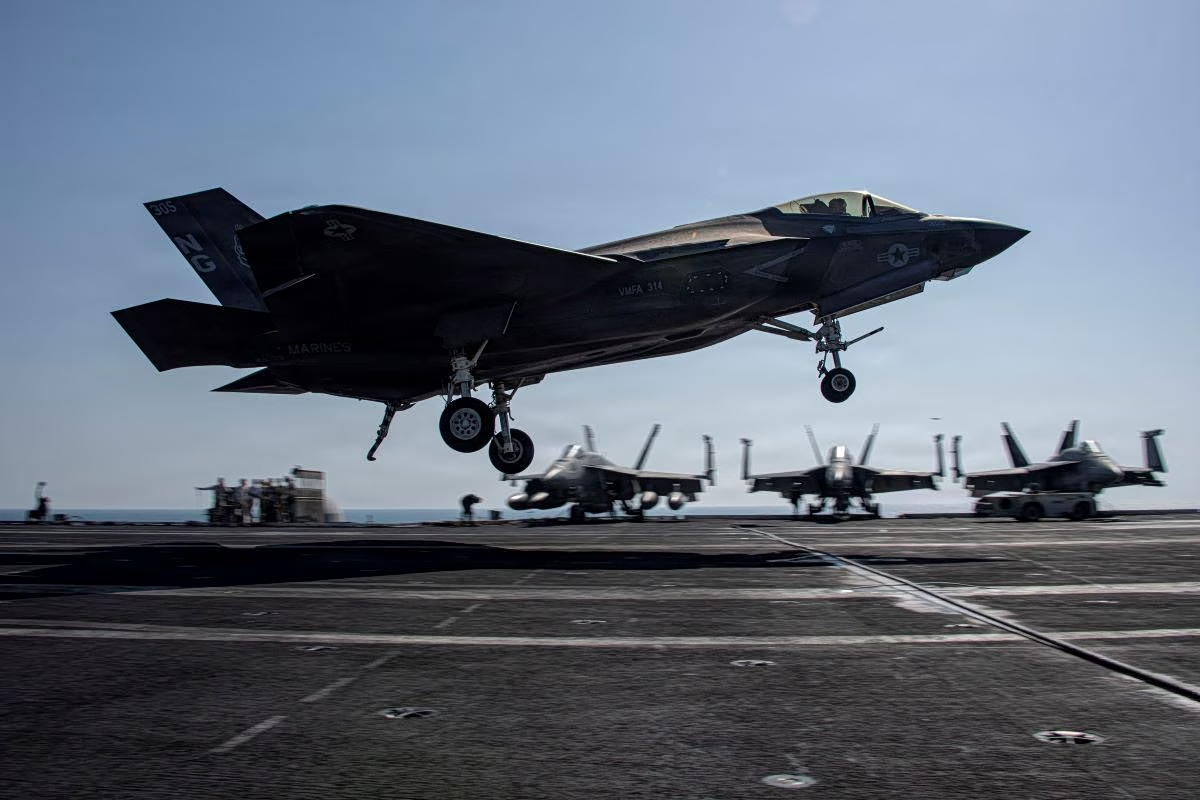
The question carries even greater weight now that the country measures its defense capabilities and finds itself superior—at least—in the skies over the Aegean. How else can one put it? For now, we’re winning. But as time moves on and no race remains static, we must also ask when this “superiority” might give way to a “balance” of “calm waters” or “mutual deterrence,” and even more, when the balance might shift against us—leaving us to face the enemy sleepless, exhausted, and exposed.
It is better to ask such questions while the feeling of superiority and mild triumph prevails, rather than in the future when patriotic anthems dominate—anthems which, as history shows, have often led to national disasters and collective humiliations. Not to replace today’s confidence with tomorrow’s fear, but finally to negotiate with all our neighbors in the Eastern Mediterranean without the humiliating sense that we are being dragged into talks—and yes, into compromise.
For fifty years, the country lived behind the illusion of safety offered by a passive foreign policy and the so-called “doctrine of immobility.” In the early years of the Metapolitefsi, Greece lamented the change in the U.S. arms ratio from 7/10 in its favor to Turkey’s advantage. Since then, every government has borne the cost of armaments, but none has borne the cost of negotiation. The last attempt at a bilateral settlement of territorial waters and maritime zones ended back in 2003 under the Simitis government. The price of a graduated sovereignty for the islands—from six to twelve nautical miles—proved too heavy, and the effort was later buried by the Karamanlis government along with the exploratory maps that never saw the light of day.
Is the “5×5 framework” a new opportunity, nearly twenty-five years later? It could be—if, above all, the internal condition of a nation were met: one not artificially divided between “traitors” and “patriots.” To remain vigilant in the Aegean, yes—but without the corrosive feeling of economic and demographic exhaustion.