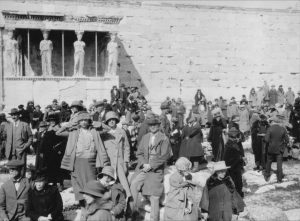
Athens is one of the few cities in the world that has survived the trials and tribulations of history and remained continuously inhabited for over two and a half millennia. But its historic center is now in danger—not from invaders or earthquakes, but from our own inertia, the complete absence of planning, and the daily deterioration brought about by unregulated tourism activity.
The heart of the city now functions as a kind of hybrid space, a mix of tourist spectacle and urban abandonment. The ruins coexist with small islands of residents, thousands of short-term rentals, hotels and bars. Between 2015 and 2023, short-term leases increased tenfold in the historic center (Syntagma-Monastiraki-Plaka-Psyrri-Koukaki). Over the same period, around 50,000 new hotel and Airbnb beds were incorporated into the center’s urban fabric. And the number of restaurants, bars and related outlets has quadrupled in a decade. The city hasn’t experienced a population increase, but how it functions as a space has altered beyond recognition. It now receives over 150,000 visitors a day.
Athens’ image and urban landscape have changed dramatically, but this hasn’t been matched by substantially improved or new infrastructure. The result? A real risk of the projected ongoing tourism boom curdling from a success into a nightmare.
The historic center of the world’s most historic city has been left unprotected. Its narrow sidewalks worn down and invaded by tables and chairs. A largely pre-war sewerage system designed for the population and requirements of the 1930s cannot hope to meet today’s needs. A mismatch which foul smells won’t let those of us who work and live in the city center forget. Inadequate waste management. And how could it be otherwise, when the garbage trucks service Athens’ downtown streets just two or three times a day? They’d have to empty the bins 13 times every 24 hours to keep up! And what about the roads they have to negotiate? In essence, Plaka has just a single one-way road for vehicles to enter and exit (Lysikratous-Tripodon-Lysiou-Navarchou Nikodimou). Meaning that Tripodon—the oldest road in Europe, and a street that has kept its name for 2,500 years—is used to deliver supplies to at least 500 taverns, bars, cafes, ice cream parlors along with who knows how many tourist shops.
The authorities really ought to pay it a visit, to see the shambles it has become for themselves. As you walk down Tripodon, you are struck by the mismatch between the sight of the Acropolis and the Erechtheion on one side of the street and the dirty, overloaded garbage bins and general chaos on the other. You feel admiration for the past and disgust for the present wash over you simultaneously. And the coaches and tourist vans which park on the already over-full streets within and on the outskirts of the historic triangle are the icing on the cake: they turn the center into a living hell. To add insult to injury, events intended to ‘promote’ Athens close the center off for one or two weekends a month, literally imprisoning the dwindling number of people who still call it home. What can we say about the shop signs that evoke a powerful third-world aesthetic? In short, all that’s left for the residents of the center is the bitter taste of abandonment. Which is why—sadly—those who can are moving away, abandoning the historic city center to its “users” and visitors and undefended by those who should be protecting it.
The Athens phenomenon is more than a mere failure of municipal management. It is an Urban Defeat, the end-result of a lack of planning and responsibility. And the blame for the unique historic center of the most historic European capital of them all being left without an infrastructure plan or mechanism for balancing tourism, housing, commerce and cultural identity must fall squarely on the state and municipal authorities.
The city is kept on its feet and supported by the weight of history. It’s held up by the Acropolis, Pericles’ gift to the city, which continues to generate glamour and arouse interest around the world. But even the Acropolis with the Parthenon atop it won’t be able to shore up a city that’s collapsing functionally indefinitely.
The hybrid state of the historic center is unsustainable. The huge weight of tourism cannot be absorbed by infrastructure so inadequate and so old. The impact won’t only be aesthetic. The consequences will endanger not only Athens, but the entire Greek tourism industry with it.
So are we just going to let the problem keep on worsening? Is there a solution? Yes. Planning and immediate action! State-Region-Municipality cooperation to rebuild the pavements, enlarge or restore the drainage and rainwater networks, and bolster the sewerage infrastructure in Mitropoleos, Monastiraki, Plaka, and beyond. New parking spaces for coaches in Plato’s Academy, Rouf, Kallirrois, Thiseio and Filellinon with electric shuttle and deliveries to shops restricted to the early hours (12.00-07.00). Proper lighting using LEDs, underground bins, fullness sensors, and the extensive use of small modern garbage trucks. Squares, arcades and points of interest, signs and shop awnings restored and re-equipped.
I am not optimistic about the State-Region-Municipality cooperation, unless it is somehow contracted out to private parties. The total cost of implementing a two-year plan of this sort would not exceed €200-250 million. Revenues from visitors to the historic center are in excess of €3.5 billion per year. You don’t have to be a genius to see what needs to be done. The project will pay for itself in six months through VAT receipts alone.
Mr. Michalis Sallas is Chairman of the Lyktos Group, Honorary Chairman of Piraeus Bank, and a former university professor.