“The Shadow of the Derricks” was the title of an issue of Lucky Luke in which the theme was the fever of black gold, the rapid rise of the passion for oil drilling in America of the 1860s. Dictionaries say that a derrick is a loading device, the crane mechanism that on tanker trucks is known as a boom.
In the wonderful comics by Morris and Goscinny, a good pioneer of oil extraction, Colonel Edwin Drake, is forced to call upon the solitary cowboy Lucky Luke to bring some order to the chaos that has developed in Titusville, Pennsylvania. After the discovery of an initial oil deposit, the town has turned into a wild place, where competition for the richest vein in the plots of land corrupts morals and relations between residents and newcomers. The enemy of Colonel Drake is the adventurer Barry Blunt and his gang. Blunt, through blackmail and intimidation, acquires oil wells across the entire region. His goal is to buy all of “America’s oil.” Lucky Luke, acting as an emergency agent of order, will confront Blunt and the dizziness of his illegal greed, ultimately restoring stability and calm to the troubled town.
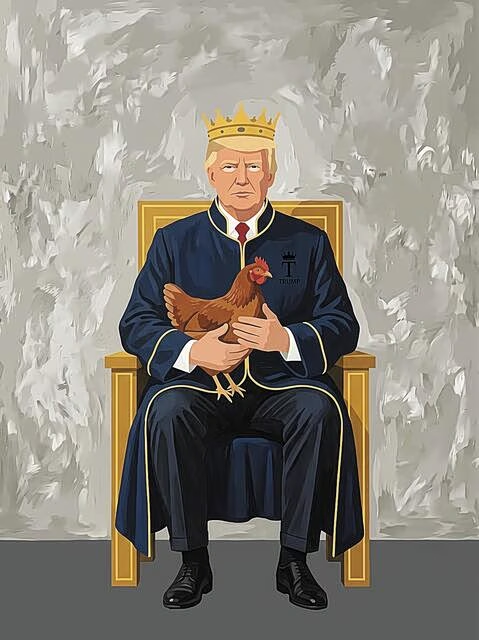
Reading now Donald Trump’s statement that he wants all of Iran’s oil and his remark that “we negotiate with them and we blow them up,” my imagination immediately flew back to Barry Blunt. This character, whom the Belgian Morris designed as a caricature of a close friend of his, seems to behave, think, and even speak like the American president in 2026. With the same words and the same alternation of methods: coercive deals and explosions, or threats of explosions and destruction.
The difference, of course, between the fiction of those two brilliant creators and our own reality lies in the role that the so-called “good guy” of the story can play. Beyond the fact that a Barry Blunt–Trump is the leader of the most powerful country in the West, we live in an era with incomparably greater capacities for destruction than those available in the agricultural and early capitalist America of the 1860s.
Moreover, even the Seneca Oil Company in the time of the real Colonel Drake was obviously not the “good side” against the viciousness of a voracious opportunist. The idealization of the era of the old robber barons is an extremely weak argument. Finally, the forces of today’s conventional ruling class appear to be becoming like the disturbing caricature of Morris and Goscinny: figures and models of power that truly want everything.
The voices of the deranged Barry Blunt in the final panel of Morris’s drawings now echo in the strategic expansion plans of a Palantir, whose CEO, Alex Karp, is now urging major AI investors to abandon commercial uses and gadgets for idle consumers, and to turn instead toward the infrastructure of war and geopolitical duels of giants. After leisure, militarization and machines of efficient extermination.
The war in Iran already carries much of this mentality and ideology of conquering will. And the outbursts of the President of the United States, even if they turn out to be the result of neurological damage or some other disorder, are classic symptoms that trace back to the basic anthropological structure of possessive individualism. We are speaking of the pairing of commerce and war, of the duo of good cop and bad cop, of the friendly and the harsh torturer. Something that, of course, comes from the past and is at the same time new, since both the technology of destruction and the moral corrosion at the root of liberal democracy are approaching a point of no return.
Is there, somewhere, a sensible Colonel Drake and a Lucky Luke to calm the storms of the age? To save the West from neo-imperialism, nihilism, anxiety over Chinese expansion, and above all the lack of alternative visions?
I, for one, have stopped seeing them around, with the exception of a Sánchez and a few other combative politicians squeezed within models of inertia and political systems of paralysing balances and dependencies. This is also the main reason I believe that most Lucky Luke stories express a bygone world. As if they were narrating stories of an honest and lawful Wild West that was a great myth, and which we are now told we should nostalgically long for in the face of the “orange clown.” And I also have the impression that nostalgia for the serious Drakes of the West no longer offers us anything against the many Barry Blunts of our era, against this machine of hatred that wages wars while laughing, as if telling yet another stale sexist joke among men.
Mr. Nikolas Sevastakis is Professor of Political Philosophy at the Aristotle University of Thessaloniki, and a writer.