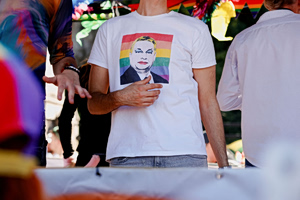
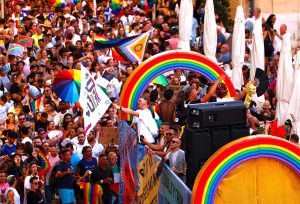
It is because you remember Prides as celebrations. It is because you kept all those photographs, as if they were from family gatherings. It is because once you saw Chraja—with her hair like small fires, her body an arrow radiating in all directions—open the way by dancing in front of the riot police.
So you search for a way to write this so that you do not appear old and disappointed, but even so: It is because you truly believed, at some point, that somehow, we had achieved something.
And it is because of all this that now it seems so exhausting to see, once again, the battle being fought over the basics.
Homophobia and transphobia—the close sibling of racial racism, sexism, and macho nationalism—rising up again, as if not a single day had passed, as if a greyness were once again pouring out from everywhere.
Exactly as that wonderful song by the Cypriot group Anemourio says, in another context: “This old colour is coming back. Like a ghost, and spreads everywhere.”
As a response: a colourful Pride in Athens next Saturday; the related events have already begun.
And if they tell you: what do we need Pride for anymore? The gay, lesbian, queer, and trans community already has the rights it needs—what more do they want?—you can show them the comments under the post of a well-known airline company that dared to put the colours of the rainbow on its logo this week.
I will not reproduce them here, but it is striking how many of our fellow citizens feel the need to prove something by making homophobic jokes. And how many others unfortunately consider it a banal stupidity—without stopping to think about the corrosive, toxic function of everyday racism and homophobia, which by now, through social media (but also through the international far-right shift), have become normalized in public discourse.
Remind them also of the ongoing attacks against LGBTQI people, and that only last week four young people chased, insulted, and beat a trans woman in Nea Smyrni, sending her to hospital.
They say they hit her “as a joke,” like those banal comments about “faggot-like airplanes” that people also write “as a joke.” Or like the hot coffees that passing cars now often throw—always “as a joke”—when they see a gay couple kissing on the street.
Or like the degrading little jokes you find almost every day, even among columnists of major newspapers.
And if you think these are isolated incidents and are not connected, it is worth thinking again.
Just as it is worth reconsidering the line that connects the renewed rise of homophobia and transphobia with cases of extreme gender-based violence and femicides—look at the banal (and at the same time unimaginable) sexist comments against the victim of the recent femicide in Kalamata, which flooded social media.
They are not unrelated to the crime; they are the climate in which it was incubated, an environment where homophobia, sexism, nationalism, and racism circulate and intertwine.
The indifference toward all this, which is also increasing, this “come on, it was just a joke,” fits perfectly with the everyday apathy toward violence against refugees and migrants and the crimes committed at the borders, which seem as though they do not concern us—it is no longer only that they are “far away”; it is also the reasoning that justifies them or takes pleasure in them.
And this reasoning is also banal, normalized; some people simply choose not to hear it.
Prides began around the world as a remembrance of a revolt by people who could no longer endure the violence inflicted upon them.
At the end of June 1969, at the gay bar Stonewall in Greenwich Village, New York, sparked by one of the many violent police attacks in the area.
Therefore, from the beginning—from that 1969—there have been celebrations of confidence and pride, created to break the abscess that hides and nourishes the racism of society and those in power.
Places for practicing new forms of claiming citizenship, they were for decades also a way to rethink what it means to say: I do not hide and I take to the streets.
What it also means to intersect, to meet, to encounter—what contemporary theory calls intersectionality: how exclusions are connected and multiplied, and how solidarity against them is created.
Thus, Prides, like the anti-fascist and feminist movements, became spaces for shaping an open, exploratory community, both internationally and locally.
They bring at the same time a general demand for rights and respect for difference, together with very specific local political demands and conflicts.
The leading fascist of your neighbourhood, who is preparing to form a party once he leaves prison—you answer him on the street: “we are waiting for you,” and you answer him through a “celebration of pride” of this kind.
Transnational and local movements, Prides are also an exercise in counter-history, a continuous struggle not to allow a long history of oppression—and the struggles against it that were often silenced—to be forgotten, but instead to become a source of inspiration.
This is also their enormous strength: by placing at the center the demand for self-respect and rights, but above all by always leaving open the subject of these rights—what “we” means—for years these pride events have been occasions to reshape collective and public memory, self-organization, biocitizenship, open discussion about discrimination, and dynamic anti-fascism.
Forget for a moment the glossy support for LGBTQI rights, the kind that seems as if it comes from a colorful magazine and a neo-capitalist symposium.
Or pinkwashing—this “but we have Pride too” that many governments around the world use to legitimize their criminal activities.
And let us not so easily assume that what happens in the world—the persecution of LGBTQI people that takes place in countries in Africa or in Russia, in the United States—cannot happen here.
Look around a little and you see that we are always one step away from a similar shift—the example of Hungary in recent years or Trump’s America shows this.
But more generally: if there is something that new queer voices at Prides and alternative Prides every June often remind us of, it is that when you tolerate (or even indirectly assist) genocides anywhere in the world, you are always just a tiny step away, if things change slightly, from organizing them in your own home.
Happy Pride 2026!
Mr Dimitris Papanikolaou is a Professor of Modern Greek and Comparative Cultural Studies, Fellow of St. Cross College in Oxford University