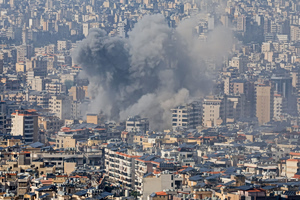
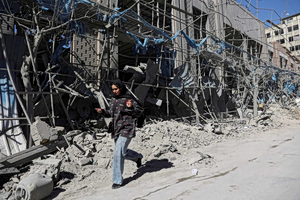
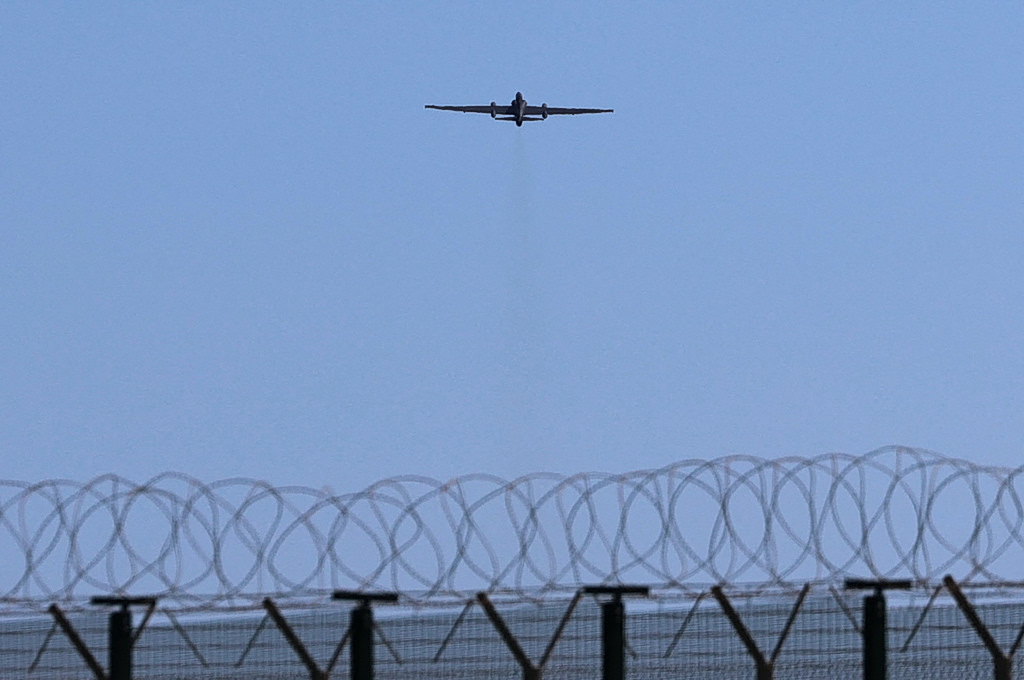
A few months ago, I wrote about belonging to a generation that experiences war through phone notifications, in real time and often without the space required for empathy. I reflected on the emotional whiplash of scrolling past memes only to encounter missile alerts, and on the uneasy realization that even from a continent away we can feel implicated. Since that article, the confrontation between Iran, Israel, and the United States has not faded into the background of international politics, but it seems that it has become more structured, more direct, and more dangerous. What once resembled another episode in a long-running shadow conflict now reflects open deterrence politics and strategic endurance, unfolding before a generation shaped by economic instability, geopolitical rivalry, and the normalization of human rights crises.
This escalation is not merely a confrontation between Tehran and Jerusalem. It is part of a broader architecture of power competition in which regional ambition intersects with the credibility of great powers. For years, tensions were managed through cyber operations and carefully calibrated strikes designed to avoid full-scale war. What we are witnessing now, visible military exchanges, explicit references to nuclear facilities, and inflexible rhetoric that leaves little space for negotiation, signal a shift from contained deterrence to open escalation. Each actor appears determined to demonstrate resolve and reinforce its messaging, while simultaneously attempting to avoid an uncontrollable dispute.
At the core of this confrontation lies a layered set of security dilemmas and strategic imperatives. Israel frames its actions as necessary to prevent existential threats. Iran situates its posture within narratives of resistance and regional assertion. The United States reinforces alliance credibility while seeking to prevent strategic corrosion. In isolation, each position exhibits internal logic and coherence. Collectively, however, they generate systemic instability. The language of deterrence, a term well known within the strategic theory, has returned to daily headlines. Deterrence depends on perception, signaling, and commitment. Its success rests less on capability than on how intentions are interpreted by adversaries and allies. In the United States, political leaders often operate in an environment that rewards performative strength and penalizes compromise, rendering restraint politically costly even when it is strategically sensible.
The implications extend far beyond the immediate region and into the global political and economic landscape. Energy markets react instantly to instability in the Gulf, highlighting how tightly geopolitics and economic security remain intertwined. Inflationary pressures, already straining societies worldwide, deepen as geopolitical risk premiums rise. Global supply chains, still fragile from pandemic disruption and ongoing conflicts, absorb additional uncertainty and unpredictability. In a deeply interconnected system, regional escalation echoes globally, reshaping fiscal planning, market stability, and public confidence thousands of kilometers away. War is no longer geographically distant. It has become inseparable from economic reality, exposing how conflict truly operates in the 21st century.
While these events unfold, other actors observe with calculated restraint. On the one hand, Russia benefits by portraying Western involvement as destabilizing, reinforcing narratives it has consistently advanced within the broader context of its confrontation with the West, particularly in its recent conflict with Ukraine. Elevated energy prices may also provide Moscow with short-term fiscal relief, elevating state revenues amid ongoing geopolitical tensions. Yet uncontrolled escalation in the Middle East carries significant strategic risks. A wider conflict could further consolidate Western cohesion and generate instability that exceeds Russia’s capacity to manage. For this reason, Moscow’s stance remains measured: assertive rhetoric, careful operational restraint and a deliberate detachment from the immediate conflict.
On the other hand, Türkiye positions itself less as a direct adversary and more as a mediator. As a NATO member with pronounced regional ambitions and significant economic interdependencies, Ankara pursues a deliberate strategy of balance and strategic flexibility. It seeks to maintain diplomatic channels with all parties, while carefully avoiding direct engagement in the conflict. This approach reflects the broader logic of middle-power politics, in which states seek to maximize strategic autonomy. Yet the sustainability of this posture depends on the trajectory of events. A dramatic escalation would limit Türkiye’s diplomatic maneuvering, demand clear commitments and reduce its capacity to influence outcomes among competing powers.
Under this prism, the question that inevitably arises is: “who is to blame, and who ultimately prevails?” In an era in which alliances shift rapidly, new conflicts emerge and nuclear threats or gray-zone tactics become embedded in strategic practice, public opinion grows deeply polarized regarding both truth and morality. However, in contemporary interstate conflicts there is rarely an uncontested winner. What tends to emerge instead are short-term gains, such as temporarily reassured populations or weakened adversaries. Such outcomes, however, are incompatible with durable stability and long-term prosperity.
For Generation Z, these dynamics are not abstract theoretical debates or hypothetical scenarios, rather, they form the everyday landscape in which their lives unfold. We have witnessed a profound financial crisis, a global pandemic, escalating climate emergencies, a sustained erosion of democratic norms and human rights, and now an open escalation in the Middle East. These developments have left clear scars on the psychological and emotional well-being of young people, heightening their exposure to uncertainty and instability. Yet constant visibility has not produced apathy. On the contrary, it has cultivated a pronounced sense of skepticism and a persistent search for truth. Young observers are no longer satisfied with simplistic narratives that cast states as inherently righteous or corrupt. Instead, they interrogate structural motives, engage with historical context and investigate leadership failures that have caused cycles of retaliation.
This critical stance does not equate to moral indifference. Rather, it reflects a deeper commitment to accountability and integrity. Recognizing the authoritarian governance of Iran does not require endorsing every action undertaken by Israel, nor does it justify them. Likewise, critiquing Western strategic choices does not amount to legitimizing regional extremism. After all, moral clarity is not achieved by taking sides, but it lies in refusing to excuse injustice, regardless of the flag under which it is committed.