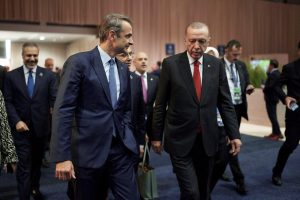
The apparent cancellation of the planned meeting between Greek Prime Minister Kyriakos Mitsotakis and Turkish President Recep Tayyip Erdogan has triggered intense debate in both Athens and Ankara, fueling speculation about motives and implications for the future.
When news of the looming deadlock first surfaced, officials in Athens suggested that Erdogan’s participation in a summit of Arab leaders organized by former U.S. President Donald Trump on the Palestinian issue had left little room in his already packed schedule. Yet observers note that his program in New York still contained open slots, raising questions about whether the delay—or outright cancellation—was intentional.
Diplomatic sources with knowledge of the developments in New York confirmed that as of Tuesday, efforts were still being made to find an appropriate time. However, with Erdogan extending his stay in the U.S. for his own meeting with Trump, many believe opportunities to meet the Greek leader still existed.
A Diplomatic Setback
As attention turns to the likely cancellation rather than a simple postponement, speculation has grown that Ankara’s move was designed to project strength over Athens. Regardless of the underlying cause, analysts describe it as a diplomatic discourtesy on Turkey’s part, one that could further strain already fragile relations.
Leaks in the Turkish press claimed Ankara was displeased with Athens for prematurely announcing the date of the meeting. However, Greek officials insisted the encounter had been fully agreed upon and was officially confirmed within the context of the UN General Assembly.
Broader Tensions
The missed opportunity comes at a time when both countries remain at odds over long-standing disputes. Mitsotakis had pledged to raise the issue of Turkey’s “casus belli” threat—its declaration that extending Greek territorial waters in the Aegean would be a cause for war—linking it to Turkey’s participation in European defense initiatives. Erdogan, meanwhile, has expressed frustration with Greece and Cyprus over regional energy projects, particularly following U.S. company Chevron’s interest in exploration south of Crete.
The Turkish president also used his UN address to reiterate Ankara’s position on Cyprus, calling for international recognition of the self-declared Turkish Republic of Northern Cyprus—an issue that remains one of the deepest divides between the two countries.
A Missed Chance for Dialogue
Greek officials had viewed the scheduled meeting as an opportunity to confirm that communication channels remain open, even if substantive progress was unlikely given the limited time available and the tense climate. The hope, they said, was to “prevent crises by ensuring dialogue remains functional, while acknowledging differences.”
The collapse of these plans now raises a pressing question: was the meeting ever likely to deliver more than a symbolic confirmation of dialogue? With both sides entrenched, striking a balance between easing tensions and asserting sovereignty is proving increasingly difficult.
Athens maintains that future opportunities for a meeting will arise, but the true test will be whether the channels of communication are indeed resilient enough to prevent crises from escalating.